
Major Wars: Strategy, Technology, and Mechanics of Conflict study guide · Lesson 10 of 13
World War II: Blitzkrieg, Deep Battle, & the Eastern Front
Blitzkrieg Mechanics & the Crucible of Stalingrad · Deep Battle Doctrine & Soviet Industrial Counter-Offensives
This is the lesson's study guide from the FlashFeed app, plus its key facts and a self-test.
What you'll be able to do
- Explain Blitzkrieg's radios, Stukas, and Sichelschnitt, Chuikov's close-in fighting at Stalingrad, Operation Uranus, and Manstein's backhand blow.
- Explain Soviet Deep Battle (Tukhachevsky and Triandafillov, tank armies), Kursk's deep defensive belts, T-34 mass production, and ISU-152s in Berlin.
Lesson 10: World War II: Blitzkrieg, Deep Battle, & the Eastern Front
The Mechanics of Bewegungskrieg and Panzer Divisions
What popular media termed Blitzkrieg ("lightning war") was the evolution of traditional German Bewegungskrieg (maneuver warfare), revolutionized by armored theorist Heinz Guderian. Unlike French and British armies that dispersed tanks in penny packets to support marching infantry, Germany concentrated tanks into autonomous Panzer Divisions. Each division integrated medium tanks, motorized infantry (Panzergrenadiers), mobile artillery, and combat engineers. Crucially, German tanks carried radio receivers as standard equipment -- with transmitters fitted in command tanks -- letting orders reach the whole unit far faster than Allied signaling by flag, and tactical air liaison officers directed Junkers Ju 87 Stuka dive bombers as precision flying artillery.
The Ardennes Breakthrough and Sedan Crossing 1940
In May 1940, Germany executed the Manstein Plan (Fall Gelb). While Army Group B launched a visible diversionary invasion into the Low Countries, General Ewald von Kleist's Panzer Group secretly navigated the "impassable" forested gorges of the Ardennes. Emerging at Sedan on the Meuse River on May 13, Guderian's panzers crossed under concentrated Stuka dive-bombing, bypassed the static concrete fortifications of the Maginot Line, and raced 200 miles west to the English Channel (Sichelschnitt, "sickle cut"), cutting off the British Expeditionary Force at Dunkirk and forcing the collapse of France in six weeks.
Barbarossa and Russian Rail-Gauge Logistics
Launched on June 22, 1941, Operation Barbarossa was the largest land invasion in history, deploying 3.8 million Axis soldiers into the Soviet Union. Despite encircling millions of Red Army soldiers at Minsk and Kiev, the invasion stalled due to immense logistical friction. Soviet railways used a broad 5-foot gauge, requiring German railway troops to manually relay thousands of miles of track to standard European gauge. Autumn rains turned unpaved dirt roads into impassable seas of mud (rasputitsa), halting motor transport weeks before sub-zero winter temperatures froze engine lubricating oil.
The Battle of Moscow and Siberian Winter Warfare
By December 1941, German advance patrols reached the outer suburbs of Moscow within sight of the Kremlin spires. Exhausted, frostbitten, and lacking winter clothing, the German army was halted. Having received intelligence from spy Richard Sorge in Tokyo that Japan would not attack Siberia, General Georgy Zhukov secretly redeployed over 18 fresh, winter-trained Siberian rifle and ski divisions. Equipped with warm quilted uniforms, submachine guns, and cold-resistant T-34 medium tanks, Zhukov launched a devastating counter-offensive on December 5, driving the Wehrmacht back 150 miles and ending the myth of German invincibility.
Rattenkrieg and Operation Uranus at Stalingrad
The Battle of Stalingrad (August 1942 – February 1943) became the turning point of World War II. General Vasily Chuikov's 62nd Army defended the ruined city through Rattenkrieg ("rat war"): hugging German lines within grenade distance to negate Luftwaffe bombing, and turning reinforced concrete rubble into fortified strongpoints (such as Pavlov's House). On November 19, 1942, the Red Army launched Operation Uranus — planned by Zhukov and Alexander Vasilevsky, with Vasilevsky coordinating execution at the front — a massive double envelopment striking weak Romanian and Hungarian armies guarding German flanks. The Red Army encircled Friedrich Paulus's German 6th Army (300,000 men), leading to its total destruction.
Manstein's Backhand Blow at Third Kharkov
In February 1943, following the Stalingrad disaster, the Red Army surged westward, overextending its supply lines. German Field Marshal Erich von Manstein executed a brilliant operational counter-stroke known as the "backhand blow" at the Third Battle of Kharkov. Rather than defending territory statically, Manstein allowed Soviet armored columns to advance deep, then struck their exposed flanks with concentrated SS-Panzer divisions. German wartime reports credited Manstein with encircling and destroying over 50 Soviet divisions — a figure later disputed by archival research — while stabilizing the southern Eastern Front and carving out the Kursk salient.
Defense in Depth and the Pakfront at Kursk
At the Battle of Kursk (Operation Citadel, July 1943), Germany launched a massive pincer assault using heavy Tiger and Panther tanks. Forewarned in part by British Ultra intercepts and intelligence attributed to the disputed "Lucy" spy ring, Soviet Marshals Konstantin Rokossovsky and Nikolai Vatutin prepared an unprecedented defense-in-depth: multiple defensive belts (accounts vary between six and eight zones) up to 100 miles deep containing 1 million anti-tank mines (reputable figures cite roughly 2,200 anti-tank mines per kilometre of front, not per square mile) and Pakfront anti-tank artillery ambushes (groups of ten 76mm anti-tank guns firing simultaneously on a single lead tank under one commander). At Prokhorovka, a massive armor collision halted the German advance, permanently shifting the strategic initiative to the Soviet Union.
Soviet Deep Battle Doctrine (Glubokaya Operatsiya)
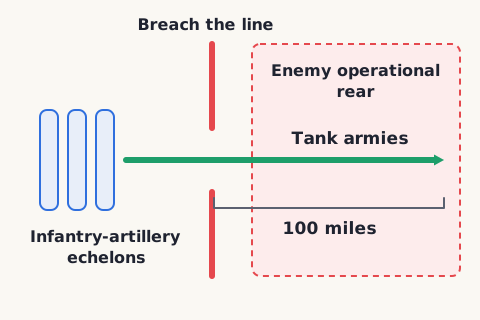
Soviet operational art was governed by Deep Battle Doctrine (Glubokaya Operatsiya), formulated in the 1930s by theorists Mikhail Tukhachevsky and Vladimir Triandafillov. Deep Battle rejected linear attrition in favor of multi-echelon simultaneous shock:
- First Echelon: Heavy shock infantry and artillery breach a narrow sector of the enemy frontline.
- Second Echelon (Mobile Groups): Independent Tank Armies and mechanized corps pour through the gap, advancing 50 to 100 miles deep to paralyze enemy operational reserves, headquarters, supply depots, and rail hubs.
Maskirovka Deception in Operation Bagration 1944
On June 22, 1944 (the third anniversary of Barbarossa), the Red Army launched Operation Bagration in Belorussia. Employing masterclass maskirovka (strategic military deception), the Soviets convinced German High Command that their summer offensive would strike in Ukraine. Instead, four Soviet front army groups struck German Army Group Centre in Belorussia. Combining Deep Battle penetration with massive partisan rail demolitions, the Soviets destroyed 28 out of 34 German divisions, advancing 300 miles to the gates of Warsaw in history's most catastrophic defeat of German arms.
Mass Production Economics of the T-34 Tank
Soviet victory was underpinned by industrial mobilization behind the Ural Mountains. Factory No. 183 in Nizhny Tagil and the Chelyabinsk Tractor Plant ("Tankograd") mass-produced the T-34 medium tank using moving assembly lines and female labor. Featuring sloped armor, a 76mm/85mm gun, a robust diesel engine, and wide tracks for mud, the T-34 was simplified for rapid mass production (over 84,000 produced). In contrast, over-engineered German tanks like the Panther and Tiger were produced in small numbers (under 6,000 Panthers) and broke down under mechanical transmission strain.
Urban Assault Tactics in the Battle of Berlin
In April–May 1945, the Red Army fought the Battle of Berlin. Red Army assault groups (shturmovye gruppy) mastered urban storming: teams of 6 to 8 soldiers combining submachine gunners, combat engineers with satchel charges and flamethrowers, and direct-fire 152mm heavy assault guns (ISU-152) firing point-blank into building facades. Red Army sappers blew through interior party walls ("mouse-holing") to bypass street-level fire from German Volkssturm armed with Panzerfaust anti-tank rockets, culminating in the hoisting of the Soviet Victory Banner over the Reichstag.
Key terms
- Bewegungskrieg
- The German operational doctrine of fluid maneuver warfare aimed at rapidly encircling and destroying enemy armies through decentralized initiative.
- Rattenkrieg
- Brutal close-quarters urban combat fought in subterranean basements, sewers, and rubble heaps at close grenade range.
- Deep Battle
- A Soviet military doctrine designed to shatter an enemy's entire defensive system simultaneously using multi-echelon combined arms and long-range armored thrusts.
- Maskirovka
- The Soviet practice of military deception, including camouflage, disinformation, and fake troop movements to mislead enemy intelligence.
Key concepts
Junkers Ju 87 Stuka
- German gull-winged dive bomber equipped with wind-driven sirens ('Jericho Trumpets')
- Functioned as airborne precision flying artillery supporting Panzer spearheads
- Directed in real-time by frontline air liaison officers embedded in armored command vehicles
Heinz Guderian
- German armored warfare theorist and commander of XIX Army Corps in 1940
- Author of *Achtung - Panzer!*, advocating the concentration of tanks in autonomous divisions
- Spearheaded the breakthrough across the Meuse at Sedan and race to the English Channel
Vasily Chuikov
- Commander of the Soviet 62nd Army during the defense of the city of Stalingrad
- Pioneered the close-quarters 'hugging' doctrine to negate German Luftwaffe air superiority
- Transformed ruined industrial factories into fortified redoubts that held the Volga bank
Erich von Manstein
- German general (later Field Marshal) who drafted the Ardennes invasion plan (*Sichelschnitt*) in 1940
- Master of fluid operational defense who executed the 'backhand blow' at Third Kharkov in 1943
- Considered one of the Wehrmacht's most brilliant operational strategists
Pakfront Tactical Group
- Soviet anti-tank artillery defense system grouping up to ten guns under a single commander
- Concealed in camouflaged positions to open simultaneous concentrated fire on a single target
- Decimated German armored formations inside the dense defensive belts at Kursk in 1943
Glubokaya Operatsiya
- Soviet military operational doctrine formulating multi-echelon deep armored penetration
- Employs initial shock echelons to pierce frontlines, releasing tank armies into the operational rear
- Created by theorists Mikhail Tukhachevsky and Vladimir Triandafillov in the 1930s
Maskirovka
- Comprehensive Soviet doctrine of military deception, camouflage, and operational disinformation
- Employed dummy radio traffic, mock airfields, and concealed nocturnal troop movements
- Successfully deceived German intelligence before Operation Bagration and Operation Uranus
T-34 Medium Tank
- Revolutionary Soviet medium tank featuring sloped armor, wide tracks, and a V-2 diesel engine
- Mass-produced in excess of 84,000 units in factories behind the Ural Mountains
- Regarded by military historians as the most operationally effective armored vehicle of World War II
Key facts
Combined Arms in Panzer Divisions
German Panzer divisions concentrated armor into autonomous combined-arms formations coordinated via two-way radios and close-support Stuka dive bombers.
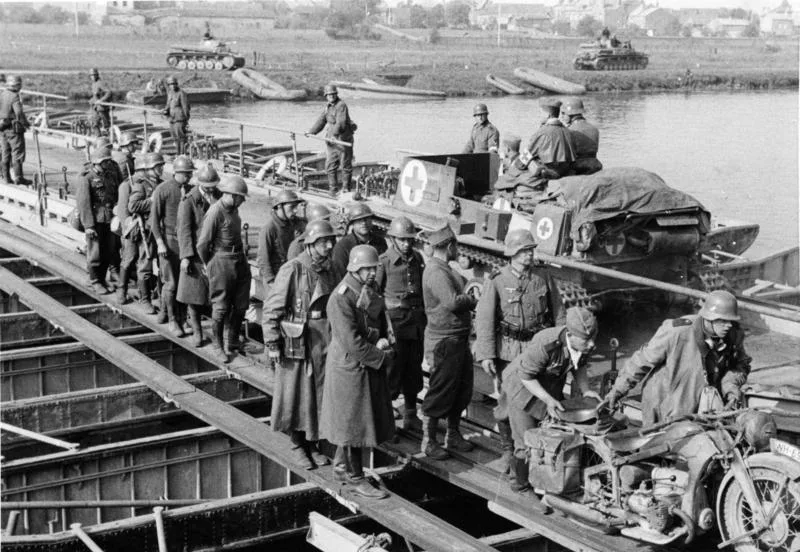
The Ardennes Thrust and Sedan Crossing
In 1940, Guderian's panzers crossed the Meuse at Sedan after crossing the Ardennes, cutting off Allied armies in Belgium in six weeks.
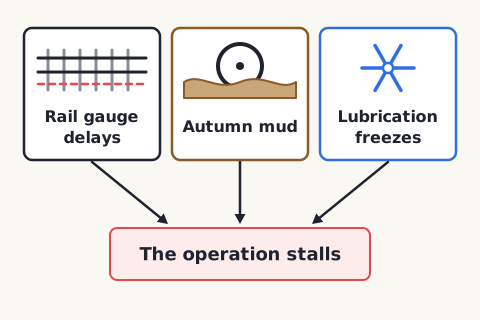
Logistical Friction in Operation Barbarossa
Operation Barbarossa stalled in 1941 due to Russian broad rail gauge conversion delays, autumn rasputitsa mud, and severe winter lubrication freezing.
Siberian Divisions at the Battle of Moscow
In December 1941, Zhukov launched over 18 fresh Siberian winter divisions and T-34 tanks outside Moscow, driving the Wehrmacht back 150 miles.
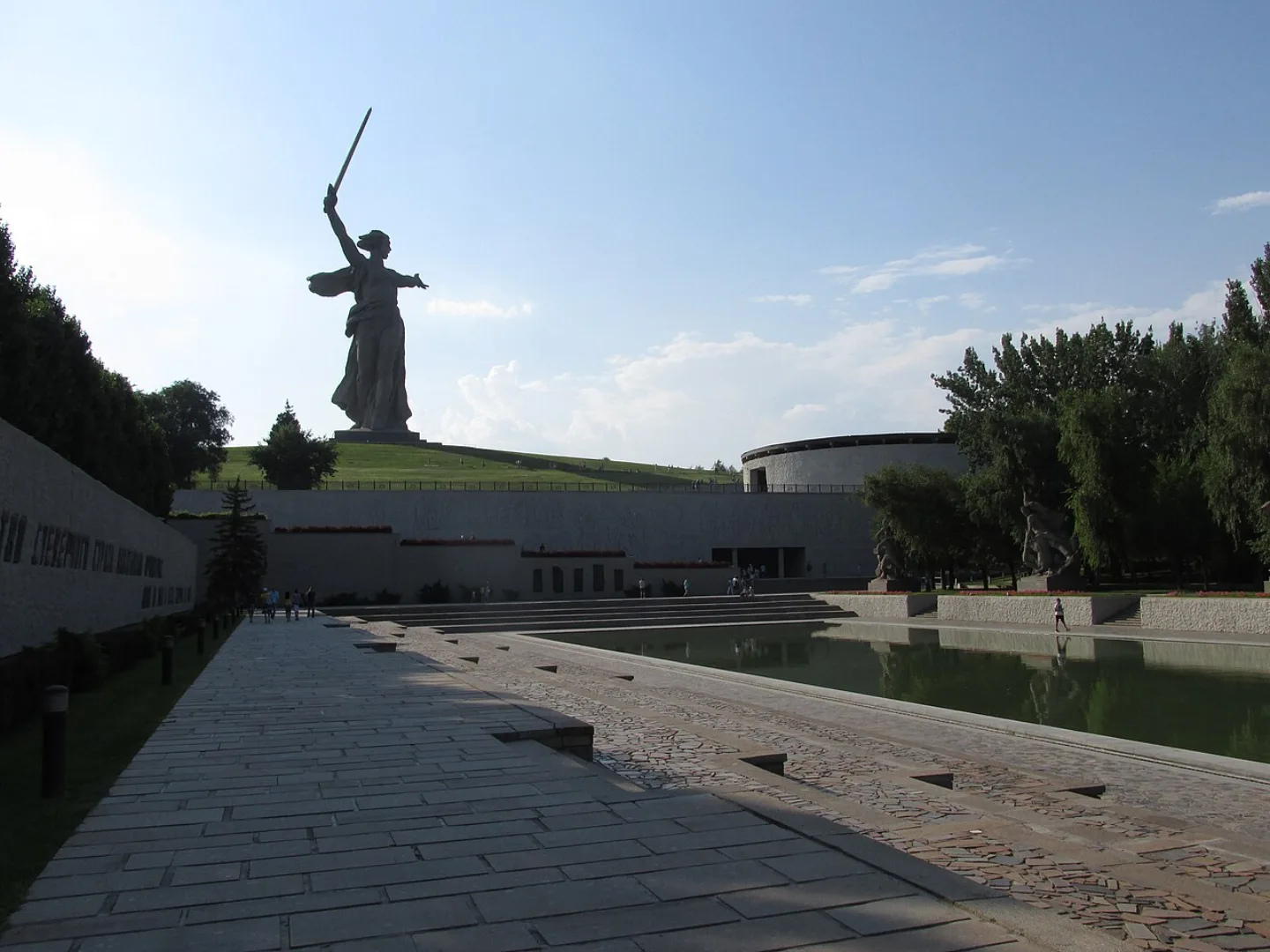
Rattenkrieg and Operation Uranus at Stalingrad
At Stalingrad, Soviet Rattenkrieg street fighting held the city until Operation Uranus executed a double envelopment that destroyed the German 6th Army.
Manstein's Backhand Blow at Third Kharkov
In early 1943, Manstein's 'backhand blow' counter-attack struck overextended Soviet flanks at Kharkov. German wartime reports claimed roughly 50 Red Army divisions destroyed or routed, though independent accounts put actual Soviet losses lower.
Pakfront Defense in Depth at Kursk
At Kursk in 1943, Soviet forces used multiple deep defensive belts with 1 million mines and Pakfront anti-tank ambushes to halt Germany's Tiger and Panther tanks.
Soviet Deep Battle Operational Doctrine
Soviet Deep Battle doctrine used infantry-artillery echelons to breach lines, allowing independent Tank Armies to drive 100 miles into the enemy operational rear.
Maskirovka Deception in Operation Bagration
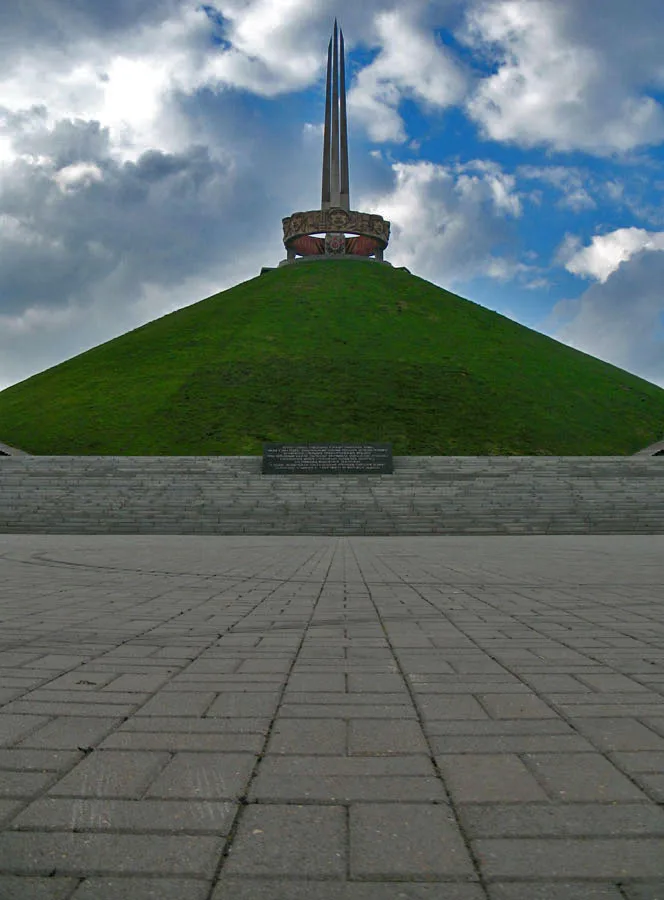
Operation Bagration used maskirovka deception to surprise and destroy German Army Group Centre in Belorussia, advancing 300 miles in two months.
Mass Production Economics of the T-34 Tank
Soviet Tankograd assembly plants produced over 84,000 simplified T-34 tanks, overwhelming low-volume, mechanically complex German Tiger and Panther armor.
Urban Storming Tactics in the Battle of Berlin
In the 1945 Battle of Berlin, Red Army assault teams combined submachine gunners, direct-fire heavy 152mm assault guns, and mouse-holing sappers.
By the numbers
- In what year AD did German Panzer forces break through the Ardennes at Sedan?
- 1940
- In what year AD did Nazi Germany launch Operation Barbarossa against the Soviet Union?
- 1941
- In what year AD was the Battle of Kursk fought on the Eastern Front?
- 1943
- In what year AD did the Red Army launch Operation Bagration in Belorussia?
- 1944
Matched pairs
Each item on the left goes with the one on the right.
- German Panzer Doctrine
- Concentrates armor into autonomous combined-arms divisions with radios and motorized support
- Chuikov's 62nd Army Defense
- Engages in close-quarters urban hugging to bleed German forces and anchor the city ruins
- First Tactical Shock Echelon
- Heavy infantry and massed artillery suppress and breach the forward enemy defense line
- Soviet T-34 Philosophy
- Simplified rugged components optimized for continuous mass assembly line production
Self-test
Answer each question from memory, then check your work against the answer key.
1. What communication technology let Guderian's Panzer Divisions coordinate rapid combined-arms maneuvers?
- AFlag semaphore signal corps
- BHoming pigeons with orders
- CEncrypted teletype landlines
- DTwo-way voice radios in tanks
2. What maneuver let Guderian's panzers bypass the Maginot Line and reach the Channel in 1940?
- AAirborne glider drop on Paris
- BFrontal assault on Belgian ports
- CSichelschnitt via the Ardennes
- DAmphibious landing near Calais
3. Which aircraft, directed by tactical air liaison officers, served as precision flying artillery for German Panzer Divisions?
- AJunkers Ju 87 Stuka
- BFocke-Wulf Fw 190
- CHeinkel He 111
- DMesserschmitt Bf 109
4. Why did Chuikov's 62nd Army fight at extremely close range ('hugging') in the ruins of Stalingrad?
- ATo conserve dwindling ammunition supplies
- BTo negate German air and artillery bombing
- CTo protect civilians sheltering nearby
- DTo confuse German radio intercepts
5. What was the core idea behind Manstein's 'backhand blow' at Third Kharkov in 1943?
- AEncircle the enemy capital in a rapid pincer
- BHold a static defensive line at all costs
- CLure Soviet armor forward, then strike its flanks
- DRetreat entirely to prepared lines in Poland
6. What Soviet tactic at Stalingrad, called Rattenkrieg, neutralized German air and artillery superiority?
- AHugging German lines closely to negate Luftwaffe bombing
- BRetreating east of the Volga to regroup for spring
- CDeploying massed T-34 columns into the city center
- DBuilding a double line of circumvallation around the city
7. What was the goal of Operation Uranus, launched by the Red Army on November 19, 1942?
- ADivert German reserves toward Kharkov
- BEncircle the German 6th Army via weak Romanian flanks
- CPush straight through the ruins of central Stalingrad
- DRelieve Pavlov's House with a frontal assault
8. In Soviet Deep Battle doctrine, what was the operational role of second-echelon Tank Armies?
- AProvide anti-aircraft cover for infantry columns
- BHold the front line while artillery bombards
- CGuard rail hubs against partisan sabotage
- DPour through gaps and strike deep into the rear
9. Why did Soviet T-34 production vastly outpace German Panther and Tiger tank production?
- ATanks ran exclusively on imported American engines
- BSimplified design suited continuous assembly-line output
- CGerman tank factories relocated east of the Urals
- DHand-riveted construction was cheaper but slower
10. How deep were the multiple Soviet defensive belts built to absorb the German assault at Kursk in 1943?
- AUp to 100 miles deep
- BUp to 15 miles deep
- CUp to 250 miles deep
- DUp to 20 miles deep
11. How did Red Army assault groups use ISU-152 heavy guns in the Battle of Berlin?
- AEscorted infantry columns as anti-aircraft cover
- BServed only as ammunition transport vehicles
- CFired point-blank into building facades
- DProvided long-range indirect fire from the rear
12. Which theorists formulated Soviet Deep Battle Doctrine in the 1930s?
- AZhukov and Chuikov
- BManstein and Guderian
- CZhukov, Konev, and Rokossovsky
- DTukhachevsky and Triandafillov
13. What is the core principle of Soviet Deep Battle Doctrine (Glubokaya Operatsiya)?
- AConcentrating all reserves at the front line
- BStatic linear defense along fortified belts
- CRapid encirclement using only airborne troops
- DMobile groups exploit breach into enemy rear
14. Which theorists formulated Soviet Deep Battle Doctrine in the 1930s?
- AManstein and Guderian
- BZhukov and Chuikov
- CTukhachevsky and Triandafillov
- DRokossovsky and Konev, WWII era
Go deeper
Answer key
- 1. D Two-way voice radios in tanksEvery German tank carried a two-way voice radio, letting crews coordinate combined-arms maneuvers in real time during combat.
- 2. C Sichelschnitt via the ArdennesThe 'sickle cut' sent panzers through the 'impassable' Ardennes to Sedan, then raced west to the Channel, bypassing the Maginot Line and trapping Allied forces.
- 3. A Junkers Ju 87 StukaThe Ju 87 Stuka dive bomber delivered precise close air support just ahead of advancing panzers, unlike the Bf 109 fighter, He 111 bomber, or Fw 190 fighter.
- 4. B To negate German air and artillery bombingFighting within grenade range of German lines (Rattenkrieg) made Luftwaffe bombing and artillery strikes too risky for Germans without hitting their own troops.
- 5. C Lure Soviet armor forward, then strike its flanksManstein let overextended Soviet armor advance, then counter-attacked its exposed flanks with concentrated SS-Panzer divisions. German wartime claims put Soviet losses at over 50 divisions destroyed, a figure disputed by later archival research.
- 6. A Hugging German lines closely to negate Luftwaffe bombingChuikov's 62nd Army fought within grenade range of German troops, a tactic called Rattenkrieg, to prevent the Luftwaffe from bombing without risking its own soldiers.
- 7. B Encircle the German 6th Army via weak Romanian flanksOperation Uranus struck the weakly held Romanian and Hungarian flanks in a double envelopment, trapping Paulus's 300,000-strong German 6th Army at Stalingrad.
- 8. D Pour through gaps and strike deep into the rearDeep Battle's second echelon, independent Tank Armies and mechanized corps, exploited breaches made by first-echelon infantry and artillery, driving 50-100 miles deep to paralyze enemy reserves and command posts.
- 9. B Simplified design suited continuous assembly-line outputThe T-34's rugged, simplified single-model design allowed rapid assembly-line output (over 84,000 units), while complex, over-engineered German Tigers and Panthers were slow to build (under 6,000 Panthers).
- 10. A Up to 100 miles deepRokossovsky's forces built multiple defensive belts (six to eight, depending on the source) up to 100 miles deep, containing 1 million anti-tank mines, absorbing the German Panzer offensive before the Soviets counter-attacked.
- 11. C Fired point-blank into building facadesISU-152s ('Zveroboy') fired their 152mm guns directly and at point-blank range into building facades and basements, blasting through German strongpoints house by house.
- 12. D Tukhachevsky and TriandafillovMikhail Tukhachevsky and Vladimir Triandafillov developed Deep Battle theory, calling for simultaneous multi-echelon shock across the enemy's full operational depth.
- 13. D Mobile groups exploit breach into enemy rearDeep Battle doctrine used a first echelon to breach the line, then sent independent Tank Armies as mobile groups 50 to 100 miles into the enemy's operational rear.
- 14. C Tukhachevsky and TriandafillovDeep Battle Doctrine, or Glubokaya Operatsiya, was formulated in the 1930s by Soviet theorists Mikhail Tukhachevsky and Vladimir Triandafillov.
Sources
- Frieser, The Blitzkrieg Legend
- Van Creveld, Supplying War
- Glantz, When Titans Clashed
- Beevor, Stalingrad
- Glantz & House, The Battle of Kursk
- Harrison, Architect of Soviet Victory
- Zaloga, Bagration 1944
- Overy, Russia's War
- Beevor, The Fall of Berlin 1945
- Frieser, The Blitzkrieg Legend; Guderian, Panzer Leader — www.usni.org
- Beevor, Stalingrad; Overy, Russia's War; Beevor, The Fall of Berlin 1945 — www.penguin.co.uk
- Citino, The Wehrmacht's Last Stand; Glantz & House, The Battle of Kursk; Glantz, When Titans Clashed — www.kansaspress.ku.edu
- Harrison, Architect of Soviet Victory — www.routledge.com
- Zaloga, Bagration 1944 — www.ospreypublishing.com
- Wikipedia, Track Gauge in Russia (cf. Van Creveld, Supplying War) — en.wikipedia.org/wiki/Track_gauge_in_Russia
- Van Creveld, Supplying War — www.cambridge.org
- Harrison, Architect of Soviet Victory — mcfarlandbooks.com
Image credits
- The Ardennes Thrust and Sedan Crossing: Wikimedia Commons · Bundesarchiv, Bild 146-1978-062-24 · CC BY-SA 3.0 de — commons.wikimedia.org/wiki/File:Bundesarchiv_Bild_146-1978-062-24,_Floing,_Pontonbr%C3%BCcke_%C3%BCber_die_Maas.jpg
- Logistical Friction in Operation Barbarossa: FlashFeed original diagram · CC-BY-4.0
- Rattenkrieg and Operation Uranus at Stalingrad: Wikimedia Commons · VladFedotov · CC BY-SA 4.0 — commons.wikimedia.org/wiki/File:%D0%92%D0%BE%D0%BB%D0%B3%D0%BE%D0%B3%D1%80%D0%B0%D0%B4._%D0%9C%D0%B0%D0%BC%D0%B5%D0%B2_%D0%BA%D1%83%D1%80%D0%B3%D0%B0%D0%BD._%D0%A0%D0%BE%D0%B4%D0%B8%D0%BD%D0%B0-%D0%BC%D0%B0%D1%82%D1%8C_%D0%B7%D0%BE%D0%B2%D0%B5%D1%82.jpg
- Pakfront Defense in Depth at Kursk: Wikimedia Commons · Дмитрий Романенко (Dmitry Romanenko) · CC BY-SA 3.0 — commons.wikimedia.org/wiki/File:%D0%92_%D0%BD%D0%B5%D0%B1%D0%B5_%D0%BD%D0%B0%D0%B4_%D0%9F%D1%80%D0%BE%D1%85%D0%BE%D1%80%D0%BE%D0%B2%D0%BA%D0%BE%D0%B9_18.jpg
- Soviet Deep Battle Operational Doctrine: FlashFeed original diagram · CC-BY-4.0
- Maskirovka Deception in Operation Bagration: Wikimedia Commons · Andrej Kuźniečyk · CC BY-SA 3.0 — commons.wikimedia.org/wiki/File:Glory_Mound_-_panoramio.jpg


