
Mythology: Greek, Norse & Egyptian study guide · Lesson 10 of 15
Worship, Fate, and Plural Afterlives
Ritual, Fate, Oaths, and Social Order · Valhöll, Fólkvangr, and Hel
This is the lesson's study guide from the FlashFeed app, plus its key facts and a self-test.
What you'll be able to do
- Identify what archaeology and later texts can jointly support without manufacturing a standard liturgy. Explain foreknowledge alongside meaningful action, recip
- Compare plural afterlife images by source and genre instead of building a mapped bureaucracy.
Ritual, Fate, Oaths, and Social Order
Ritual, Fate, Oaths, and Social Order
Old Norse religion was not governed by one standard liturgy used everywhere. Archaeological evidence points instead to local variation in rites, sacred spaces, and burial practices. That variation should shape how we talk: “Old Norse religion” is a useful historical category, but it does not imply that every community performed the same actions or explained them in the same way.
Blót is an Old Norse term for offering or sacrifice. The approved evidence connects blót with reciprocal relationships among people, gods, fertility, peace, and authority. “Reciprocal” means that an offering belonged to an exchange of benefits, loyalty, prosperity, or protection; it was not merely destruction for its own sake. Later written descriptions can illuminate this pattern, but no single feast account should be treated as a transcript of practice across all times and places.
Cult activity could occur in several settings, including elite centers, dedicated buildings, and places where objects were deposited. That variety warns against labeling every large hall a temple or assuming that one site type served every ritual function. Archaeology supplies buildings, deposits, objects, and burial contexts. Texts supply narrated actions and explanations. Strong interpretation compares them, while admitting that material evidence rarely recreates a full ceremony.
The word “sacrifice” also requires care. It can refer to offerings that are not human. Evidence concerning animal sacrifice and debated human sacrifice should be described precisely and without sensationalism. The safest lesson is methodological as well as historical: identify the kind of evidence, its location and date, and the gap between what survives and the ceremony reconstructed from it.
Ritual exchange and the ordering of social life belong in the same historical frame. Sources that describe fate, oaths, hospitality, and reputation do not provide a universal law code, but they show how obligation could be imagined at both cosmic and human scales.
In Völuspá, three norns—female figures associated with destiny—establish laws and mark out lives. This is a strong statement about order in that poem, but it does not establish that every Norse account recognized exactly three universal norns. Later and differing source presentations resist that tidy system.
Fate in these myths does not make action meaningless. A character may know or suspect that disaster is coming and still seek wisdom, keep an obligation, resist an enemy, or prepare for what follows. Foreknown doom and purposeful choice can operate together. The tension is more useful than forcing the material into either complete freedom or mechanical predestination.
Social order is also something people do. Völuspá treats oath-breaking as a breach with cosmic consequences. Hávamál offers counsel about hospitality, gifts, friendship, reputation, and prudent speech. These are social disciplines: repeated practices for navigating dependence on other people. They are not a single religious law code, and Hávamál should not be repackaged as a Norse Ten Commandments or a timeless self-help manual. Its counsel belongs to a historically situated and sometimes hierarchical social world.
The current Codex Regius electronic edition controls these Eddic claims. The older Bellows translation remains a convenient passage locator, not the authority for final wording or interpretation.
Valhöll, Fólkvangr, and Hel
The surviving sources do not preserve one systematic Norse doctrine of the afterlife. They offer multiple images whose details depend on source and genre. A poem, a skaldic expression, a prose narrative, and a burial context may answer different questions. Combining all of them into a mapped bureaucracy creates a level of order that the evidence itself does not provide.
Valhöll, commonly anglicized as Valhalla, is Odin’s hall. In Grímnismál, it is associated with selected warriors slain in battle, not everyone who dies. The same poem says that Freyja receives half of the battle-slain in Fólkvangr, while Odin receives the other half. The Fólkvangr statement is brief, so it supports plurality but not a detailed invented doctrine. Together, these passages rule out the popular shortcut that every Viking expected a universal warrior heaven called Valhalla.
Hel is especially easy to mistranslate through later Christian expectations. Across the surviving material, the word can refer to a being, a place, or a conventional expression for death. Snorri presents Hel within an extended prose account, but the term’s uses across genres are not all identical. It is therefore inaccurate simply to replace Hel with the Christian Hell, as though the two concepts had the same moral logic and textual history.
Burial variation reinforces this caution without supplying a complete key. Different practices show that responses to death were not uniform, but a grave does not automatically identify one named destination. A more reliable afterlife question is: What does this particular source say happens to whom? That approach preserves Valhöll, Fólkvangr, and Hel as meaningful evidence without glamorizing warrior death or pretending that the ordinary dead were sorted by one universally attested system.
Try correcting the popular statement “all Vikings expected to go to Valhalla” as an evidence exercise. Name the source: Grímnismál. Narrow the population: selected people slain in battle. Keep the alternative named in the same passage: Freyja receives half of the battle-slain in Fólkvangr. Then stop where the poem stops instead of inventing a selection mechanism or a complete description of life in Fólkvangr. Each step turns a memorable slogan into a claim the evidence can actually carry.
Hel requires a different classification exercise because the term itself changes function. Before translating it, ask whether the passage presents a being, a place, or a conventional expression for death. That question prevents the spelling “Hel” from importing the moral geography of Christian Hell. Burial evidence supplies a third evidence type: it can demonstrate varied responses to death without assigning a named literary destination to a particular grave.
Sources
- Codex Regius of the Poetic Edda: electronic edition
- The Poetic Edda — accessible passage locator
- Snorri Sturluson: Edda — Prologue and Gylfaginning
- Gylfaginning and Early Medieval Conversion Theory
- Old Norse Mythology
- Old Norse religion — Swedish History Museum
- The Viking blót sacrifices — National Museum of Denmark
- Representations of the Pagan Afterlife in Medieval Scandinavian Literature
Key terms
- norns
- Female figures associated with destiny; Völuspá presents three who establish laws and mark lives, without fixing every account to exactly three.
- blót
- An Old Norse offering or sacrificial practice embedded in reciprocal relations among people, gods, fertility, peace, and authority.
- Valhöll
- Odin's hall for selected battle-slain warriors in surviving literary presentations, not a universal destination for everyone who dies.
Key facts
The Norns Mark Destinies
In Völuspá, three norns establish laws and destinies. Other source presentations do not reduce all fate to exactly three universal figures.
Fate Does Not Cancel Action
Norse myths can hold foreknown doom together with purposeful choices, obligations, and resistance. Constraint does not make every action meaningless.
Order Is Also Social
Völuspá treats oath-breaking as a cosmic breach, while Hávamál teaches hospitality, gifts, friendship, reputation, and prudent speech as social disciplines.
Practice Varied Locally
Old Norse religion varied locally in rites, sacred spaces, and burial practices. One standardized liturgy cannot represent every community or period.
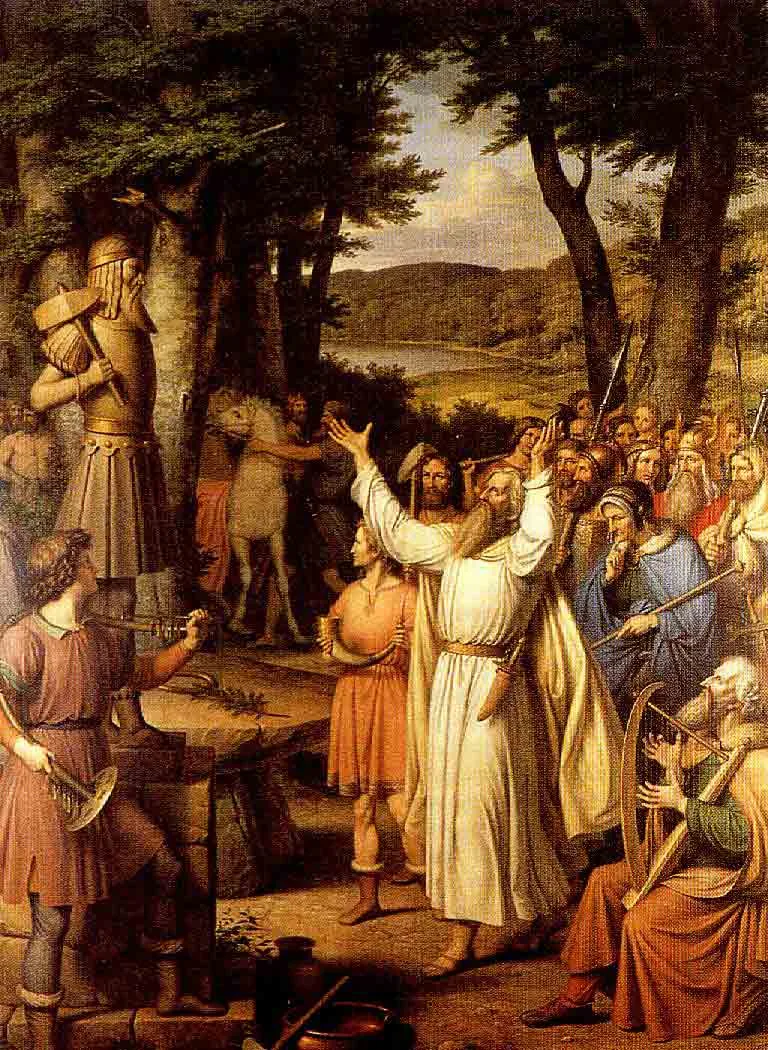
Blót as Reciprocal Offering
Blót involved offerings and reciprocal relationships among people, gods, fertility, peace, and authority. Later descriptions do not define all blót everywhere.
Several Cult Contexts
Cult activity could occur at elite centers, dedicated buildings, and deposition sites. Written ritual accounts must be checked against archaeological evidence.
No Single Afterlife System
The surviving sources do not preserve one systematic Norse afterlife doctrine. Images and destinations vary by genre, date, and narrative purpose.
Valhöll Is Not Universal
Grímnismál presents Valhöll for selected battle-slain warriors and says Freyja receives half the battle-slain in Fólkvangr. The passage does not send every dead person to Valhöll.
Hel Is Not Simply Hell
Hel can name a being, a place, or a conventional expression for death. It is not simply identical to Christian Hell.
Matched pairs
Each item on the left goes with the one on the right.
- Hávamál
- Counsel on hospitality, gifts, friendship, reputation, and prudent speech
- Blót
- Offering within reciprocal religious, social, and political relationships
- Fólkvangr
- The field where Grímnismál says Freyja receives half the battle-slain
Self-test
Answer each question from memory, then check your work against the answer key.
1. How do Norse myths often relate fate and agency?
- AForeknowledge removes social responsibility from decisions
- BA foretold outcome can be avoided through sufficient courage
- CForeknown doom can coexist with meaningful choices and obligations
- DFate belongs to prose synthesis rather than Eddic poetry
2. Which evidence strategy is most responsible for studying Norse ritual?
- AUse one literary feast as a standardized liturgy
- BCompare later written accounts with archaeological contexts
- CRead deposited objects as complete ritual scripts
- DClassify large halls as temples from size alone
3. What role do the three norns perform in Völuspá?
- AEstablish laws and mark out lives
- BOffer sacrifices for prosperity and peace
- CTreat oath-breaking as a cosmic breach
- DCounsel hospitality and prudent speech
4. Which of these is NOT one of Hávamál's social disciplines?
- AHospitality
- BPrudent speech
- CGift-giving
- DOath-breaking as cosmic breach
5. What best characterizes blót's 'reciprocal' quality?
- AIdentical ritual at every site
- BDestruction for its own sake
- COne universal feast record
- DExchange of loyalty and protection
6. Which statement best reflects the surviving uses of Hel?
- AHel is simply the Christian Hell under another name
- BHel may be a being, a place, or an expression for death
- CHel is the preferred destination of battle-slain warriors
- DHel and Valhöll are interchangeable names
7. Whose hall is Valhöll, according to the surviving sources?
- AOdin
- BLoki
- CBaldr
- DFreyja
8. In Grímnismál, Freyja receives half of the battle-slain in which location?
- ANiflheim
- BHel
- CFólkvangr
- DValhöll
9. Which best describes the surviving Norse afterlife sources?
- AEvery grave names a destination
- BAll the dead enter Valhöll
- CImages vary by source and genre
- DOne shared bureaucratic map
10. Why can't a single grave alone confirm a named afterlife destination?
- ABurial shows variation, not a destination
- BGraves always list the deceased's fate
- CGraves are more reliable than poems
- DGraves replace all literary sources
Go deeper
Answer key
- 1. C Foreknown doom can coexist with meaningful choices and obligationsThe myths sustain a tension between constraint and purposeful response rather than erasing agency.
- 2. B Compare later written accounts with archaeological contextsTexts and archaeology illuminate different aspects and must be compared without overstating either.
- 3. A Establish laws and mark out livesVöluspá says the norns establish laws and mark out lives. Oath-breaking as a cosmic breach, sacrificial offering, and social counsel belong elsewhere (Völuspá's oath claim, blót, and Hávamál), not to the norns.
- 4. D Oath-breaking as cosmic breachHávamál's counsel covers hospitality, gifts, friendship, reputation, and prudent speech. Treating oath-breaking as a cosmic breach comes from Völuspá instead.
- 5. D Exchange of loyalty and protectionBlót embedded offerings in an exchange of benefits, loyalty, prosperity, or protection, not mere destruction, and not one fixed ritual everywhere.
- 6. B Hel may be a being, a place, or an expression for deathThe term changes across genres and cannot be collapsed into a single Christian category.
- 7. A OdinValhöll is presented as Odin's hall for selected battle-slain warriors, distinct from Freyja's Fólkvangr and unrelated to Baldr or Loki here.
- 8. C FólkvangrGrímnismál states Freyja receives half of the battle-slain in Fólkvangr, while Odin receives the other half in Valhöll.
- 9. C Images vary by source and genreThe sources offer multiple images that depend on genre and date rather than one systematic, mapped doctrine of the afterlife.
- 10. A Burial shows variation, not a destinationBurial variation shows differing responses to death, but a grave does not by itself identify one named literary destination like Valhöll or Hel.
Sources
- The Codex Regius of the Poetic Edda: GKS 2365 4to, Electronic Edition — eae.ku.dk/q?p=eae%2Fvols%2Ftext%2F1
- The Poetic Edda — www.gutenberg.org/cache/epub/73533/pg73533-images.html
- Old Norse Mythology — academic.oup.com/book/41179
- Old Norse religion — historiska.se/en/explore-history/history-hub/old-norse-religion/
- The Viking blót sacrifices — en.natmus.dk/historical-knowledge/denmark/prehistoric-period-until-1050-ad/the-viking-age/religion-magic-death-and-rituals/the-viking-blot-sacrifices/?force=desktop
- Gylfaginning and Early Medieval Conversion Theory — vsnr.org/wp-content/uploads/2021/11/Saga-Book-XXXIII.pdf
- Representations of the Pagan Afterlife in Medieval Scandinavian Literature — discovery.ucl.ac.uk/id/eprint/3488/
- Snorri Sturluson: Edda — Prologue and Gylfaginning — vsnr.org/editions/snorri-sturluson-edda-prologue-and-gylfaginning/
- Evidence synthesis — see lesson sources
Image credits
- Blót as Reciprocal Offering: Wikimedia Commons · Johan Ludwig Lund · Public domain — commons.wikimedia.org/wiki/File:Offering_by_Lund.jpg
