
U.S. National Parks study guide · Lesson 25 of 27
Spotlight: Great Smoky Mountains
The Blue Smoke Mountains · Forests, Fireflies & Heritage · Visiting the Smokies
This is the lesson's study guide from the FlashFeed app, plus its key facts and a self-test.
What you'll be able to do
- Explain the Smokies' blue haze, ancient age, and superlatives.
- Recognize the Smokies' donor gift and salamander-capital fame.
- Explain the Smokies' biodiversity, synchronous fireflies, and Cherokee heritage.
- Plan a Smokies visit and explain why it charges no entrance fee.
- Identify the Smokies' landmark places on sight.
The Blue Smoke Mountains
Straddling the Tennessee–North Carolina line, the Great Smoky Mountains are the most-visited and most biodiverse national park in America — ancient, mist-wrapped peaks across roughly 522,400 acres, fully established in 1934 from land bought and donated rather than carved from the public domain.
The Blue Smoke
The park is named for the perpetual blue haze that hangs over its ridges — and the forest itself makes it. The dense Appalachian vegetation breathes out volatile organic compounds (VOCs) that scatter blue wavelengths of light; mixed with the natural fog rising off the wet forest, it reads as a smoke-like veil. There's no fire involved. The Cherokee named this country Shaconage — "place of the blue smoke" — long before the park existed. Look across the ridgelines at dawn and you'll see why: layer after layer of mountains dissolving into paler and paler blue. The park was assembled in 1934 not from federal land but from thousands of private parcels, bought and donated — including roughly $5 million from John D. Rockefeller Jr.
Among Earth's Oldest Mountains
The Smokies' soft, rounded silhouette is a clue to staggering age. These are the eroded roots of a once-Himalayan range, raised between about 480 and 300 million years ago as colliding continents assembled the supercontinent Pangaea. Hundreds of millions of years of rain and rivers have ground the sharp peaks down to gentle, forested domes. Where the Rockies are young and jagged, the Appalachians are old and worn — the difference you can read straight off the skyline.
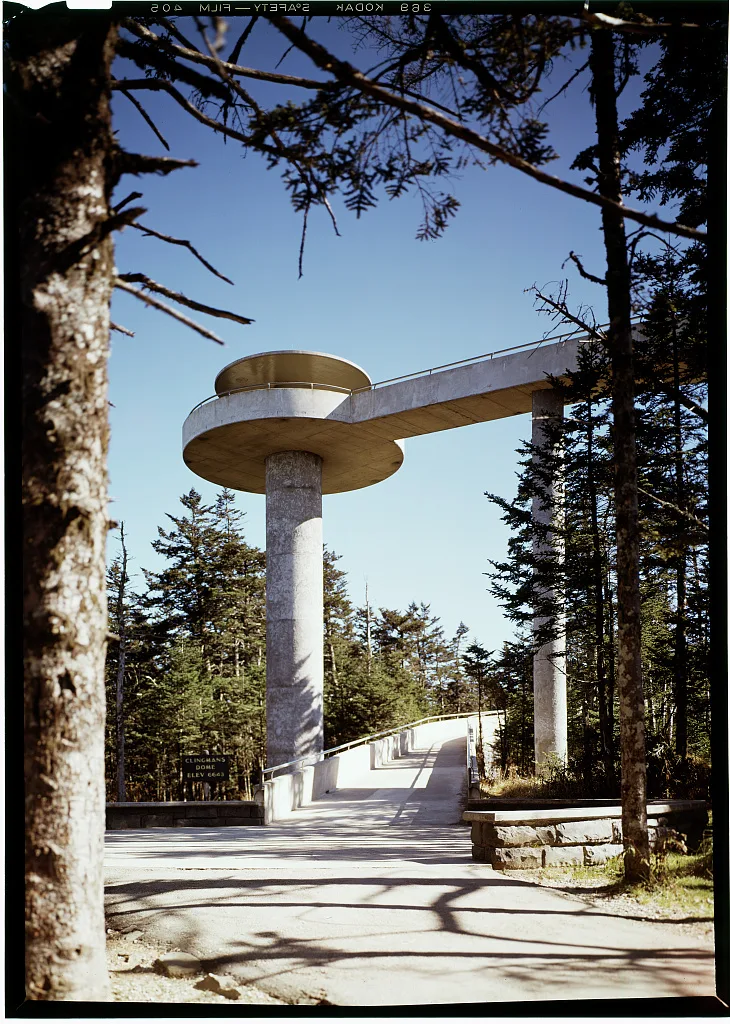
Kuwohi (formerly Clingmans Dome)
At 6,643 feet, Kuwohi is the highest point in the park, the highest in Tennessee, and the highest along the entire 2,190-mile Appalachian Trail. Kuwohi (koo-WHOA-hee) is the Cherokee name and means "mulberry place"; the mountain was long called Clingmans Dome, after an 1859 survey named it for Thomas Clingman, until the U.S. Board on Geographic Names restored the Cherokee name in September 2024. A spiral concrete observation tower lifts visitors above a dark spruce-fir forest into a 360-degree panorama of blue ridges. The summit is cool, damp, and frequently fogbound — effectively a transplanted slice of Canadian boreal forest perched in the American South, a relic of the last Ice Age that survives only at these elevations.
The most biodiverse park
More species have been documented in the Smokies than in any other U.S. national park — over 19,000 confirmed, with scientists estimating the true total at 80,000 or more. The standout group is salamanders: with 30-plus species, the park is nicknamed the "Salamander Capital of the World." That richness flows from the park's range of elevation, abundant rainfall, and unbroken old-growth forest, which together stack many habitats into one protected block.
Worth remembering: Shaconage means "place of the blue smoke"; Kuwohi (formerly Clingmans Dome), 6,643 ft, tops the entire Appalachian Trail; the haze is forest-made VOCs and fog, not smoke; the park was established in 1934 with help from a ~$5 million Rockefeller gift.
Forests, Fireflies & Heritage
The Smokies are less a single landscape than a stack of them — five forest types layered by elevation, a famous synchronized light show, the densest black bears in the East, and a human story reaching back to the Cherokee homeland.
Old-Growth Forest
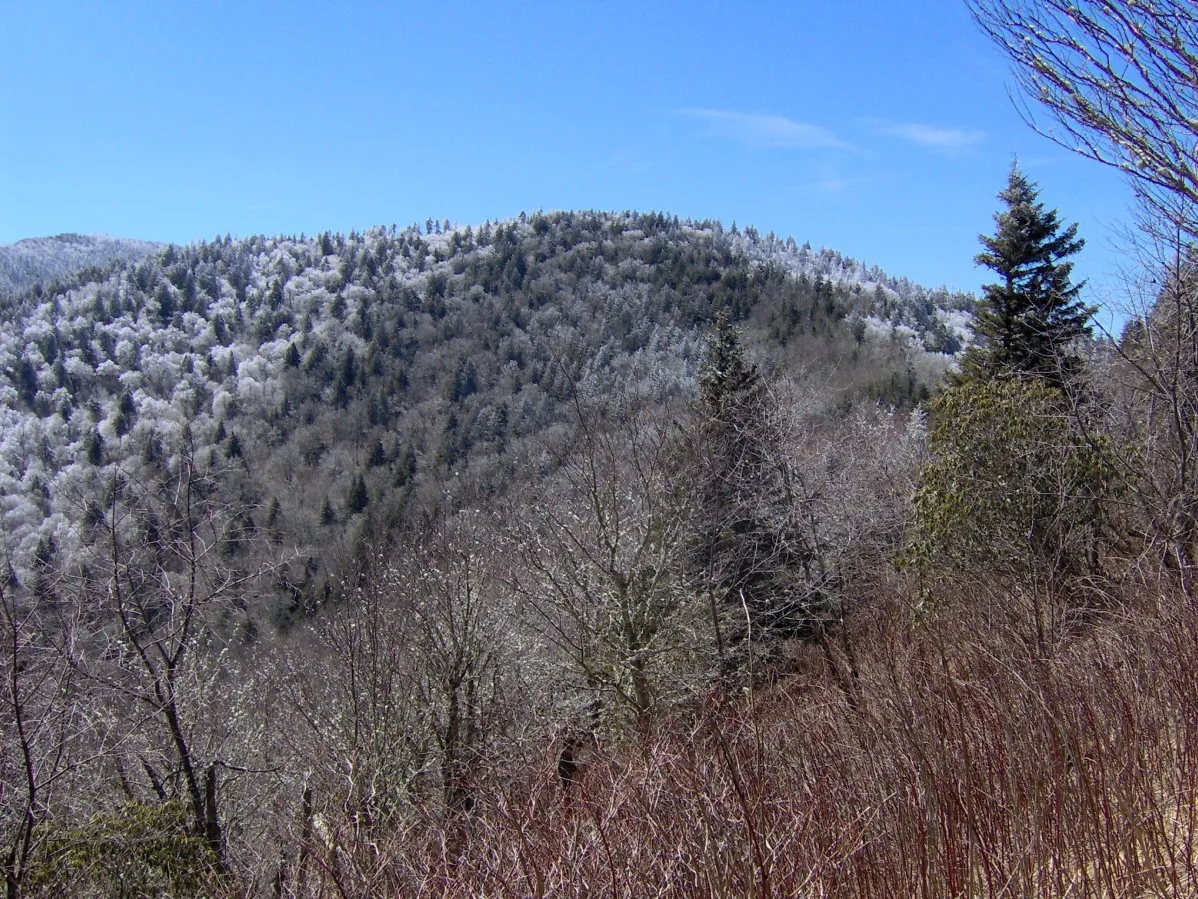
The park holds one of the largest blocks of old-growth forest in the eastern United States — woods the logger's saw never reached. Forest type changes with height: rich cove hardwoods of tulip poplar, hemlock, and silverbell fill the valleys, giving way upslope to a high spruce-fir "Canadian" forest near the summits, a cold-climate relic left behind when Ice-Age glaciers retreated. That vertical stacking of habitats is a big reason the Smokies are so biologically rich, sheltering some of the tallest and most ancient hardwood stands in the East.
Synchronous Fireflies
For about two weeks in late spring, the park stages one of nature's rarest spectacles: thousands of Photinus carolinus fireflies blinking in unison, sending waves of light rippling through the dark forest. It's one of only a handful of places on Earth where this species synchronizes its flash. Demand to witness it is so intense that the park runs a lottery for viewing spots near Elkmont in early June. Scientists still debate exactly why the beetles coordinate — courtship signaling is the leading idea, but the mechanism remains a genuine mystery.
Black Bear Stronghold
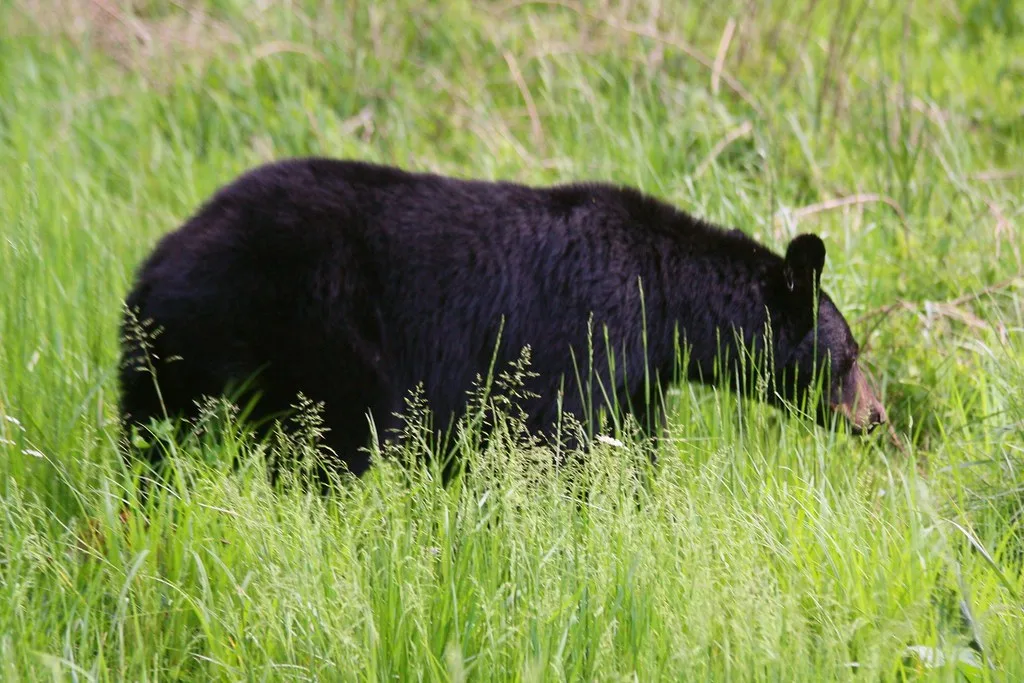
The Smokies are black bear country at its densest: roughly 1,900 bears, about two per square mile — one of the densest populations anywhere in the country. The bears thrive on the forest's mast of acorns, berries, and nuts, and the park stands as a symbol of the species' recovery across the East. Sightings are common in open areas like Cades Cove, where bears amble through the meadows at dawn and dusk. Proper food storage and keeping your distance are the firm rules of the land.
Cherokee Homeland
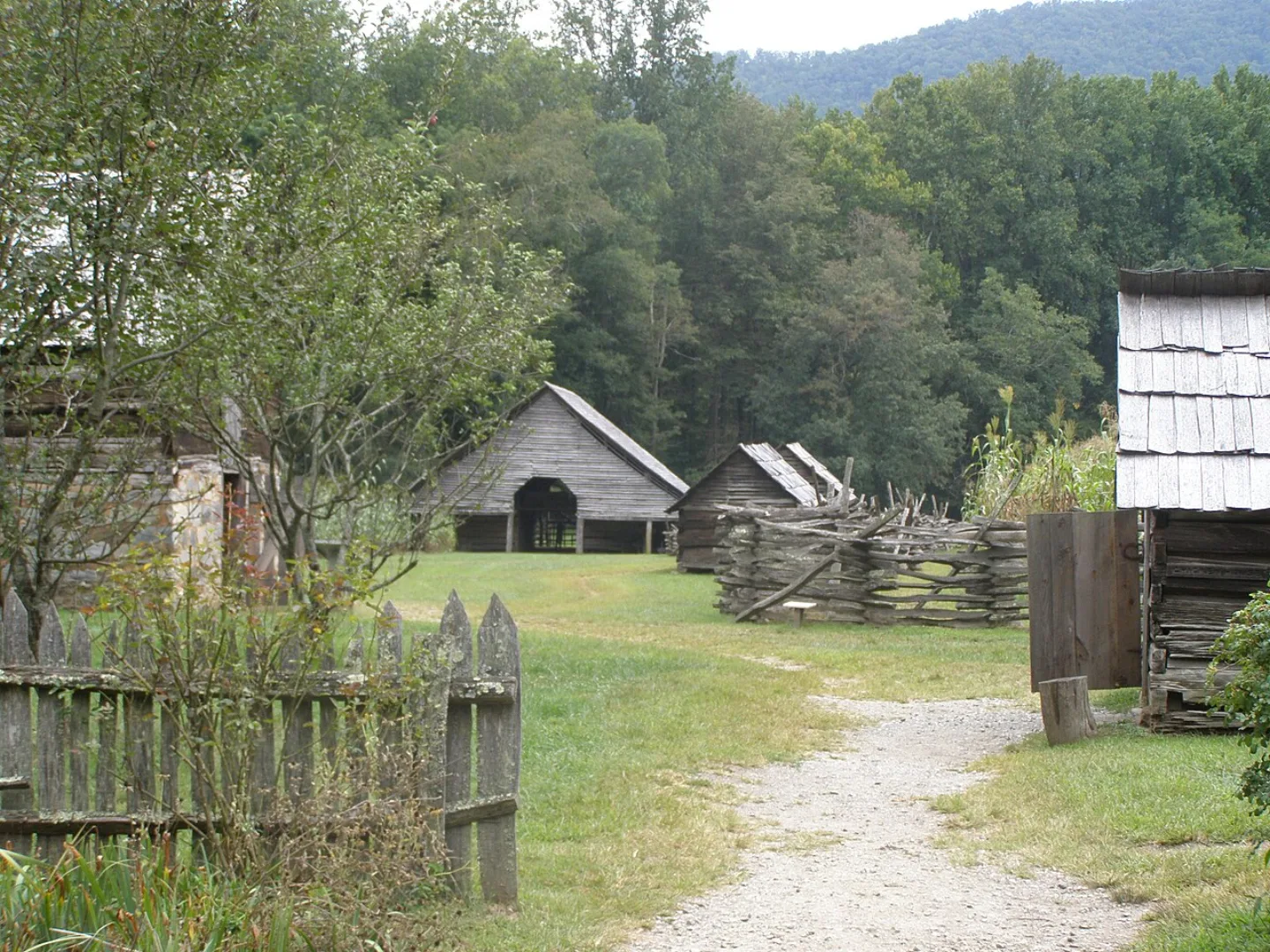
These mountains are the ancestral homeland of the Cherokee (Tsalagi). In 1838 most were forced west on the Trail of Tears, but some resisted removal and remained; their descendants, the Eastern Band of Cherokee, still live on the adjacent Qualla Boundary at the park's southern edge. Cherokee place-names and stewardship are woven through the land. At the Oconaluftee entrance, a preserved Appalachian farmstead museum tells the parallel story of the mountain settlers who farmed these coves — log cabins, a barn, and split-rail fences moved here to honor a way of life the park displaced.
Worth remembering: ~19,000 species documented (est. 80,000+); 30-plus salamander species; ~1,900 black bears at ~2 per square mile; Photinus carolinus is the synchronous firefly; the Trail of Tears was 1838; the Eastern Band remains on the Qualla Boundary.
Visiting the Smokies
The Great Smoky Mountains draw more visitors than any other national park — and unlike most national parks, they charge no entrance fee. Here's how to make sense of the crowds, the cabins, and the color.
The Most-Visited Park
By a wide margin, this is the most-visited national park in America: 12.19 million people came in 2024, more than the next two parks combined. The reasons are geography and access — the Smokies sit within a day's drive of a huge share of the eastern U.S., charge no entrance fee, and offer endless ridgelines and roadside scenery. The trade-off is traffic. On peak fall weekends, Cades Cove and Newfound Gap Road can crawl bumper-to-bumper, so early starts and shoulder-season visits pay off.
Free Entry, Paid Parking
The Smokies charge no entrance fee, and the Park Service says it is unable to. In 1951 the State of Tennessee transferred Newfound Gap Road and Little River Road, the park's two main roads, with a restriction against tolls on either, and a federal law bars entrance fees where tolls are prohibited on a park's primary roads. That makes the busiest national park in America one of about a third of the 64 national parks (23 as of October 2026, including seven of Alaska's eight) with free entry, and by far the most visited of them. The one catch: since March 1, 2023, a paid parking tag has been required to park anywhere in the park for more than 15 minutes. Entry itself, though, remains free (camping has long cost money, too).
Cades Cove
Cades Cove is the park's most beloved corner: a broad green valley ringed by mountains and circled by an 11-mile one-way loop road. Along it stand preserved log cabins, churches, and a working grist mill from the Appalachian settlers who farmed here before the park. The cove is also prime wildlife viewing — white-tailed deer, wild turkey, and black bears graze the meadows, especially at dawn and dusk. Expect slow going on the loop when a bear stops traffic.
Autumn Color and Bugling Elk
October is the Smokies' showcase month. Because forest type shifts with elevation, fall color ripples down the mountains over several weeks, painting the slopes red, orange, and gold far longer than a single peak weekend. It's also elk season. Elk were reintroduced to the park in 2001 after more than a century's absence; today they gather in the Oconaluftee and Cataloochee valleys, where bulls bugle and spar through the autumn rut. The color brings peak crowds, so early mornings reward the patient — better light, fewer cars, and the best odds of seeing wildlife.
Worth remembering: 12.19 million visitors in 2024 (rank #1); no entrance fee, but a parking tag (for parking over 15 minutes) since March 2023; the Cades Cove loop is 11 miles one-way; Newfound Gap crosses the TN–NC crest; elk were reintroduced in 2001; October is the best season for fall color.
Key concepts
Kuwohi (formerly Clingmans Dome)
- The highest point in the entire park, and the highest peak in the state of Tennessee.
- At 6,643 feet it also tops the whole 2,190-mile Appalachian Trail, its cool spruce-fir summit often lost in fog.
- A spiral concrete observation tower lifts visitors above the trees into a 360-degree panorama of blue ridges.
Oconaluftee
- A park entrance and valley on the southern, North Carolina side, a good place to see reintroduced elk in autumn.
- Here a preserved Appalachian farmstead museum — log cabins, a barn, split-rail fences — honors the mountain settlers the park displaced.
Elkmont
- A spot in the park at the heart of a rare late-spring spectacle, so sought-after the park runs a lottery for viewing.
- In early June, viewing spaces near here are drawn by lottery to watch thousands of Photinus carolinus flash in unison.
Cades Cove
- A broad green valley ringed by mountains — the park's most beloved corner.
- An 11-mile one-way loop road circles it, passing preserved log cabins, churches, and a working grist mill.
- At dawn and dusk deer, wild turkey, and black bears graze its meadows — and a bear can bring the loop to a standstill.
Newfound Gap
- A high mountain pass whose scenic road crosses the crest between Tennessee and North Carolina.
- Tennessee's 1951 transfer of this road barred tolls on it, part of why the busiest U.S. national park charges no entrance fee.
- On peak fall weekends, the drive over it can slow to bumper-to-bumper traffic.
Key facts
Kuwohi (formerly Clingmans Dome)
At 6,643 feet, Kuwohi is the highest point in the Smokies, the highest in Tennessee, and the highest along the entire 2,190-mile Appalachian Trail. Its Cherokee name means "mulberry place"; the mountain was long called Clingmans Dome until the U.S. Board on Geographic Names restored the Cherokee name in September 2024. A spiral concrete observation tower lifts visitors above the spruce-fir forest into a 360-degree sweep of blue ridges. The summit is cool, damp, and often fog-wrapped — a transplanted slice of Canadian forest perched in the American South.
Salamander Capital of the World
With over 19,000 documented species and estimates of 80,000 or more, Great Smoky Mountains holds the title of most biodiverse U.S. national park, earning it the nickname "Salamander Capital of the World."
A Park of Parcels
Great Smoky Mountains was assembled in 1934 from thousands of private parcels, with roughly $5 million toward the purchase donated by John D. Rockefeller Jr.
Black Bear Stronghold
The Smokies are black bear country at its densest — roughly 1,900 bears roam the park, about two per square mile, one of the densest populations anywhere in the country. The bears thrive on the forest's acorns, berries, and nuts, and the park is a symbol of their comeback in the East. Sightings are common in places like Cades Cove, where bears amble through the meadows. Storing food and keeping your distance is the rule of the land.
Cherokee Homeland
These mountains are the ancestral homeland of the Cherokee (Tsalagi). In 1838 most were forced west on the Trail of Tears, but some resisted and remained; their descendants, the Eastern Band of Cherokee, still live on the adjacent Qualla Boundary at the park's southern edge. Cherokee place-names, stories, and stewardship are woven through the land. At the Oconaluftee entrance, a preserved Appalachian farmstead tells a parallel story of the mountain settlers who farmed these coves.
An Ice-Age Relic
A spruce-fir forest more typical of Canada grows near the Smokies' highest summits, an Ice-Age relic stranded on the coldest peaks when the glaciers retreated. It's part of why the park stacks five distinct forest types by elevation.
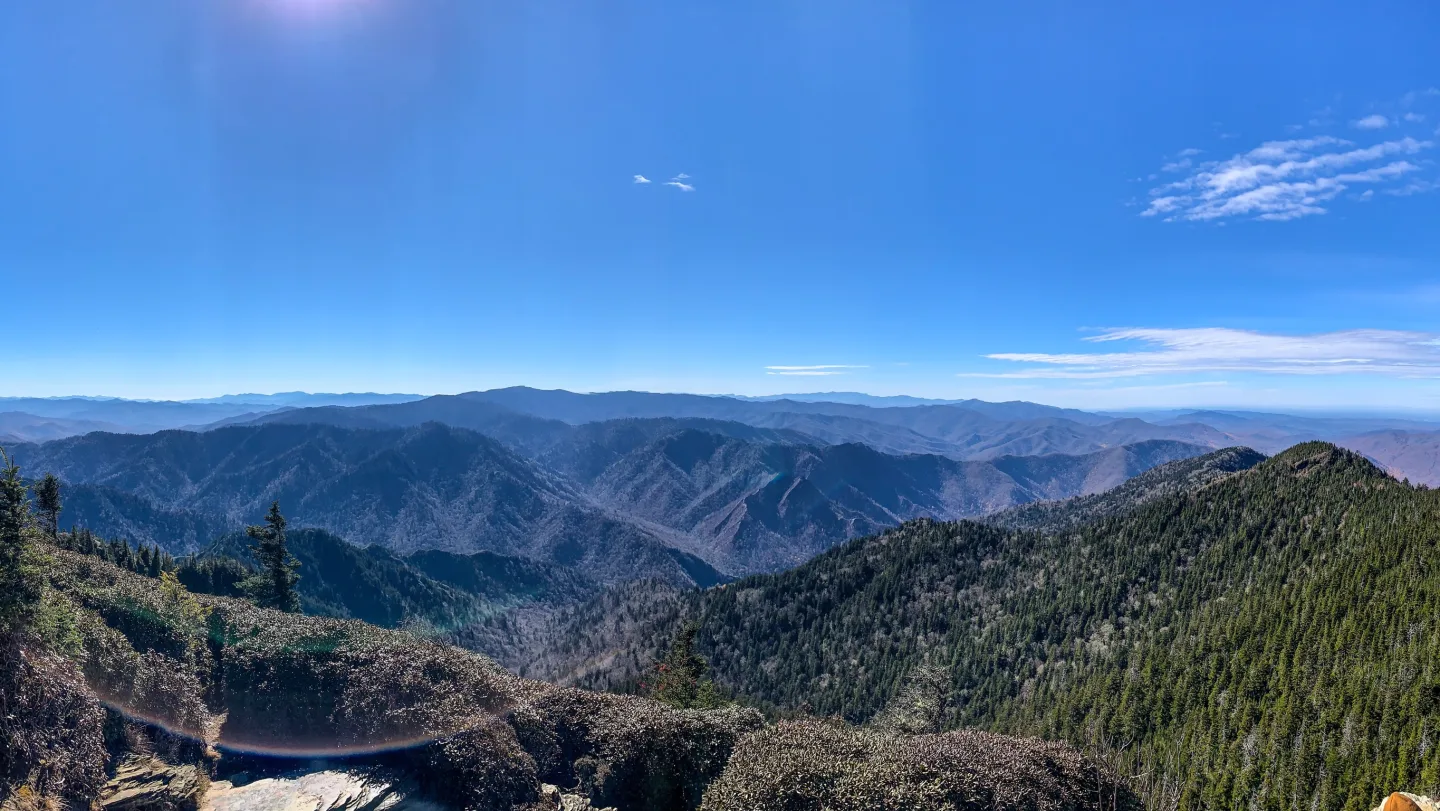
Free Entry, Paid Parking
The Smokies charge no entrance fee, and the Park Service says it can't: Tennessee's 1951 deed for Newfound Gap Road and Little River Road, the park's main roads, bars tolls on them, and a federal law bars entrance fees where tolls are barred on primary park roads. That makes the most-visited national park in America one of about a third of the national parks with free entry. There's a catch: since March 2023 a paid parking tag has been required to park anywhere in the park for more than 15 minutes.
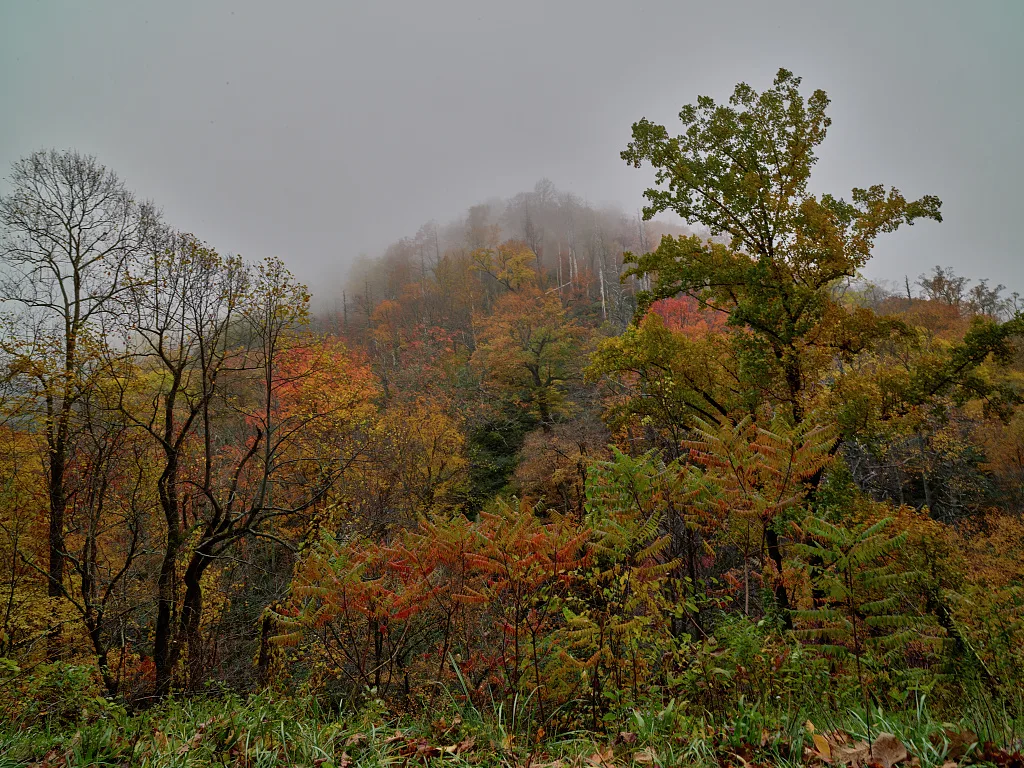
Autumn Color and Bugling Elk
October is the Smokies' showcase month. Because forest type changes with elevation, fall color ripples down the mountains for weeks, painting the slopes in red, orange, and gold. It's also elk season: reintroduced to the park in 2001 after a century-plus absence, elk gather in the Oconaluftee and Cataloochee valleys, where bulls bugle and spar through the autumn rut. Crowds peak with the color, so early mornings reward the patient.
A Parking Tag Since 2023
Since March 1, 2023, a paid parking tag has been required to park in Great Smoky Mountains National Park for more than 15 minutes, even though entry itself remains free. Camping has long carried fees too.
By the numbers
- How high is Kuwohi (formerly Clingmans Dome), the highest point in the Smokies?
- 6643 ft
- Roughly how many acres does Great Smoky Mountains National Park cover?
- 522427 acres
- In what year was Great Smoky Mountains fully established as a national park?
- 1934 year
- Up to about how old is the rock of the Smoky Mountains (in millions of years)?
- 480 million years
- About how many species have been documented in the Great Smoky Mountains?
- 19000 species
- Roughly how many black bears live in the Great Smoky Mountains?
- 1900 bears
- At least how many salamander species live in the "Salamander Capital of the World"?
- 30 species
- In what year were most Cherokee forced west on the Trail of Tears?
- 1838 year
- How many visitors did Great Smoky Mountains receive in 2024 (in millions)?
- 12.19 million visitors
- Where does Great Smoky Mountains rank among U.S. national parks by visitation?
- 1 rank
- How long is the one-way loop road around Cades Cove?
- 11 mi
- In what year were elk reintroduced to the Great Smoky Mountains?
- 2001 year
Matched pairs
Each item on the left goes with the one on the right.
- Shaconage
- Cherokee name meaning "place of the blue smoke"
- Kuwohi (formerly Clingmans Dome)
- Highest point in the park and on the entire Appalachian Trail
- Salamander Capital of the World
- Nickname for the Smokies, home to 30+ salamander species
- John D. Rockefeller Jr.
- Donated ~$5 million to help buy the land for the park
- Photinus carolinus
- The firefly species that blinks in synchrony in the Smokies
- Eastern Band of Cherokee
- Cherokee who remained, living on the adjacent Qualla Boundary
- Oconaluftee
- Southern entrance with a preserved Appalachian farmstead museum
- Newfound Gap
- Mountain pass and road crossing the TN–NC crest of the park
- Parking tag (since 2023)
- Required to park for more than 15 minutes — though entry stays free
- Best season to visit the Smokies
- October for peak fall color (and the biggest crowds)
Self-test
Answer each question from memory, then check your work against the answer key.
1. What superlative does Great Smoky Mountains hold among U.S. national parks?
- AThe driest national park
- BThe highest national park
- CThe youngest national park
- DThe most biodiverse national park
2. What actually creates the perpetual blue haze that gives the Smokies their name?
- ASalt mist drifting inland from the coast
- BEmissions from nearby coal plants
- CForest VOCs scattering blue light, mixed with fog
- DSmoke from frequent wildfires
3. How high is Kuwohi (formerly Clingmans Dome), the highest point in the park?
- A6,643 ft
- B5,280 ft
- C4,229 ft
- D8,751 ft
4. In what year was Great Smoky Mountains fully established as a national park?
- A1950
- B1934
- C1919
- D1872
5. The Smokies' soft, rounded summits are a clue to what about the range?
- AThey are active volcanic cones
- BThey are among Earth's oldest mountains, worn down over eons
- CThey were carved by glaciers in the last century
- DThey are young, recently uplifted peaks
6. Which philanthropist donated roughly $5 million toward buying land for the park?
- AHenry Ford
- BAndrew Carnegie
- CJohn Muir
- DJohn D. Rockefeller Jr.
7. Which statement about the Smokies is NOT true?
- AThe park is nicknamed the 'Salamander Capital of the World'
- BIt hosts more than 30 salamander species
- CIt charges a steep entrance fee that funds salamander research
- DIts land was assembled from private parcels, bought and donated
8. What nickname has the Smokies earned for hosting 30-plus species of one small, tailed amphibian?
- ASalamander Capital of the World
- BFrog Capital of America
- CNewt Nation
- DAmphibian Kingdom of the East
9. At least how many salamander species earn the Smokies their 'capital' title?
- A8
- B30
- C60
- D15
10. How was the land for Great Smoky Mountains National Park acquired?
- ACarved directly from federal public domain like western parks
- BPurchased entirely with federal funds
- CBought from thousands of private parcels and donated
- DDonated whole by a single timber company
11. A cold-climate spruce-fir "Canadian" forest grows near the Smokies' highest summits. Why does it survive so far south?
- AIt is an Ice-Age relic, stranded near the cold summits when the glaciers retreated
- BIt regrew from Canadian seed after 20th-century logging
- CSettlers planted it as a timber crop in the 1800s
- DThe park's heavy rainfall alone allows it to grow there
12. Which firefly species stages the Smokies' rare synchronous light show?
- APhoturis pennsylvanica
- BPyractomena angulata
- CLampyris noctiluca
- DPhotinus carolinus
13. In what year were most Cherokee forced west on the Trail of Tears?
- A1838
- B1776
- C1890
- D1804
14. The Eastern Band of Cherokee, descendants of those who resisted removal, live on which adjacent land?
- APine Ridge Reservation
- BWind River Reservation
- CCherokee Strip
- DQualla Boundary
15. About how many species have been documented in the Smokies, the most biodiverse U.S. park?
- ARoughly 500
- BOver 19,000
- COver 100,000
- DClose to 2,000
16. Why does Great Smoky Mountains charge no entrance fee?
- ACongress banned all fees in eastern parks
- BThe park is too large to staff entrance booths
- CA toll ban in Tennessee's road deed, plus a federal law
- DA private donor pays the fees on visitors' behalf
17. How many visitors did the Smokies receive in 2024, ranking #1 among U.S. national parks?
- A4.7 million
- B25 million
- C12.19 million
- D8.3 million
18. How long is the one-way loop road around Cades Cove?
- A50 miles
- B25 miles
- C5 miles
- D11 miles
19. Since March 2023, vehicles that stop in Great Smoky Mountains for more than 15 minutes must display what?
- AAn entrance fee
- BA paid parking tag
- CA camping surcharge
- DA shuttle fare
20. A visitor hoping for peak fall color and bugling elk should plan to come in which month?
- AOctober
- BJanuary
- CApril
- DJuly
21. Which place is a broad green valley circled by an 11-mile loop, with preserved cabins and a working grist mill?
- ANewfound Gap
- BOconaluftee
- CCades Cove
- DElkmont
22. Which landmark is the mountain pass and road crossing the TN–NC crest of the park?
- AElkmont
- BNewfound Gap
- CCades Cove
- DKuwohi
23. Which southern entrance features a preserved Appalachian farmstead museum of log cabins and split-rail fences?
- ANewfound Gap
- BCades Cove
- CElkmont
- DOconaluftee
24. Near which area does the park run an early-June lottery for synchronous firefly viewing?
- AElkmont
- BCades Cove
- CNewfound Gap
- DOconaluftee
25. Which landmark is the park's highest point, topped by a spiral concrete observation tower?
- AOconaluftee
- BNewfound Gap
- CCades Cove
- DKuwohi
Go deeper
Answer key
- 1. D The most biodiverse national parkWith over 19,000 documented species and estimates of 80,000 or more, the Smokies are the most biodiverse U.S. national park — earning the nickname "Salamander Capital of the World."
- 2. C Forest VOCs scattering blue light, mixed with fogThe dense Appalachian vegetation exhales volatile organic compounds that scatter blue light; blended with forest fog it reads as a smoke-like veil. No fire is involved.
- 3. A 6,643 ftAt 6,643 feet, Kuwohi is the highest point in the park, in Tennessee, and along the entire 2,190-mile Appalachian Trail.
- 4. B 1934The park was assembled in 1934 from thousands of private parcels bought and donated. 1872 is Yellowstone's founding, not the Smokies'.
- 5. B They are among Earth's oldest mountains, worn down over eonsThe rounded silhouette marks the eroded roots of a once-Himalayan range raised 480–300 million years ago. Where the Rockies are young and jagged, the Appalachians are old and worn.
- 6. D John D. Rockefeller Jr.The park was assembled from private land in 1934 with help from a ~$5 million gift by John D. Rockefeller Jr. John Muir was a naturalist, not a donor here.
- 7. C It charges a steep entrance fee that funds salamander researchThe Smokies charge no entrance fee. The rest are true: the 'Salamander Capital' nickname, 30-plus salamander species, and land assembled from bought-and-donated private parcels.
- 8. A Salamander Capital of the WorldWith 30-plus salamander species, the Smokies are nicknamed the 'Salamander Capital of the World.' Salamanders are the tailed amphibians behind the title.
- 9. B 30The park hosts 30-plus salamander species, the standout group behind its status as the most biodiverse U.S. national park.
- 10. C Bought from thousands of private parcels and donatedUnlike western parks carved from public land, the Smokies were assembled in 1934 from thousands of private parcels bought and donated, aided by Rockefeller's ~$5 million gift.
- 11. A It is an Ice-Age relic, stranded near the cold summits when the glaciers retreatedAs Ice-Age glaciers retreated, cold-adapted spruce-fir forest survived only on the coldest high peaks — a "Canadian" forest stranded far south, part of why the Smokies stack five forest types by elevation.
- 12. D Photinus carolinusThousands of Photinus carolinus fireflies blink in unison for about two weeks in late spring, one of only a few places on Earth where this species synchronizes.
- 13. A 1838In 1838 most Cherokee were forced west on the Trail of Tears, though some resisted and remained as the Eastern Band.
- 14. D Qualla BoundaryThe Eastern Band still lives on the Qualla Boundary at the park's southern edge. The others are unrelated western lands.
- 15. B Over 19,000More than 19,000 species are confirmed, with scientists estimating the true total at 80,000 or more — the most of any U.S. national park.
- 16. C A toll ban in Tennessee's road deed, plus a federal lawIn 1951 Tennessee transferred Newfound Gap Road and Little River Road to the park with a ban on tolls, and a federal law bars entrance fees where tolls are barred on primary park roads. Entry stays free, though a paid parking tag has been required since 2023.
- 17. C 12.19 million12.19 million people visited in 2024 — more than the next two parks combined — making it the most-visited national park by a wide margin.
- 18. D 11 milesCades Cove is circled by an 11-mile one-way loop road lined with preserved cabins, churches, and a grist mill.
- 19. B A paid parking tagA paid parking tag has been required since March 1, 2023 to park in the Smokies for more than 15 minutes. Entry itself remains free: the park charges no entrance fee.
- 20. A OctoberOctober is the showcase month: fall color ripples down the mountains for weeks and elk bugle through the autumn rut in Oconaluftee and Cataloochee.
- 21. C Cades CoveCades Cove is the park's most beloved corner — a valley ringed by mountains, looped by an 11-mile road, and prime for spotting deer, turkey, and bears.
- 22. B Newfound GapNewfound Gap is the pass and road crossing the Tennessee–North Carolina crest; Tennessee's 1951 deed for the road barred tolls, part of why the park charges no entrance fee.
- 23. D OconalufteeAt the Oconaluftee entrance, a preserved farmstead museum tells the story of the mountain settlers the park displaced.
- 24. A ElkmontDemand to see the Photinus carolinus display is so intense the park runs a lottery for viewing spots near Elkmont in early June.
- 25. D KuwohiKuwohi (formerly Clingmans Dome), 6,643 ft, is the highest point in the park and on the Appalachian Trail; its spiral tower lifts visitors to a 360-degree panorama of blue ridges.
Sources
- U.S. National Parks — Great Smoky Mountains
Image credits
- Kuwohi (formerly Clingmans Dome): Library of Congress · Great Smoky Mountains National Park Roads & Bridges, Clingma · No known restrictions (verify at source) — www.loc.gov/item/tn0279/
- Black Bear Stronghold: N Vision Photos (Openverse) · by 2.0 — www.flickr.com/photos/77746985@N03/6818510016
- Cherokee Homeland: Chris Light · CC BY-SA 4.0 — commons.wikimedia.org/wiki/File:Mountain_farm_Museum_P9090787.jpg
- An Ice-Age Relic: Wikimedia Commons · Brian Stansberry · CC BY 2.5 — commons.wikimedia.org/wiki/File:Appalachian-Trail-OldBlack.jpg
- Free Entry, Paid Parking: Wikimedia Commons · AppalachianCentrist · CC BY-SA 4.0 — commons.wikimedia.org/wiki/File:View_atop_Cliff_Tops_on_Mount_LeConte,_GSMNP,_TN.jpg
- Autumn Color and Bugling Elk: Library of Congress · Fog in the Tennessee portion of Great Smoky Mountains Nation · No known restrictions (verify at source) — www.loc.gov/item/2021756577/


