
U.S. National Parks study guide · Lesson 14 of 27
Spotlight: Yellowstone
Geysers Springs and the Supervolcano · America's Serengeti · Visiting Yellowstone
This is the lesson's study guide from the FlashFeed app, plus its key facts and a self-test.
What you'll be able to do
- Explain Yellowstone's supervolcano, hotspot, and geothermal system.
- Identify Yellowstone's signature thermal and canyon features.
- Explain Yellowstone's wildlife and the wolves' trophic cascade.
- Plan a Yellowstone visit around its scale, overlooks, and seasons.
Geysers Springs and the Supervolcano
Some parks protect a mountain or a canyon. Yellowstone protects a window into the living Earth — a place where the planet's inner heat breaks the surface in steam, color, and roaring water.
Yellowstone
On March 1, 1872, President Ulysses S. Grant signed Yellowstone into existence as the world's first national park — an idea so new the word "national park" barely existed yet. It sprawls across three states, anchored in northwest Wyoming and spilling into Montana and Idaho. Its roughly 2.22 million acres (about 3,472 square miles) make it the 8th-largest U.S. national park and the largest in the contiguous United States after Death Valley. The land ranges from around 5,282 feet at Reese Creek up to 11,358-foot Eagle Peak, its high point. But Yellowstone's true claim to fame isn't its size — it's what lies beneath.
The Yellowstone Supervolcano
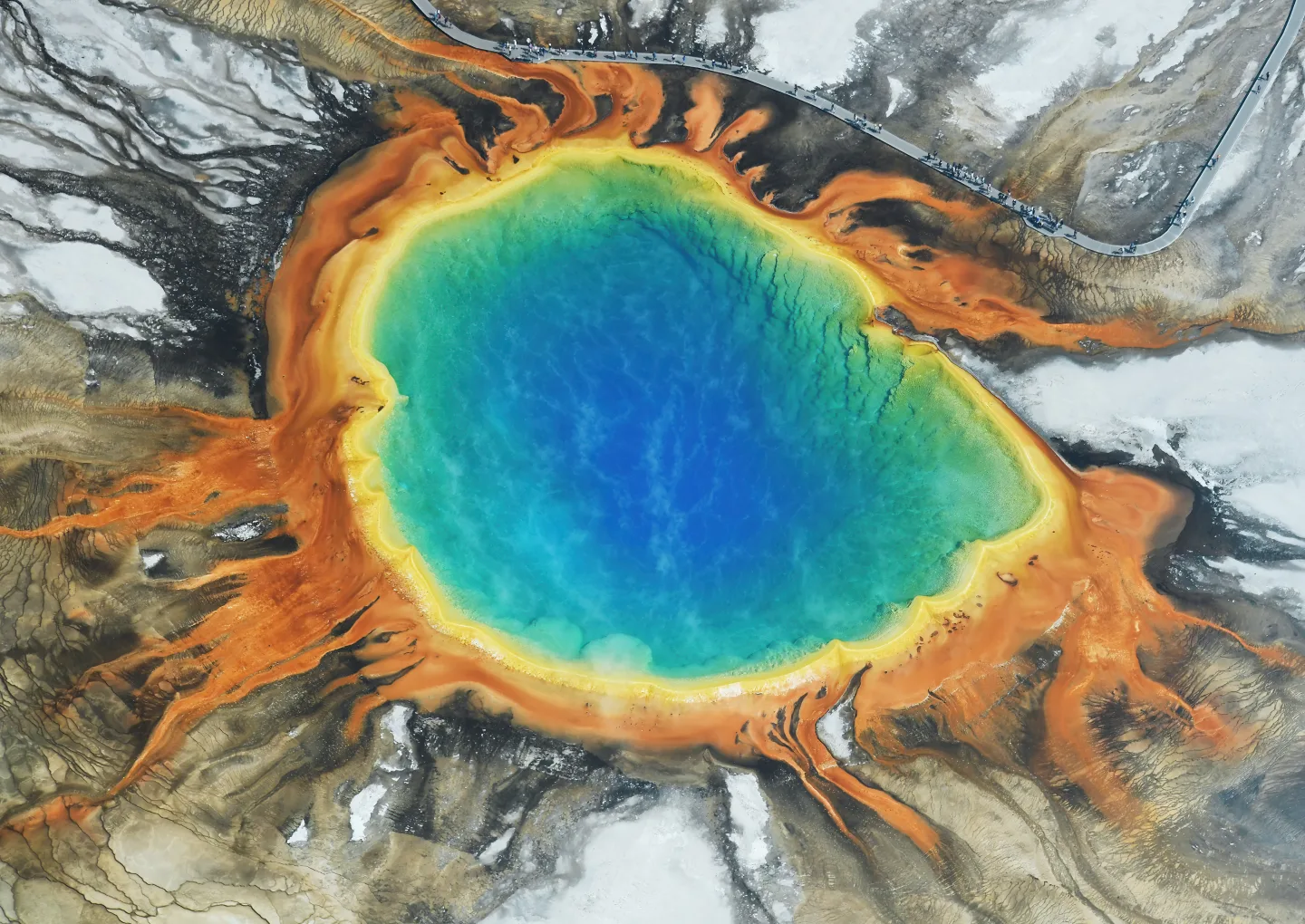
Yellowstone sits inside a caldera, a vast crater left when a supervolcano erupted about 640,000 years ago and the ground collapsed into the emptied magma chamber. Feeding that system is the Yellowstone hotspot — a plume of heat rising through the Earth's crust. This underground furnace is why the park holds the greatest concentration of geothermal features on the planet: roughly 10,000 hydrothermal features and about 500 geysers, nearly half of all the active geysers on Earth. Every steaming pool and shuddering geyser is the hotspot venting its heat. Among them, the Grand Prismatic Spring is the largest hot spring in the U.S., about 370 feet across, its rainbow rings painted by heat-loving microbes. Steamboat Geyser, the world's tallest active geyser, can blast water past 300 feet.
Old Faithful
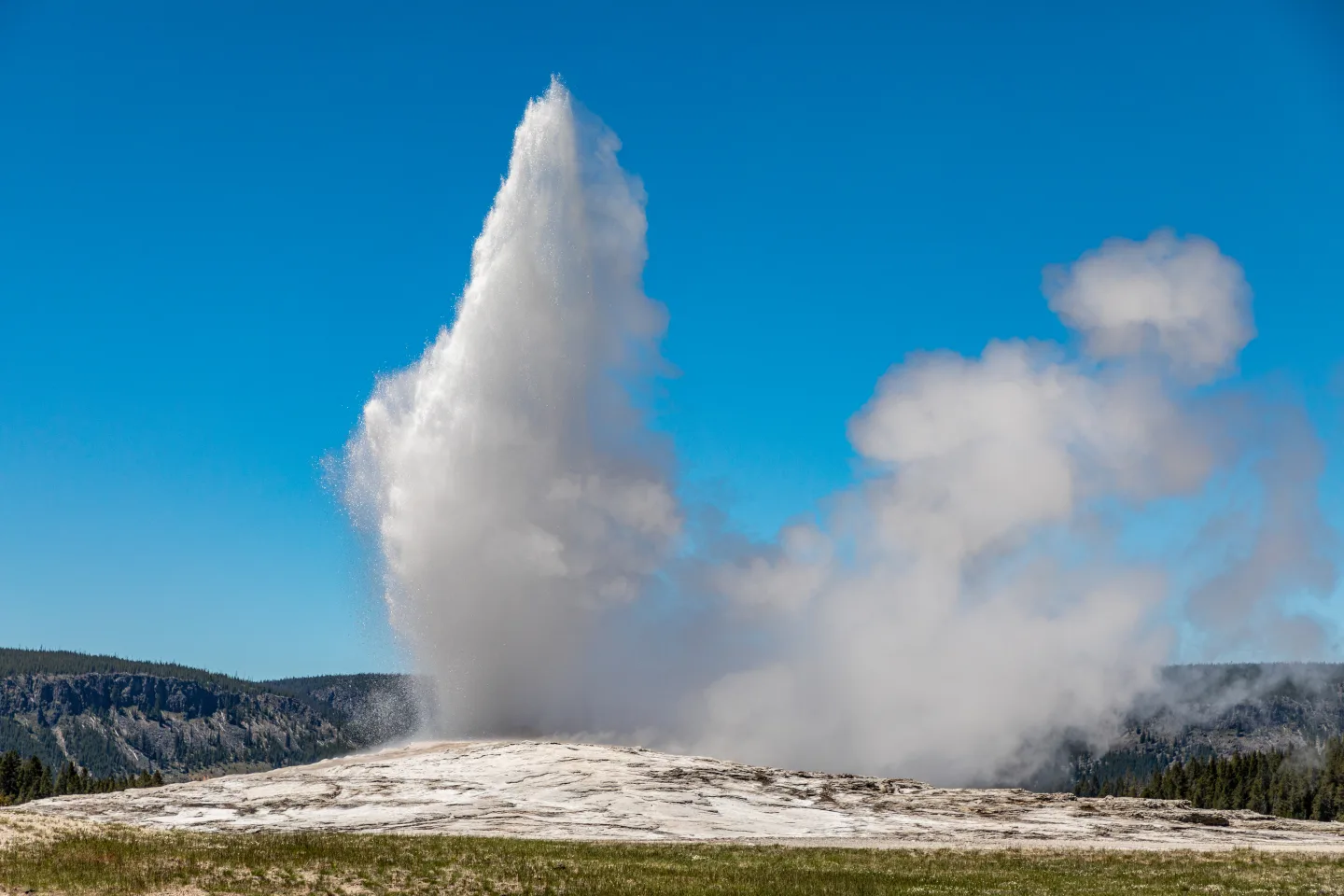
The park's most beloved geyser earned its name for dependability, not height. Old Faithful erupts roughly every 60 to 90 minutes, sending boiling water 106 to 185 feet skyward. Rangers can predict each eruption within about ten minutes, and crowds gather on the boardwalks of the Upper Geyser Basin — the densest single cluster of geysers found anywhere on Earth — to watch the show repeat, faithful as a heartbeat.
The canyon and the falls
East of the geyser basins, the Yellowstone River has carved the Grand Canyon of the Yellowstone, a gorge about 1,000 feet deep through soft, sulfur-yellow rhyolite — the rock that gives the park its name. The river's centerpiece is the Lower Falls, which drops 308 feet, nearly twice the height of Niagara. From overlooks like Artist Point, the white plume of the falls against the canyon's gold and orange walls is one of the park's defining images — proof that even amid all the steam and fire, water still does the patient work of carving the land.
America's Serengeti
Yellowstone is one of the last places in the Lower 48 where you can watch a complete wild food web at work — predators and prey, all of it, across open valleys at dawn.
America's Serengeti
The broad grasslands of the Lamar and Hayden valleys hold wildlife so abundant and visible that Yellowstone is often nicknamed "America's Serengeti." Roaming them is the largest wild bison herd in the United States — about 4,000 to 6,000 animals — the last continuously wild bison population in the country, descended from the few that survived the near-extermination of the 1800s. They share the valleys with elk, pronghorn, bighorn sheep, and moose. At sunrise and sunset the grass fills with movement, and patient watchers with binoculars and spotting scopes line the pullouts to take it in.
This abundance is no accident. Yellowstone sits at the heart of the Greater Yellowstone Ecosystem, one of the largest nearly intact temperate ecosystems left on Earth — millions of acres of connected wild land that let big animals migrate, breed, and survive the way they have for millennia. About 1,000 grizzly bears range across this ecosystem, a recovery success story from the days when their numbers had crashed.
The wolves return
For most of the 20th century, the picture was incomplete. Wolves were hunted out of Yellowstone by the 1920s, and without them the system slipped out of balance — elk grew overabundant and overgrazed the river valleys. Then, in 1995, biologists reintroduced wolves, and the change rippled outward. With wolves hunting again, elk no longer lingered along the streams; willows and aspens regrew, beavers returned to build ponds, songbirds and fish followed, and stabilized banks even changed how some rivers flowed. Scientists call this chain reaction a trophic cascade, and Yellowstone's wolves became its most famous example — a living demonstration that a top predator can reshape an entire landscape. Today wolves are once again a permanent part of the park.
The first peoples
Long before any of this was called a park, people knew this country intimately. At least 27 tribes are formally associated with Yellowstone, among them the Eastern Shoshone, Crow (Apsáalooke), Blackfeet, Bannock, and Nez Perce. The Tukudika, or Sheep Eaters — a band of Shoshone — were unusual in living in the high country year-round, hunting bighorn sheep and crafting prized bows from their horns while most peoples used the plateau seasonally. Their presence is a reminder that Yellowstone was never an empty wilderness; it was, and remains, a homeland.
Visiting Yellowstone
Yellowstone is enormous and busy, so a little planning turns a crowded blur into a string of unforgettable mornings. Here's how to see the best of it — and one secret hiding in the hot springs.
Mammoth Hot Springs
At the park's north end, Mammoth Hot Springs offers a geothermal feature unlike the geysers: here hot water rich in dissolved limestone rises to the surface and, as it cools, deposits travertine — soft, pale stone that builds tier upon tier into terraces that look like a frozen waterfall, or a cave turned inside out. Because the plumbing constantly shifts underground, individual terraces flood, grow, and dry out from one year to the next, so the formation is never quite the same twice. It's one of the park's must-see stops, along with the Artist Point overlook of the Lower Falls and the rainbow expanse of Grand Prismatic.
The microbe that changed science
Yellowstone's scalding springs are far from lifeless. They teem with thermophiles — heat-loving microbes whose colonies paint the pools in bands of orange, green, and yellow. In 1966 a researcher collected one such microbe, Thermus aquaticus, from a Yellowstone hot spring. Its heat-stable enzyme, Taq polymerase, later became the engine of PCR — the DNA-copying technique behind modern genetic testing, forensics, paternity tests, and disease diagnostics. A humble park hot spring quietly seeded one of the great revolutions in biology, a reminder that protected wild places hold value we can't always foresee.
Hikes and the lay of the land
To rise above the crowds, hikers climb Mount Washburn, a roughly 6.4-mile round trip gaining about 1,400 feet to a summit with panoramic views across the whole plateau. For an easier outing, the Fairy Falls trail runs about 5 miles and passes the overlook above Grand Prismatic, where the spring's full rainbow finally reveals itself from above.
Timing your visit
Yellowstone drew about 4.74 million recreation visits in 2024, making it the 4th-most-visited national park — and most of that crowd arrives in summer. Summer (June through September) is the season for full road access and open facilities; in winter the park's interior can be reached only by snowcoach or snowmobile, a quieter, stranger, steam-wreathed world. There's no park-wide timed entry, but in-park lodging books up roughly a year ahead, so plan early.
A safety word
One more thing the rangers will tell you: give the wildlife room. Bison injure more visitors than any other animal in Yellowstone, almost always because someone crept too close for a photo. They look slow and placid, but they're fast, powerful, and unpredictable. Stay at least 25 yards from bison and elk, 100 yards from bears and wolves — and let the wild stay wild.
Key concepts
Grand Prismatic Spring
- Yellowstone holds roughly 10,000 hydrothermal features, and this is among the most photographed of them all.
- It is the largest hot spring in the United States, roughly 370 feet across.
- Heat-loving microbes paint its water in vivid rainbow rings of blue, green, orange, and red.
Steamboat Geyser
- Yellowstone has about 500 geysers, nearly half the active geysers on the whole planet.
- This one is the world's tallest active geyser.
- Its rare, unpredictable major eruptions can blast water past 300 feet into the sky.
Lower Falls
- The centerpiece of the Yellowstone River, famously viewed from Artist Point.
- This 308-foot waterfall drops nearly twice the height of Niagara.
- Its white plume plunges into the gold and orange walls of the Grand Canyon of the Yellowstone.
Grand Canyon of the Yellowstone
- East of the geyser basins, a river has carved a deep gorge nearly 1,000 feet down.
- Its walls of soft, sulfur-yellow rhyolite glow gold and orange, best seen from the Artist Point overlook.
- Its centerpiece, the Lower Falls, plunges 308 feet — nearly twice the height of Niagara.
Mammoth Hot Springs
- At Yellowstone's north end sits a geothermal feature quite unlike the park's geysers.
- Here hot water rich in dissolved limestone deposits soft travertine as it cools.
- It builds pale, tiered terraces like a frozen waterfall, never quite the same from one year to the next.
Key facts
Old Faithful
The park's most famous geyser earned its name for reliability, not size: Old Faithful erupts roughly every 60–90 minutes, jetting boiling water 106–185 feet into the air. Rangers can predict its next show within about ten minutes, drawing crowds to the boardwalks of the Upper Geyser Basin — the densest cluster of geysers anywhere on Earth.
Half of Earth's Geysers
Yellowstone has about 500 geysers, roughly half of all the active geysers on Earth. That count is different from its roughly 10,000 total hydrothermal features, which also includes hot springs and mudpots.
Colored by Microbes
Grand Prismatic Spring, about 370 feet across, is the largest hot spring in the United States. Its rainbow rings of color come from heat-loving microbes living in the water, not the water itself.
The Last Wild Herd
Yellowstone's bison herd numbers roughly 4,000 to 6,000 animals, the largest wild herd in the United States and the country's last continuously wild population.
The Sheep Eaters
The Tukudika, or Sheep Eaters, a band of Shoshone, were unusual among Yellowstone's associated tribes for living in the high country year-round, hunting bighorn sheep and crafting bows from their horns.
The Trophic Cascade
Yellowstone's wolves, exterminated by the 1920s, were reintroduced to the park in 1995 — the event that triggered the famous trophic cascade reshaping the ecosystem.
The Microbe That Changed Science
Yellowstone's scalding springs teem with thermophiles — heat-loving microbes that paint the pools in rainbow colors. In 1966 a researcher collected one, Thermus aquaticus, from a hot spring here. Its heat-stable enzyme, Taq polymerase, later became the engine of PCR, the technique behind modern DNA testing, forensics, and disease diagnostics. A park hot spring quietly seeded a revolution in biology.
4.74 Million Visits
Yellowstone drew about 4.74 million recreation visits in 2024, ranking it the fourth most-visited national park in the country that year.
Snowcoach or Snowmobile Only
Yellowstone offers full road access and open facilities only in summer, from June through September. In winter, the interior can be reached only by snowcoach or snowmobile.
One of the Most Photographed
Artist Point is the classic overlook for viewing the Lower Falls set against the canyon's gold-and-orange walls, one of Yellowstone's most photographed views.
By the numbers
- In what year was Yellowstone established as the world's first national park?
- 1872 year
- Roughly how many years ago did the eruption that formed the Yellowstone Caldera occur?
- 640000 years
- How tall is the Lower Falls of the Grand Canyon of the Yellowstone?
- 308 ft
- What is the elevation of Eagle Peak, Yellowstone's highest point?
- 11358 ft
- About how many bison live in Yellowstone's herd, the largest wild herd in the U.S. (lower estimate)?
- 4000 bison
- Roughly how many grizzly bears live in the Greater Yellowstone Ecosystem?
- 1000 grizzlies
- In what year were wolves reintroduced to Yellowstone?
- 1995 year
- How many Indigenous tribes are formally associated with Yellowstone?
- 27 tribes
- How many recreation visits did Yellowstone receive in 2024?
- 4744353 visitors
- About how long is the round-trip hike to the summit of Mount Washburn?
- 6.4 miles
Matched pairs
Each item on the left goes with the one on the right.
- Grand Prismatic Spring
- Largest U.S. hot spring (~370 ft across), ringed in rainbow microbial mats
- Steamboat Geyser
- World's tallest active geyser — major eruptions exceed 300 ft
- Grand Canyon of the Yellowstone
- ~1,000-ft-deep gorge carved in yellow rhyolite, home to the 308-ft Lower Falls
- ~10,000 hydrothermal features
- Earth's greatest concentration, including ~500 geysers — about half the world's total
- Yellowstone hotspot
- Rising plume of crustal heat that powers the entire geothermal system
- Greater Yellowstone Ecosystem
- One of the largest intact temperate ecosystems on Earth, with the park at its core
- Lamar & Hayden valleys
- Open grasslands prized for wildlife viewing — bison, wolves, and grizzlies
- Tukudika (Sheep Eaters)
- Shoshone people who lived in Yellowstone's high country year-round
- Artist Point
- Classic overlook of the Lower Falls and the yellow canyon walls
- Fairy Falls trail
- Easy-moderate ~5-mi hike passing the Grand Prismatic Overlook
- Best season
- Summer (June–Sept) for full road access; winter interior reached only by snowcoach or snowmobile
Self-test
Answer each question from memory, then check your work against the answer key.
1. Yellowstone sits inside a caldera. What is a caldera?
- AA dome pushed upward by magma rising beneath the crust
- BA basin carved by an ancient glacier
- CA crater left when the ground collapsed into an emptied magma chamber after a supervolcano eruption
- DA crater blasted out by a meteorite impact
2. Roughly how long ago did the eruption that formed the Yellowstone Caldera occur?
- A640,000 years ago
- B2.2 million years ago
- C64 million years ago
- D6,400 years ago
3. What ultimately powers Yellowstone's geysers, hot springs, and other geothermal features?
- AHeat released by melting glaciers
- BA shallow reservoir of trapped seawater
- CFriction from two colliding tectonic plates
- DThe Yellowstone hotspot, a rising plume of crustal heat
4. About how many geysers does Yellowstone hold — nearly half of all the active geysers on Earth?
- A10,000
- B500
- C5,000
- D100
5. Which statement about the Yellowstone supervolcano system is NOT true?
- AThe park holds Earth's greatest concentration of geothermal features
- BThe last major eruption was about 640,000 years ago
- CThe caldera formed when ground collapsed into an emptied magma chamber
- DThe hotspot has cooled and no longer produces geothermal activity
6. Which feature is the largest hot spring in the U.S., about 370 feet across and ringed in rainbow microbial mats?
- ASteamboat Geyser
- BGrand Prismatic Spring
- CMammoth Hot Springs
- DOld Faithful
7. The world's tallest active geyser, which can blast water past 300 feet, is:
- ALower Falls
- BGrand Prismatic Spring
- CSteamboat Geyser
- DOld Faithful
8. About how often does Old Faithful erupt?
- AEvery 60 to 90 minutes
- BEvery 6 hours
- COnce a day
- DEvery 10 minutes
9. The Lower Falls of the Grand Canyon of the Yellowstone drops how far — nearly twice the height of Niagara?
- A1,000 feet
- B185 feet
- C308 feet
- D106 feet
10. The Grand Canyon of the Yellowstone is carved through what soft, sulfur-yellow rock that gives the park its name?
- ASandstone
- BRhyolite
- CLimestone
- DGranite
11. After wolves returned to Yellowstone in 1995, elk stopped overgrazing the valleys, willows and beavers came back, and even some rivers changed course. What do scientists call this chain reaction?
- AA trophic cascade
- BKeystone predation
- CEcological succession
- DA population bottleneck
12. About how many animals make up Yellowstone's bison herd, the largest wild herd in the United States?
- Aroughly 27
- Bnearly 100,000
- Caround 1,000
- D4,000 to 6,000
13. In what year were wolves reintroduced to Yellowstone, triggering the famous trophic cascade?
- A1872
- B1966
- C1920
- D1995
14. Which broad grasslands are so rich in visible wildlife that Yellowstone is nicknamed "America's Serengeti"?
- ALamar and Hayden valleys
- BMammoth and Norris terraces
- CWashburn and Fairy meadows
- DUpper and Lower Geyser basins
15. Which people lived in Yellowstone's high country year-round, hunting bighorn sheep and crafting bows from their horns?
- AThe Apsáalooke (Crow)
- BThe Tukudika (Sheep Eaters), a band of Shoshone
- CThe Bannock
- DThe Blackfeet
16. Where did Yellowstone rank among the most-visited U.S. national parks in 2024?
- A6th
- B2nd
- C4th
- D3rd
17. Which Yellowstone feature builds pale, terraced travertine from limestone-rich hot water, changing shape year to year?
- ASteamboat Geyser
- BMammoth Hot Springs
- CGrand Prismatic Spring
- DOld Faithful
18. When does Yellowstone offer full road access and open facilities?
- ASummer, June through September
- BYear-round with no seasonal limits
- CSpring only
- DWinter, December through February
19. Which animal injures more visitors than any other in Yellowstone, usually when people approach too closely?
- AGrizzly bears
- BWolves
- CElk
- DBison
20. Which overlook offers the classic view of the Lower Falls against the yellow canyon walls?
- AMammoth Hot Springs
- BMount Washburn
- CArtist Point
- DFairy Falls trail
Go deeper
- WatchThe Other Grand Canyon Yellowstone has its own Grand Canyon. The Yellowstone River carved a gorge about 1,000 feet deep.
- WatchThe Wolves Return Wolves were hunted out of Yellowstone by the 1920s. Without them, elk overgrazed the river valleys.
- WatchA Cave Turned Inside Out Mammoth Hot Springs looks like a frozen waterfall, or a cave turned inside out.
- StudyU.S. National Parks in the FlashFeed app
Answer key
- 1. C A crater left when the ground collapsed into an emptied magma chamber after a supervolcano eruptionA caldera is the vast crater that formed about 640,000 years ago when a Yellowstone supervolcano erupted and the ground collapsed into the emptied magma chamber. The Yellowstone hotspot still feeds its geothermal features.
- 2. A 640,000 years agoThe caldera formed about 640,000 years ago when a supervolcano erupted and the ground collapsed into the emptied magma chamber. 2.2 million is the park's acreage, not its age.
- 3. D The Yellowstone hotspot, a rising plume of crustal heatThe Yellowstone hotspot is a plume of heat rising through the crust; it feeds the entire geothermal system, venting through some 10,000 hydrothermal features.
- 4. B 500Yellowstone has about 500 geysers, roughly half the world's active total. The 10,000 figure counts all hydrothermal features, not just geysers.
- 5. D The hotspot has cooled and no longer produces geothermal activityThe hotspot is still active — it powers roughly 10,000 hydrothermal features. The other three statements are all accurate.
- 6. B Grand Prismatic SpringGrand Prismatic Spring is the largest U.S. hot spring (~370 ft across), its rainbow rings painted by heat-loving microbes. Steamboat and Old Faithful are geysers.
- 7. C Steamboat GeyserSteamboat Geyser is the world's tallest active geyser, with major eruptions exceeding 300 ft. Old Faithful is famous for reliability, not height (106–185 ft).
- 8. A Every 60 to 90 minutesOld Faithful erupts roughly every 60–90 minutes, sending boiling water 106–185 feet up. Rangers can predict each eruption within about ten minutes.
- 9. C 308 feetThe Lower Falls drops 308 feet. 1,000 feet is the canyon's depth; 106 and 185 feet are Old Faithful's eruption range.
- 10. B RhyoliteThe canyon cuts through soft, sulfur-yellow rhyolite — the rock that gives Yellowstone its name. Limestone is what forms Mammoth's travertine terraces.
- 11. A A trophic cascadeA trophic cascade is when a top predator reshapes an entire ecosystem down the food chain. Yellowstone's wolves are its most famous example — their return regrew streamside willows, revived beavers, and stabilized riverbanks.
- 12. D 4,000 to 6,000Yellowstone's herd numbers roughly 4,000–6,000 bison, the last continuously wild population in the country. ~1,000 is the grizzly count; 27 is the number of associated tribes.
- 13. D 1995Wolves were reintroduced in 1995. 1872 is the park's founding, wolves were exterminated by the 1920s, and 1966 is when Thermus aquaticus was collected.
- 14. A Lamar and Hayden valleysThe Lamar and Hayden valleys hold abundant, visible wildlife — bison, elk, wolves, and grizzlies. The geyser basins and Mammoth terraces are thermal, not grassland, areas.
- 15. B The Tukudika (Sheep Eaters), a band of ShoshoneThe Tukudika, or Sheep Eaters — a Shoshone band — were unusual in living in the high country year-round. The other tribes are among the 27 associated with Yellowstone but used the plateau seasonally.
- 16. C 4thWith about 4.74 million recreation visits in 2024, Yellowstone was the 4th-most-visited national park.
- 17. B Mammoth Hot SpringsAt the park's north end, Mammoth Hot Springs deposits travertine into shifting tiered terraces. Grand Prismatic is a flat hot spring; Steamboat and Old Faithful are geysers.
- 18. A Summer, June through SeptemberSummer (June–September) brings full road access and open facilities. In winter the interior can be reached only by snowcoach or snowmobile.
- 19. D BisonBison injure more visitors than any other animal, almost always because someone crept too close for a photo. Stay at least 25 yards from bison and elk, 100 yards from bears and wolves.
- 20. C Artist PointArtist Point is the classic overlook of the Lower Falls and the gold-and-orange canyon walls. Fairy Falls trail overlooks Grand Prismatic; Washburn is a summit hike.
Sources
- U.S. National Parks — Yellowstone
Image credits
- Old Faithful: Wikimedia Commons · Dietmar Rabich · CC BY-SA 4.0 — commons.wikimedia.org/wiki/File:Yellowstone_National_Park_(WY,_USA),_Old_Faithful_Geyser_--_2022_--_2599.jpg
- The Microbe That Changed Science: Wikimedia Commons · Carsten Steger · CC BY-SA 4.0 — commons.wikimedia.org/wiki/File:Aerial_image_of_Grand_Prismatic_Spring_(view_from_the_south).jpg

