
U.S. National Parks study guide · Lesson 16 of 27
Spotlight: Yosemite
Granite Walls and Waterfalls · Giant Trees and a Founding Idea · Visiting Yosemite
This is the lesson's study guide from the FlashFeed app, plus its key facts and a self-test.
What you'll be able to do
- Explain Yosemite's granite features and how glaciers carved the valley.
- Explain Yosemite's giant sequoias and its founding role in the national-park idea.
- Plan a Yosemite visit around Half Dome, Firefall, and waterfall season.
- Identify Yosemite's waterfalls on sight.
Granite Walls and Waterfalls
Yosemite is what happens when ice meets granite. For two million years, glaciers ground down a river canyon in California's Sierra Nevada, leaving behind a valley so concentrated with marvels — sheer walls, naked domes, the tallest waterfall on the continent — that it became the very idea of what a national park should protect.
Yosemite
Yosemite National Park covers about 759,600 acres of the Sierra Nevada in central California, ranking 16th in size among the national parks. Its heart is Yosemite Valley, a glacier-carved trough only about seven miles long but lined with the most famous granite on Earth. Established as a national park in 1890, it now draws roughly 4.1 million visitors a year. The valley floor sits near 4,000 feet; the park climbs to 13,114-foot Mount Lyell. Almost everything Yosemite is known for began with one geologic gift: a vast body of granite, and the ice that exposed it.
El Capitan
El Capitan rises about 3,000 feet of nearly vertical, monolithic granite straight off the valley floor — the largest exposed granite monolith in the world, and climbing's ultimate proving ground. Its golden face has no easy way up. In 2015 the punishingly thin Dawn Wall route saw its first free climb; in 2017 Alex Honnold free-soloed El Cap with no rope at all, a feat that stunned the climbing world. From below, the climbers are invisible specks against the stone.
Half Dome
Half Dome looks as if a giant sheared it in two, but no missing half ever crashed down. Its shape comes from exfoliation — curved sheets of granite flaking off like the layers of an onion — combined with glacial plucking that steepened its northwest face. Its bald crown stands roughly 4,737 feet above the valley floor and serves as the park's unmistakable emblem, instantly recognizable on California's state quarter and a thousand photographs.
Yosemite Falls
Yosemite Falls drops 2,425 feet in three thundering tiers, making it the tallest waterfall in North America. It is fed entirely by snowmelt, so its mood swings with the calendar: a deafening, wind-whipped torrent in late spring, and by late summer often a faint streak — or nothing at all. Nearby Bridalveil Fall, a slender 620-foot ribbon at the valley's mouth, blows so easily sideways in the wind that its plume seems to float rather than fall.
How the valley was carved
Yosemite's granite cooled slowly deep underground as part of a huge mass called a batholith, then was lifted skyward with the rising Sierra Nevada. Rivers cut a V-shaped canyon into it; then ice-age glaciers filled that canyon and ground it into the broad U-shaped valley we see today, polishing the walls and steepening cliffs like El Capitan. The valley's signature profile is glacial, not volcanic — no eruption, impact, or collapse was involved. Ice did the sculpting, one slow inch at a time.
Giant Trees and a Founding Idea
Yosemite's fame is not only carved in granite. In its forests stand the largest living things on Earth, and in its history lies the spark of an idea that would spread across a continent: that the most beautiful places should belong to everyone, forever.
Mariposa Grove
In the park's south end, the Mariposa Grove shelters about 500 giant sequoias, the most massive living things on the planet by volume — bulkier even than the taller coast redwoods. The grove's elder statesman, the Grizzly Giant, has stood for an estimated 2,000-plus years; a single one of its lower branches is thicker than the trunks of most other trees. Walking among their cinnamon-red columns, you feel time itself slow down. These trees helped convince a young nation that such places were worth saving.
The 1864 Yosemite Grant
In 1864, with the Civil War still raging, President Abraham Lincoln signed the Yosemite Grant — the first time the U.S. government set aside scenic land purely to protect it for public use and enjoyment. The grant entrusted Yosemite Valley and the Mariposa Grove to the state of California. It was a radical notion, and it planted the seed of the national-park idea that fully bloomed eight years later at Yellowstone in 1872, and that returned to Yosemite when the surrounding high country became a national park in 1890.
John Muir
The naturalist John Muir wandered the Sierra he lovingly called the "Range of Light," and no one did more to make Yosemite a national park. His vivid writing and tireless lobbying helped win Yosemite full national-park status in 1890. In 1892 he co-founded the Sierra Club to defend wild places, and his 1903 camping trip with President Theodore Roosevelt — three days alone in the backcountry — helped steer the nation toward sweeping land conservation. Decades later, the photographer Ansel Adams carried that torch: his luminous black-and-white prints of Yosemite's cliffs and storms made the park an enduring icon of American wilderness.
The high country
Beyond the famous valley lies a vast alpine world reached by the seasonal Tioga Road, which crests Tioga Pass at 9,943 feet. At its heart sprawls Tuolumne Meadows, a broad subalpine meadow ringed by granite domes and laced with the Tuolumne River — a cooler, quieter Yosemite that opens only after the deep Sierra snow melts, usually by early summer. The park rises all the way to Mount Lyell at 13,114 feet, its highest summit, cradling one of Yosemite's last glaciers.
Ahwahnee, the first home
Long before any grant, the valley was home to the Ahwahneechee, a Southern Sierra Miwok and Paiute people who called it Ahwahnee. They shaped the landscape they lived in, using fire to keep the valley's oak woodlands and meadows open. In 1851, during the Mariposa War, they were violently expelled from the valley — a loss that sits beneath Yosemite's story of preservation, and one the park works to remember and honor today.
Visiting Yosemite
Yosemite rewards a little planning. The valley's greatest views are minutes from a parking lot, but its best hikes ask for your legs and lungs — and in peak season, the park itself asks for a reservation. Here is how to meet it at its best.
Tunnel View
Drive into the valley from the south on Highway 41 and the road bursts out of a tunnel onto the single most famous viewpoint in the park: Tunnel View. In one windshield frame you get El Capitan on the left, Bridalveil Fall feathering down on the right, and Half Dome floating in the hazy distance between them. It is the classic Yosemite postcard, made real — and it is where Ansel Adams shot some of his most famous images. Come at sunset, when the granite catches fire.
Glacier Point
From Glacier Point, a road-accessible overlook 3,200 feet above the valley floor, you stand nearly eye-to-eye with Half Dome and gaze straight down on Vernal and Nevada Falls. Sunset turns the granite to glowing orange, and because the overlook faces the wild high country, the night sky here is among the darkest you'll find anywhere near a paved road. The Glacier Point Road is seasonal, closing under winter snow — another reminder to check conditions before you go.
The Mist Trail
The Mist Trail is Yosemite's most beloved day hike, climbing a staircase of granite steps so close to two waterfalls that spray drenches hikers on a warm afternoon — hence the name. A roughly 3-mile round trip reaches the top of Vernal Fall; pushing on to Nevada Fall stretches it to about 7 steep miles. For the truly ambitious, the Half Dome hike runs 14–16 miles and gains about 4,800 feet, finishing with a grip up the famous Half Dome cables — two steel cables bolted to the final sheer pitch. That last stretch requires a permit issued by lottery, so plan months ahead.
When to come
Timing shapes everything at Yosemite. Late spring is when the waterfalls roar at their fullest, gorged on Sierra snowmelt; by late summer many slow to a trickle or vanish. Summer and early fall are best for the high country, once Tioga Road clears of snow. And in mid-February, a rare trick of light called the Firefall makes seasonal Horsetail Fall glow like flowing lava down El Capitan at sunset — a spectacle that now draws enormous crowds.
Crowds and reservations
Yosemite welcomed about 4.1 million visitors in 2024, and most of them funnel into the small valley in summer. To manage the crush, the National Park Service has run peak-period entry reservation systems in recent years, requiring a timed reservation to drive in during the busiest stretches. The rules change year to year, so always check the current NPS reservation requirements before your trip — and consider arriving early, staying late, or visiting in the shoulder seasons to find the quiet Yosemite that John Muir knew.
Key concepts
Bridalveil Fall
- A slender waterfall at the mouth of Yosemite Valley.
- A 620-foot ribbon that blows sideways so easily its plume seems to float rather than drop.
- It frames the right side of the classic Tunnel View, opposite El Capitan.
Vernal Fall
- The lower of the two waterfalls reached by Yosemite's beloved Mist Trail.
- A roughly 3-mile round-trip climb up granite steps reaches its brink, soaked in spray.
- From Glacier Point you gaze down on it and its taller upstream neighbor.
Nevada Fall
- The upper and taller of the two waterfalls along Yosemite's Mist Trail.
- Reaching its top stretches the hike to about 7 steep miles.
- Glacier Point looks straight down on it and its lower neighbor.
Horsetail Fall
- A seasonal waterfall on the sheer flank of El Capitan.
- In mid-February a rare trick of light makes it glow like flowing lava at sunset.
- This 'Firefall' spectacle now draws enormous crowds each winter.
Key facts
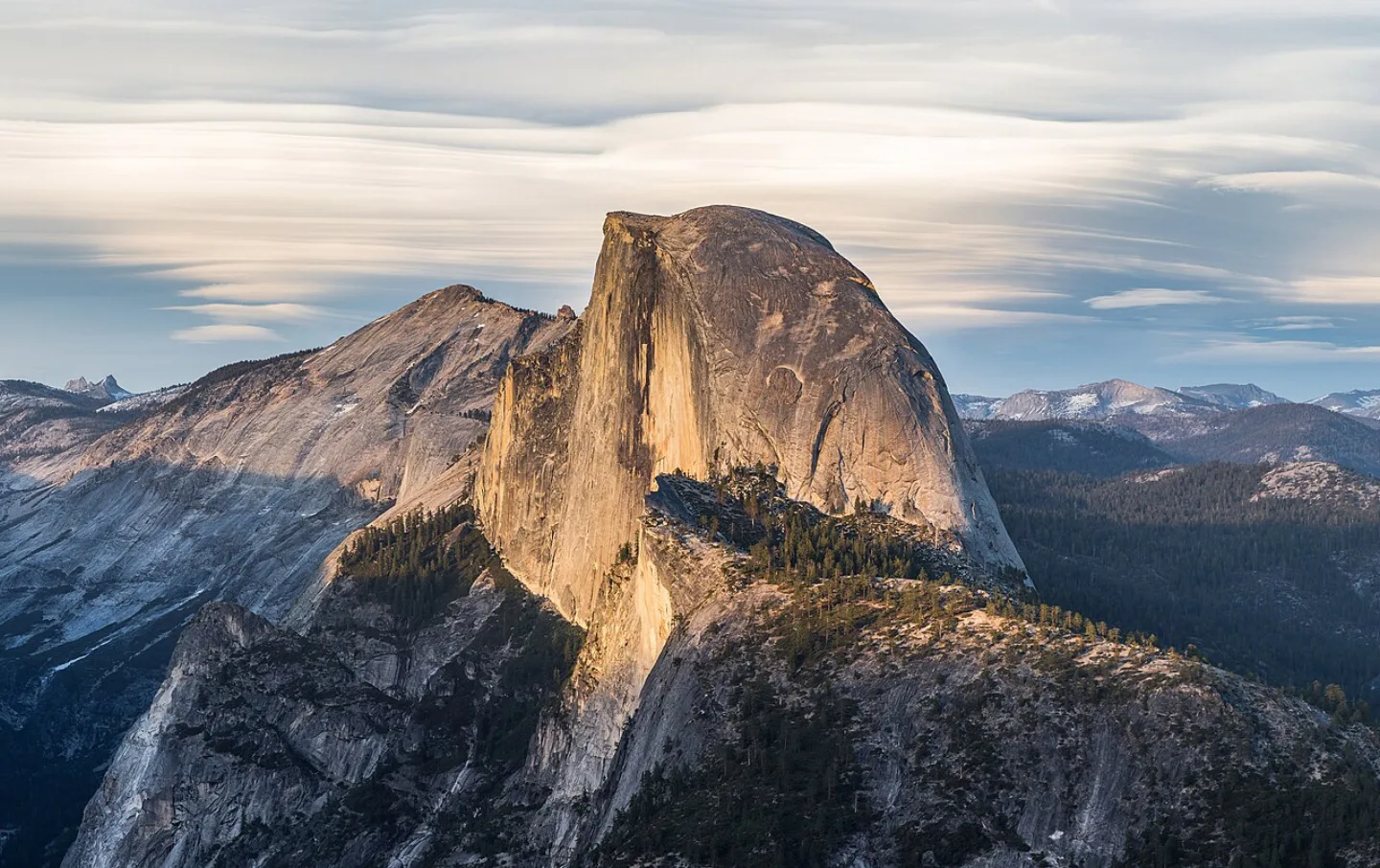
Half Dome
Half Dome looks sheared in two, but no missing half ever fell — glaciers and the slow flaking of curved granite sheets (exfoliation) shaped its rounded back and flat northwest face. Its bald crown stands roughly 4,737 feet above the valley floor, the unmistakable emblem of the park.
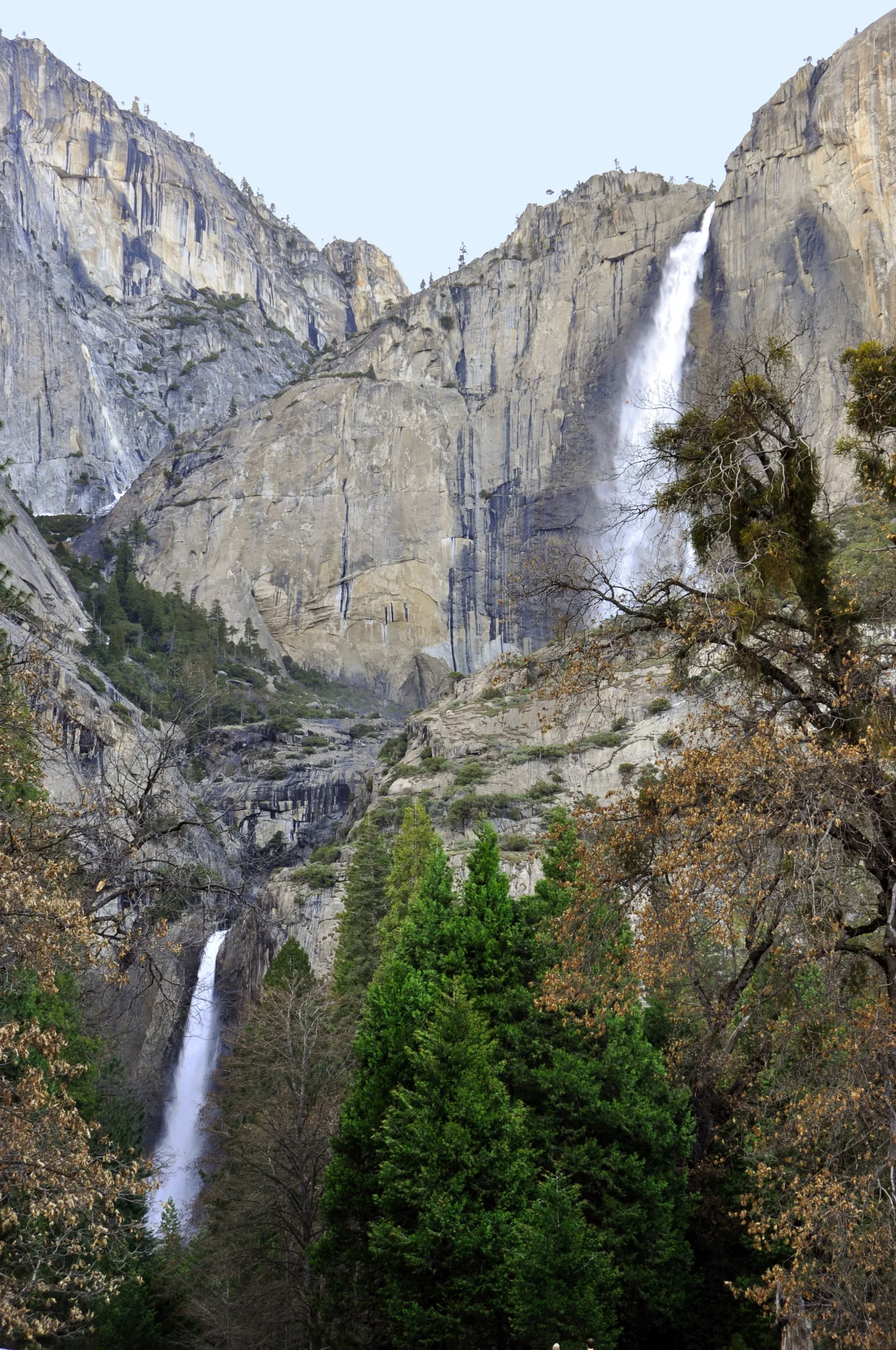
Yosemite Falls
Dropping 2,425 feet in three thundering tiers, Yosemite Falls is the tallest waterfall in North America. It roars loudest in late spring as Sierra snowmelt peaks — and can slow to a trickle, or vanish entirely, by late summer.
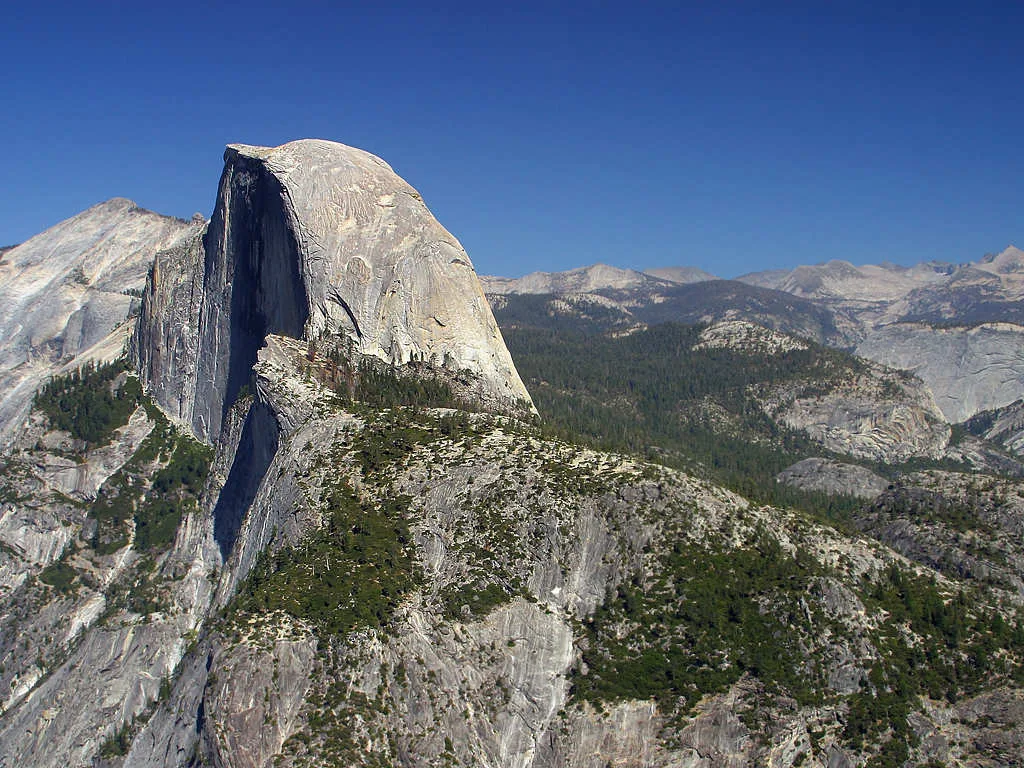
The Batholith
Yosemite's domes and walls are carved from a batholith, a vast body of granite that cooled slowly deep underground before the Sierra Nevada lifted it toward the sky. Ice later exposed and sculpted the rock into today's cliffs and domes.
The 1864 Yosemite Grant
In 1864, with the Civil War still raging, President Lincoln signed the Yosemite Grant — the first time the federal government set aside scenic land to protect it for public enjoyment. Yosemite Valley and the Mariposa Grove were entrusted to California, planting the seed of the national-park idea that bloomed at Yellowstone in 1872.
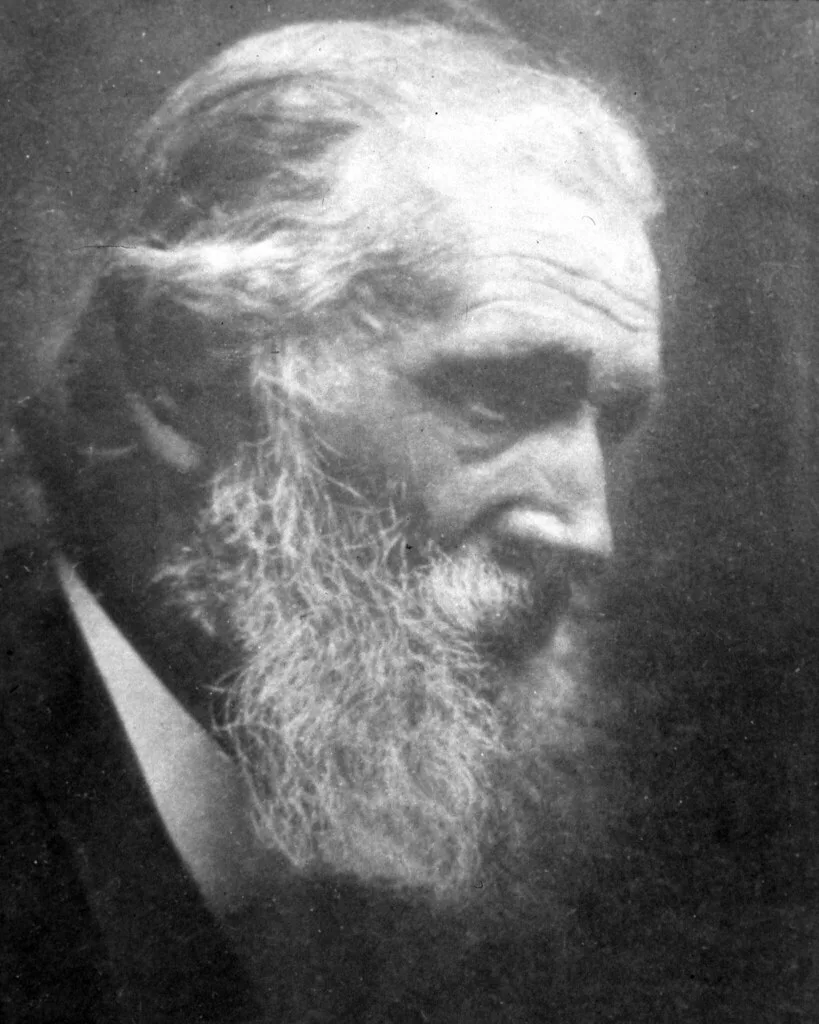
John Muir
The naturalist John Muir wandered the Sierra he called the 'Range of Light,' and his writing and lobbying helped win Yosemite full national-park status in 1890. In 1892 he co-founded the Sierra Club, and a famous 1903 camping trip with Theodore Roosevelt helped steer the country toward broad land protection.
Driven From Ahwahnee
The Ahwahneechee, who called the valley Ahwahnee, were driven out during the Mariposa War in 1851 — more than a decade before the 1864 Yosemite Grant set the land aside for protection.
Through Ansel Adams's Lens
Photographer Ansel Adams captured Yosemite's cliffs and storms in luminous black-and-white prints, and his images helped cement the park as an enduring symbol of American wilderness.
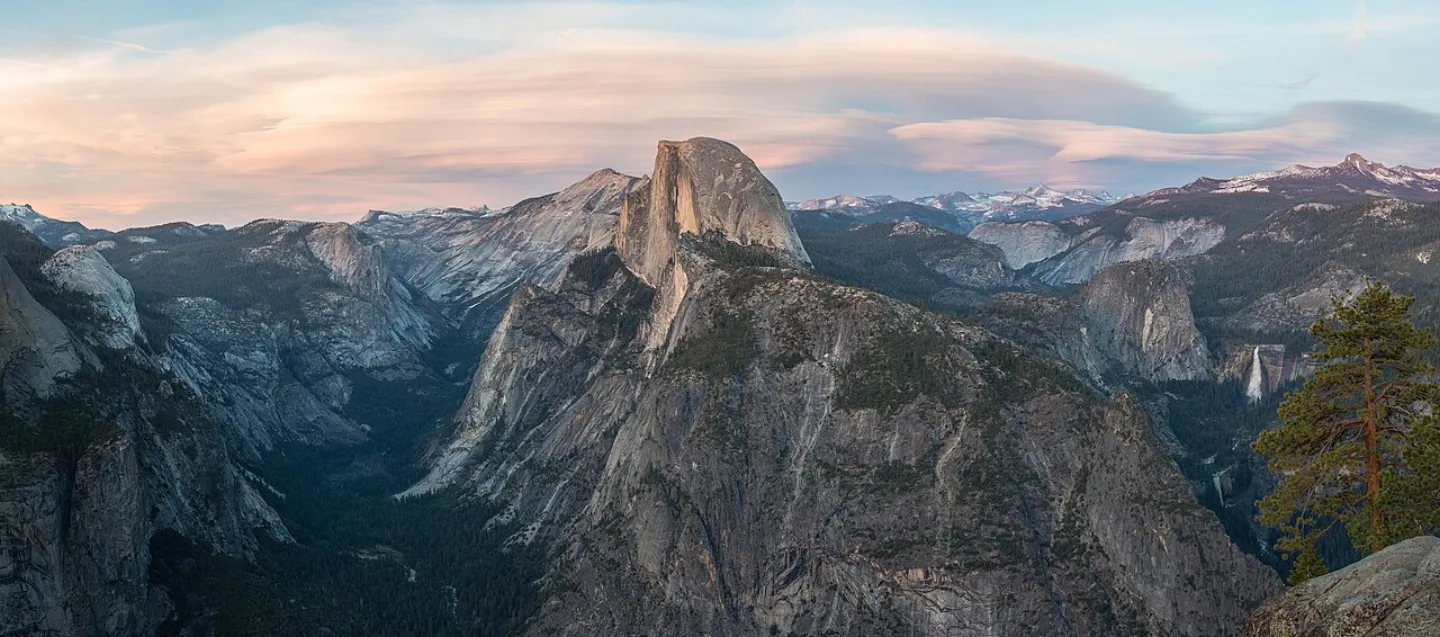
Glacier Point
From Glacier Point, a road-accessible overlook 3,200 feet above the valley floor, you stand eye-to-eye with Half Dome and gaze straight down on Vernal and Nevada Falls. Sunset here turns the granite to fire, and the night sky over the high country is among the darkest you'll find near a road.
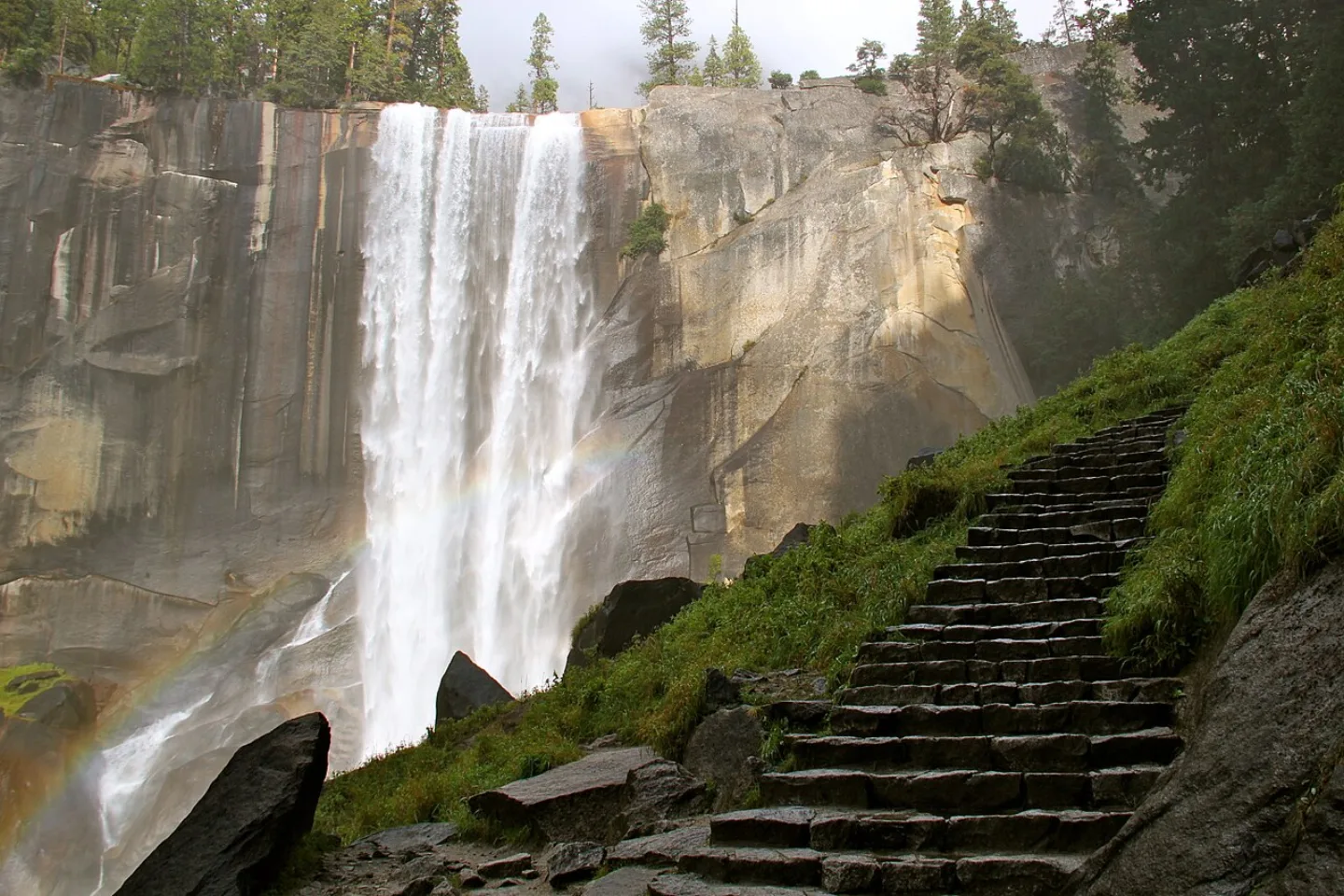
The Mist Trail
The Mist Trail climbs a staircase of granite steps so close to Vernal and Nevada Falls that spray soaks hikers on a hot day — hence the name. A ~3-mile round trip reaches Vernal Fall; pushing on to Nevada Fall makes it ~7 steep miles. It is the park's most beloved day hike.
Glowing Like Lava
In mid-February, sunset light hits seasonal Horsetail Fall at just the right angle to make it glow like flowing lava down El Capitan — a rare phenomenon called the Firefall.
Win the Lottery First
The last pitch to the top of Half Dome is a steep, cable-assisted climb, and hikers must obtain a permit issued by lottery before attempting it — so a trip up the cables takes months of advance planning.
By the numbers
- How tall is Yosemite Falls, the tallest waterfall in North America?
- 2425 ft
- About how tall is El Capitan's sheer granite wall above the valley floor?
- 3000 ft
- About how high does Half Dome's crown stand above the Yosemite Valley floor?
- 4737 ft
- In what year was Yosemite established as a national park?
- 1890 year
- How high is Mount Lyell, Yosemite's highest point?
- 13114 ft
- How high is Tioga Pass, the crest of the seasonal high-country Tioga Road?
- 9943 ft
- About how many people visited Yosemite in 2024?
- 4100000 visitors
- About how much elevation does the strenuous Half Dome day hike gain?
- 4800 ft
Matched pairs
Each item on the left goes with the one on the right.
- Bridalveil Fall
- Slender 620-ft fall that greets you at the valley's mouth; wind often blows its plume sideways
- Batholith
- The huge mass of granite, cooled deep underground then uplifted, from which Yosemite's domes and walls are carved
- Tuolumne Meadows
- Vast subalpine meadow in the high country, ringed by granite domes and reached by the seasonal Tioga Road
- Ansel Adams
- Photographer whose black-and-white Yosemite prints made the park an icon of American wilderness
- Ahwahneechee
- The Native people who lived in the valley they called Ahwahnee, violently expelled in 1851
- Half Dome cables
- Two steel cables hikers grip to climb the final sheer granite pitch to the summit — a permit by lottery is required
- Firefall
- Mid-February sunset light that makes seasonal Horsetail Fall glow like flowing lava down El Capitan
Step by step
Trace how Yosemite Valley's granite walls and U-shaped floor came to be.
- Granite cools slowly deep underground as a batholith
- The rising Sierra Nevada lifts the granite skyward
- Rivers cut a V-shaped canyon into the rock
- Ice-age glaciers fill the canyon and grind it into a U shape
Granite forms underground, rises with the Sierra, is cut by rivers, then carved by ice into a U.
Self-test
Answer each question from memory, then check your work against the answer key.
1. What gave Yosemite Valley its broad, U-shaped profile?
- AA meteor impact
- BGlaciers grinding down the river canyon
- CA volcanic eruption
- DA collapsed cave system
2. About how tall is El Capitan's sheer, nearly vertical granite wall above the Yosemite Valley floor?
- A620 feet
- B2,425 feet
- C4,737 feet
- D3,000 feet
3. What gave Half Dome its rounded back and steep, flat northwest face?
- AExfoliation of curved granite sheets plus glacial plucking
- BWind erosion over millions of years
- CLayers of hardened volcanic lava
- DA missing half that broke off and crashed down
4. What is the batholith from which Yosemite's domes and walls are carved?
- AA river that cut the original canyon
- BA layer of volcanic ash from an ancient eruption
- CA huge granite mass cooled deep underground, then uplifted
- DA glacier that still fills the high country
5. Which statement about Yosemite's granite features is NOT true?
- AEl Capitan is the largest exposed granite monolith in the world
- BHalf Dome's missing half broke off and crashed down
- CYosemite Falls drops 2,425 feet in three tiers
- DThe valley's U-shape was carved by glaciers, not volcanism
6. Who signed the 1864 Yosemite Grant, the first time the U.S. government set aside scenic land purely to protect it for public enjoyment?
- AAbraham Lincoln
- BJohn Muir
- CTheodore Roosevelt
- DUlysses S. Grant
7. The Mariposa Grove shelters about 500 of what — the most massive living things on Earth by volume?
- ACoast redwoods
- BDouglas firs
- CGiant sequoias
- DBristlecone pines
8. Whose writing and lobbying helped win Yosemite full national-park status in 1890 and led to co-founding the Sierra Club in 1892?
- AAnsel Adams
- BTheodore Roosevelt
- CAbraham Lincoln
- DJohn Muir
9. The Ahwahneechee, who called the valley Ahwahnee, were violently expelled during the Mariposa War in what year?
- A1890
- B1872
- C1851
- D1864
10. Whose luminous black-and-white prints of Yosemite's cliffs and storms made the park an enduring icon of American wilderness?
- AAnsel Adams
- BAbraham Lincoln
- CTheodore Roosevelt
- DJohn Muir
11. When do Yosemite's waterfalls roar at their fullest?
- ALate summer
- BMidwinter
- CEarly autumn
- DLate spring
12. In which month does the rare Firefall make Horsetail Fall glow like flowing lava down El Capitan at sunset?
- AMay
- BFebruary
- CJuly
- DOctober
13. To climb the final pitch up the Half Dome cables, what must a hiker obtain?
- AA first-come parking pass
- BNothing — it is open to all
- CA ranger-guided tour booking
- DA permit issued by lottery
14. About how much elevation does the strenuous 14-16 mile Half Dome day hike gain?
- A2,425 feet
- B4,800 feet
- C3,200 feet
- D620 feet
15. Once Tioga Road clears of snow, which season is best for exploring Yosemite's high country?
- ASummer and early fall
- BEarly spring
- CLate spring
- DMidwinter
16. Dropping 2,425 feet in three thundering tiers, ___ is the tallest waterfall in North America. It roars loudest in late spring as Sierra snowmelt peaks — and can slow to a trickle, or vanish entirely, by late summer.
- AVernal Fall
- BNevada Fall
- CYosemite Falls
- DBridalveil Fall
17. Which waterfall is a slender 620-foot ribbon at the valley's mouth whose plume blows sideways in the wind?
- AYosemite Falls
- BNevada Fall
- CBridalveil Fall
- DVernal Fall
18. Which seasonal waterfall glows like flowing lava down El Capitan during the mid-February Firefall?
- AYosemite Falls
- BVernal Fall
- CBridalveil Fall
- DHorsetail Fall
19. The Mist Trail climbs past which two waterfalls, drenching hikers with spray?
- AVernal and Nevada Falls
- BNevada and Yosemite Falls
- CBridalveil and Horsetail Falls
- DYosemite and Bridalveil Falls
20. The Mist Trail's shorter, ~3-mile round trip climbs to the top of which waterfall?
- AHorsetail Fall
- BVernal Fall
- CNevada Fall
- DBridalveil Fall
Go deeper
- WatchThe Missing Half Yosemite's Half Dome looks as if a giant sliced it in two. But no missing half ever crashed down.
- WatchLincoln's Grant The Civil War was still raging when Abraham Lincoln signed the Yosemite Grant.
- WatchThe Firefall A waterfall in Yosemite can glow like flowing lava. The effect is called the Firefall.
- StudyU.S. National Parks in the FlashFeed app
Answer key
- 1. B Glaciers grinding down the river canyonIce-age glaciers flowed through the Merced River canyon, grinding the V-shaped river valley into a wide U-shaped trough and leaving sheer walls like El Capitan.
- 2. D 3,000 feetEl Capitan rises about 3,000 feet of monolithic granite, the largest exposed granite monolith in the world. 4,737 ft is Half Dome's crown; 2,425 ft is Yosemite Falls; 620 ft is Bridalveil.
- 3. A Exfoliation of curved granite sheets plus glacial pluckingHalf Dome was shaped by exfoliation (curved granite sheets flaking off like an onion) combined with glacial plucking. No missing half ever fell.
- 4. C A huge granite mass cooled deep underground, then upliftedA batholith is a vast body of granite that cooled slowly deep underground before being lifted skyward with the Sierra Nevada. Ice later exposed and sculpted it.
- 5. B Half Dome's missing half broke off and crashed downNo missing half ever fell from Half Dome; its shape comes from exfoliation and glacial plucking. The other three statements are all accurate.
- 6. A Abraham LincolnAmid the Civil War in 1864, Abraham Lincoln signed the Yosemite Grant, entrusting Yosemite Valley and the Mariposa Grove to California — the seed of the national-park idea that bloomed at Yellowstone in 1872.
- 7. C Giant sequoiasGiant sequoias are the most massive living things by volume, bulkier even than the taller coast redwoods. The Grizzly Giant is over 2,000 years old.
- 8. D John MuirJohn Muir, who called the Sierra the 'Range of Light,' championed Yosemite and co-founded the Sierra Club in 1892. Adams was a later photographer; Lincoln signed the 1864 grant.
- 9. C 1851The Ahwahneechee were expelled in 1851. 1864 was the Yosemite Grant, 1872 was Yellowstone, and 1890 was Yosemite's national-park status.
- 10. A Ansel AdamsPhotographer Ansel Adams carried the conservation torch with his black-and-white Yosemite images. Muir was the naturalist; Lincoln and Roosevelt were presidents.
- 11. D Late springWaterfalls peak in late spring as Sierra Nevada snowmelt surges; by late summer many slow to a trickle or dry up. Summer and early fall are best for the high country.
- 12. B FebruaryThe Firefall is a mid-February trick of sunset light on seasonal Horsetail Fall. It is a winter event, not a spring, summer, or autumn one.
- 13. D A permit issued by lotteryThe final cabled stretch of Half Dome requires a permit issued by lottery, so hikers must plan months ahead.
- 14. B 4,800 feetThe Half Dome hike gains about 4,800 feet. 3,200 ft is Glacier Point's height above the valley, not the hike's gain.
- 15. A Summer and early fallSummer and early fall are best for the high country, after Tioga Road clears. Late spring is best for roaring waterfalls, not the snowbound high country.
- 16. C Yosemite FallsCompare: Nevada Fall — The upper and taller of the two waterfalls along Yosemite's Mist Trail. Bridalveil Fall — A slender waterfall at the mouth of Yosemite Valley.
- 17. C Bridalveil FallBridalveil Fall is the 620-foot ribbon at the valley's mouth that seems to float sideways in the wind. Yosemite Falls is the 2,425-foot giant.
- 18. D Horsetail FallSeasonal Horsetail Fall is the one lit like lava during the Firefall. Bridalveil and Yosemite Falls are elsewhere in the valley.
- 19. A Vernal and Nevada FallsThe Mist Trail passes Vernal Fall (~3 miles) then Nevada Fall (~7 miles), soaking hikers in spray. The other pairs are scattered around the valley.
- 20. B Vernal FallThe ~3-mile round trip tops out at Vernal Fall; pushing on to Nevada Fall stretches the hike to about 7 steep miles.
Sources
- U.S. National Parks — Yosemite
Image credits
- Half Dome: Diliff · CC BY-SA 3.0 — commons.wikimedia.org/wiki/File:Half_Dome_from_Glacier_Point,_Yosemite_NP_-_Diliff.jpg
- Yosemite Falls: Wikimedia Commons · chensiyuan · CC BY-SA 4.0 — commons.wikimedia.org/wiki/File:Yosemite_falls_winter_2010.JPG
- The Batholith: Wikimedia Commons · Jon Sullivan · Public domain — commons.wikimedia.org/wiki/File:Yosemite_20_bg_090404.jpg
- John Muir: USDAgov (Openverse) · pdm 1.0 — www.flickr.com/photos/41284017@N08/7803230262
- Glacier Point: Diliff · CC BY-SA 3.0 — commons.wikimedia.org/wiki/File:Glacier_Point_at_Sunset,_Yosemite_NP,_CA,_US_-_Diliff.jpg
- The Mist Trail: David Fulmer · CC BY 2.0 — commons.wikimedia.org/wiki/File:Vernal_Falls_and_Mist_Trail.jpg


