
Philosophy: The Big Questions study guide · Lesson 2 of 15
Ancient Greece
The Pre-Socratics · Socrates · Plato & the Forms · Aristotle
This is the lesson's study guide from the FlashFeed app, plus its key facts and a self-test.
What you'll be able to do
- Match each Pre-Socratic thinker to the first principle (arche) they proposed.
- Contrast Democritus's atomism with the Sophists' relativism about truth.
- Explain the Socratic method (elenchus, aporia) and why virtue is a kind of knowledge.
- Explain Plato's Theory of Forms and the Allegory of the Cave.
- Apply Aristotle's ethics of flourishing: eudaimonia, the golden mean, and phronesis.
Before Socrates, a handful of thinkers along the Ionian coast (modern Turkey) did something revolutionary: they stopped explaining the world by the will of gods and started explaining it by reason and observation. They asked a single, electrifying question — what is everything ultimately made of? — and in answering it invented natural philosophy, the ancestor of both science and metaphysics.
Thales and the First Naturalist
Thales of Miletus (~585 BCE) is traditionally called the first philosopher. His claim — that water is the fundamental substance of all things — matters less than his method. Instead of saying "the gods made it so," he sought a single natural principle (an arche) underlying the changing world. That move, from myth to reasoned explanation, is the birth of philosophy. Aristotle credited him as the founder of natural philosophy.
Anaximander's Apeiron
Thales' successor Anaximander (~610–546 BCE) found water too specific. The first cause, he argued, must be the apeiron — the "boundless" or "infinite," an indefinite stuff with no fixed qualities, out of which all opposites (hot/cold, wet/dry) emerge. It is the first genuinely abstract concept in Western thought: a first principle that is not any one thing you can point to.
Pythagoras: Number as Reality
Pythagoras (~570–490 BCE) located reality not in a substance but in mathematics. Number and proportion, he held, are the hidden structure of the cosmos — a vision confirmed for him by the discovery that musical harmony follows whole-number ratios. He also founded a secretive religious-philosophical community that believed in the transmigration of the soul.
Heraclitus and the River of Flux
Heraclitus (~535–475 BCE) taught that reality is constant change: "You cannot step in the same river twice," because fresh waters are forever flowing. Yet beneath the flux runs the logos — a rational, ordering principle that governs all change. Reality is process held together by hidden law.
Parmenides: Change Is an Illusion
Parmenides (~515 BCE), founder of the Eleatic school, argued the exact opposite of Heraclitus. Using pure logic, he concluded that being simply is — eternal, unchanging, indivisible. Change and motion are logically impossible, so the world our senses report is illusion. He forced philosophy to confront the gap between reason and perception.
Democritus and the Atoms
Democritus (~460–370 BCE) offered a brilliant synthesis: reality is atoms and void — countless tiny, indivisible particles (atomos, "uncuttable") moving through empty space. All change is just atoms rearranging. This materialist, mechanistic picture anticipated modern atomic theory by over two thousand years.
The Sophists and Protagoras
Around 450 BCE the Sophists turned philosophy from the cosmos toward human life. Professional teachers of rhetoric, they argued truth is relative to the perceiver. Protagoras summed it up: "Man is the measure of all things" — what is true or good depends on the human standpoint. Their relativism set the stage for Socrates' lifelong fight to find knowledge that is not merely opinion.
Socrates (469–399 BCE) wrote nothing, founded no school, and charged no fees — yet he reoriented all of Western philosophy. He turned its gaze from the cosmos to the soul, asking not "what is the world made of?" but "how should I live, and what is virtue?" Everything we know of him comes filtered through his student Plato.
A Philosopher Who Wrote Nothing
Socrates left no writings. He philosophized only in conversation, buttonholing Athenians in the marketplace. Our portrait comes mainly from Plato's dialogues (and some from Xenophon), which raises the famous "Socratic problem": where the historical Socrates ends and Plato's mouthpiece begins is genuinely hard to say.
The Elenctic Method
Socrates' signature tool was the elenchus — cross-examination by relentless questioning. He would coax a confident claim ("I know what justice is"), then probe it for contradictions, drawing out the speaker's own assumptions until the definition collapsed. He claimed no doctrine of his own; he only asked. The method survives today as the "Socratic method."
Aporia: Productive Bewilderment
The elenchus aims at aporia — a state of puzzlement in which a person realizes they do not actually know what they thought they knew. Far from a failure, aporia is the goal: a man who does not know he is lost cannot begin to look for the way. Acknowledged ignorance is the first step toward wisdom.
Meno in a Tangle
In Plato's Meno, a young aristocrat arrives certain he can define virtue. After a few rounds of questioning every confident definition crumbles, and he complains that Socrates has numbed him "like a stingray," leaving him in "a tangle." Socrates takes this as progress: Meno has finally stopped mistaking opinion for knowledge.
"The Unexamined Life Is Not Worth Living"
At his trial (recorded in Plato's Apology), Socrates was offered his life if he would only stop philosophizing. He refused, declaring: "The unexamined life is not worth living for a human being." This was no flourish — for Socrates, the daily inquiry into virtue is the substance of a human life. To live unexamined is to live as an echo of other people's assumptions.
"No One Does Wrong Knowingly"
Socrates held a startling ethical thesis: no one does wrong knowingly. Everyone aims at the good as they see it; wrongdoing always springs from a mistaken belief about what is truly good. It follows that ignorance is the root of all vice — and that virtue is a kind of knowledge, which means it can, in principle, be taught and learned.
The Trial and the Apology
Charged with impiety and "corrupting the youth," Socrates was tried before an Athenian jury in 399 BCE. His defense — the Apology — is a refusal to grovel; he insisted the greatest harm is not death but injustice. Condemned, he drank hemlock rather than abandon his mission, becoming philosophy's first martyr.
Plato (428–348 BCE), Socrates' devoted student, built the first great philosophical system. Where Socrates only asked questions, Plato answered them — with a sweeping vision in which the everyday world is a mere shadow of a higher, perfect reality grasped not by the eyes but by reason.
The Academy
Around 387 BCE Plato founded the Academy in Athens, often called the first institution of higher learning in the Western world. It endured for centuries and trained, among others, Aristotle. Its name gives us the word "academic."
The Theory of Forms
Plato's central claim is the Theory of Forms: beyond the visible, changing world lies a realm of Forms — eternal, perfect, immaterial archetypes. The Form of Justice is more real than any just act; the Form of Beauty more real than any beautiful thing. Physical objects are only imperfect copies that "participate" in their Forms. True knowledge is knowledge of Forms; everything else is mere opinion.
The Form of the Good
Above all Forms stands the Form of the Good — the highest reality and the source of all truth and being. Plato compares it to the sun: just as sunlight makes things visible and lets them grow, the Good makes the other Forms knowable and gives them their reality. To grasp the Good is the summit of philosophical education.
The Allegory of the Cave
In Republic Book VII, Plato gives Western philosophy's most famous image. Prisoners are chained since birth facing a cave wall, able to see only shadows cast by puppets paraded before a fire behind them. They mistake the shadows for reality. One prisoner is freed, dragged painfully up into the sunlight, and at last sees real things and the sun itself. Realizing the shadows were illusions, he returns to free the others — who, comfortable in their ignorance, mock him and would kill him.
Mapping the Cave
The allegory maps precisely onto Plato's epistemology: the shadows on the wall are mere images and rumor; the cave interior is the physical world of the senses; the outside world is the realm of Forms grasped by reason; the sun is the Form of the Good; and the returning prisoner is the philosopher (Socrates), who has seen the truth and is resented for it. The ascent from darkness to light is education itself.
The Theory of Recollection
In the Meno, Plato confronts a paradox: if you know something you needn't learn it, and if you don't, you won't recognize the answer — so learning seems impossible. His solution: all learning is recollection. The immortal soul knew the Forms before birth and merely forgets them; education draws this dormant knowledge back out.
Meno's Slave Boy
To prove recollection, Socrates questions an uneducated slave boy about geometry, asking only questions and never supplying answers, until the boy correctly derives a geometric truth he was never taught. He did not learn it, Plato argues — he remembered it, evidence that knowledge lay within all along.
Philosopher-Kings
Plato concluded that the ideal state should be ruled by philosopher-kings — those who have seen the Good and so know true justice. They must govern reluctantly, for the wise prefer contemplation to power, and the populace, like the cave prisoners, will resist the very people who could free them.
Aristotle (384–322 BCE) studied under Plato for twenty years, then broke with him on the deepest point. Where Plato looked up to a separate realm of Forms, Aristotle looked at the world in front of him, cataloguing it with a systematizing genius unmatched until the Scientific Revolution.
Rejecting the Separate Forms
Aristotle accepted that things have forms but denied they exist separately. The form of a horse does not float in an eternal realm; it exists in horses, inseparably bound to the matter that makes them. This view is called hylomorphism (from hyle, matter, and morphe, form): every concrete thing is matter shaped by form. It anchored philosophy back in the observable world.
The Lyceum
Around 335 BCE Aristotle founded his own school, the Lyceum, in Athens. He and his followers were nicknamed the Peripatetics ("walkers") for his habit of teaching while strolling. There he ranged across biology, physics, logic, rhetoric, poetry, ethics, and politics, founding whole disciplines.
Eudaimonia: Flourishing
Aristotle's ethics center on eudaimonia — often translated "happiness," but better rendered as flourishing or living well. It is not a passing feeling but the activity of a whole life lived excellently. He asks not "What is the right action?" but "What kind of person should I become, and what is the best life for a human being?"
The Golden Mean
His central ethical idea is the Golden Mean: every virtue is a mean between two extremes, one of deficiency and one of excess. Courage sits between cowardice and recklessness; generosity between stinginess and extravagance; truthfulness between self-deprecation and boastfulness. The mean is not a rigid midpoint but the appropriate response for the situation.
Phronesis: Practical Wisdom
Finding the mean requires phronesis — practical wisdom, the experienced judgment that reads a particular situation and discerns the right response. No rulebook can supply it; only a person of practical wisdom can reliably hit the mean, the way a skilled navigator reads changing conditions.
Virtue as a Learned Skill
For Aristotle virtue is not innate but a skill acquired by practice, like archery or playing an instrument. A skilled archer adjusts to wind and distance rather than repeating one fixed motion; the virtuous person likewise adjusts to circumstance. As he put it, "We become just by doing just acts, courageous by doing courageous acts." Character is built by habit.
The Syllogism
In logic Aristotle invented the syllogism, the basic unit of deductive reasoning. The classic example: All men are mortal; Socrates is a man; therefore Socrates is mortal. From a major premise and a minor premise, a conclusion follows necessarily. This was the foundation of all formal logic for two millennia.
Validity Versus Truth
Aristotle's deepest logical insight: the validity of an argument — whether the conclusion truly follows from the premises — is independent of the truth of those premises. An argument can be valid yet have a false conclusion (if its premises are false), and true premises arranged badly prove nothing. Separating form from content is the cornerstone of logic.
Key terms
- Atomism (Democritus)
- The theory that reality consists entirely of indivisible particles moving through empty void — all change is just these particles rearranging.
- The Elenchus
- Socrates' method of cross-examination: he draws out a confident claim, then probes it for contradictions until it collapses, exposing the speaker's ignorance.
- Theory of Forms
- Plato's claim that beyond the changing physical world lies a realm of eternal, perfect, immaterial archetypes; visible things are only imperfect copies of these.
- Eudaimonia
- Aristotle's goal of human life — best translated as flourishing or living well; not a passing feeling but the activity of a whole life lived excellently.
- Phronesis
- Practical wisdom — the experienced judgment that reads a particular situation and discerns the right response; no rulebook can supply it.
Key concepts
Thales of Miletus
- An early thinker from the Ionian coast, traditionally honored as the very first philosopher.
- Instead of saying 'the gods made it so,' he sought a single natural first principle, an arche, behind the changing world.
- He claimed water is the fundamental substance of everything; Aristotle credited him as the founder of natural philosophy.
Anaximander
- A thinker from the Ionian city of Miletus, successor to the man who named water as the first cause.
- He judged water too specific, and reached instead for something with no fixed qualities at all.
- His first principle was the apeiron, the 'boundless' or infinite, the first genuinely abstract concept in Western thought.
Parmenides
- Founder of the Eleatic school, he trusted pure logic over the evidence of the senses.
- He argued the exact opposite of Heraclitus: that change and motion are logically impossible.
- For him, being simply is, eternal, unchanging, and indivisible, so the shifting world our senses report must be illusion.
Democritus
- An early Greek thinker who offered a strikingly modern-sounding account of matter.
- He held that reality is nothing but countless tiny, indivisible particles moving through empty space.
- His picture of atoms and void anticipated modern atomic theory by more than two thousand years.
Protagoras
- A leading figure among the Sophists, the professional teachers of rhetoric who emerged around 450 BCE.
- He turned philosophy away from the cosmos toward human life, insisting truth is relative to the perceiver.
- His famous slogan: 'Man is the measure of all things.'
Key facts
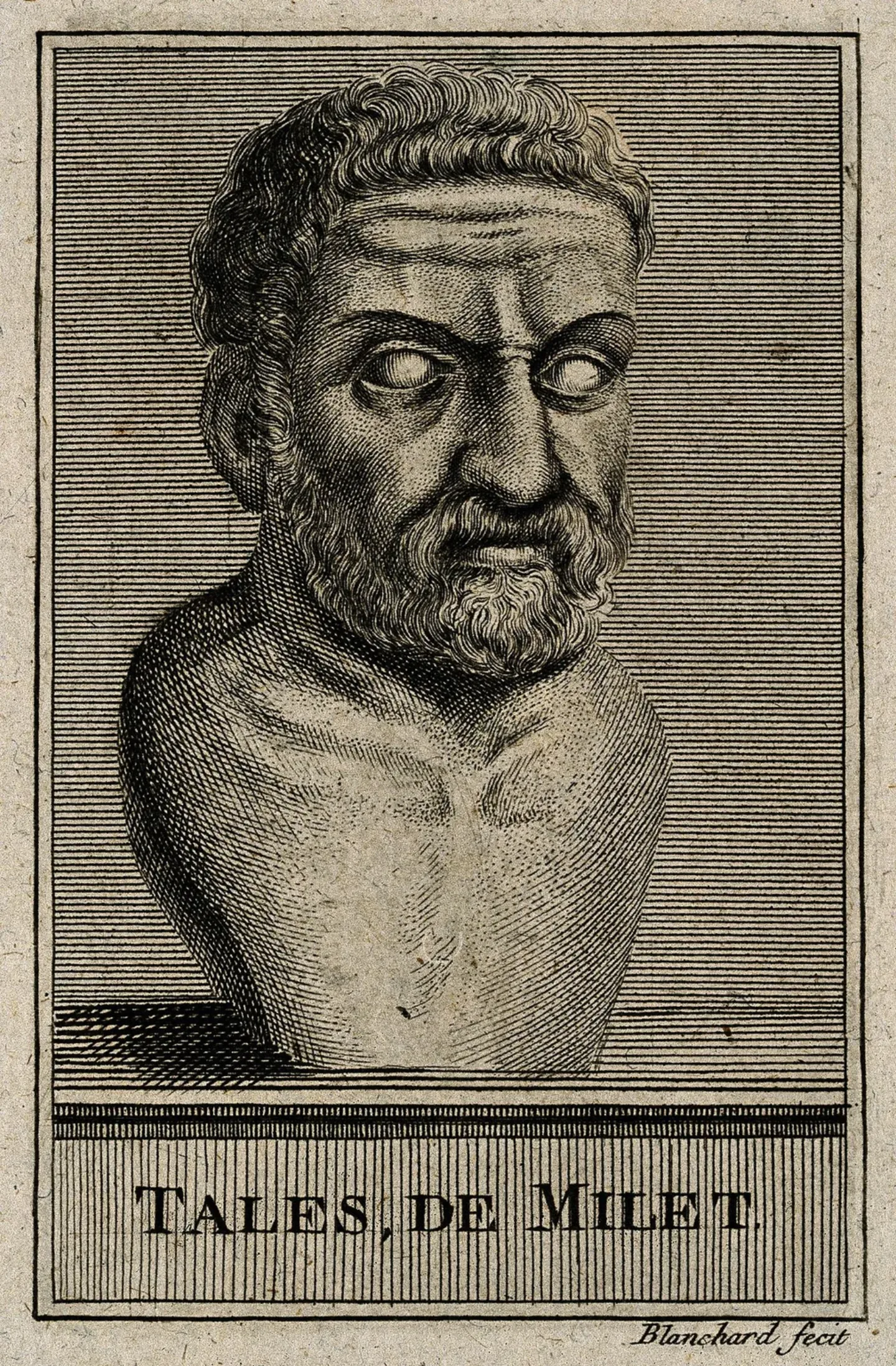
Thales: The First Philosopher
Thales of Miletus (~585 BCE) is traditionally called the first philosopher. He proposed that water is the fundamental substance of all things — but his real breakthrough was the method: instead of crediting the gods, he sought a single natural principle (an arche) behind the changing world. That shift from myth to reasoned explanation is the birth of philosophy.
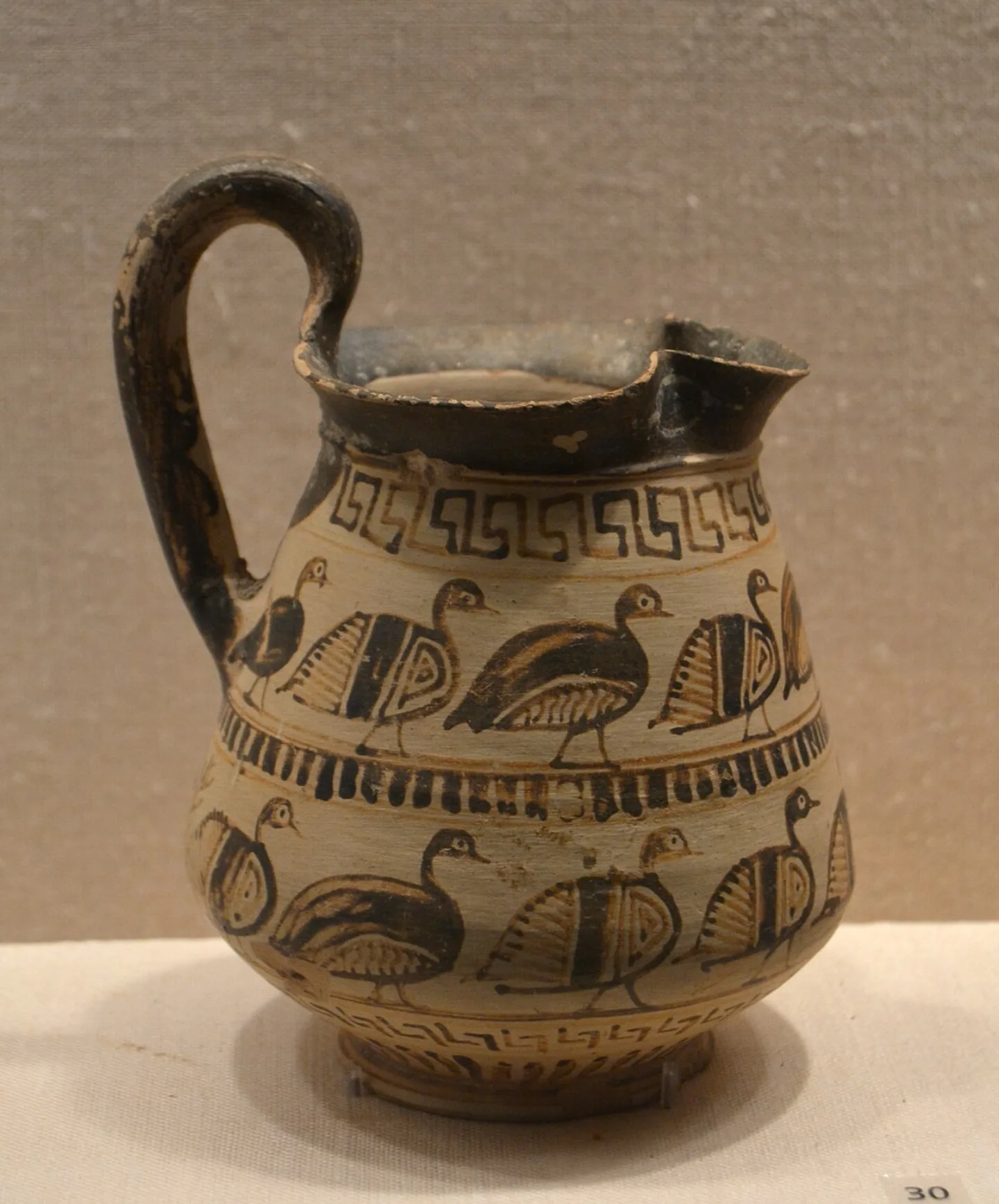
From Myth to Reason
The Pre-Socratics of Ionia (modern Turkey) launched philosophy by replacing mythological explanation with rational inquiry. They asked one electrifying question — what is everything ultimately made of? — and their competing answers (water, the boundless, number, flux, atoms) became the seedbed of both science and metaphysics. The Sophists later turned the focus from the cosmos to human life.
Parmenides: Change Is Illusion
Using pure logic, Parmenides concluded that being simply is—eternal and unchanging—so the motion and change our senses report are only illusion.
Pythagoras: Reality Is Number
Pythagoras located the hidden structure of reality in mathematics—number and proportion—a view he felt confirmed by musical harmony following whole-number ratios.
The Philosopher Who Wrote Nothing
Socrates (469–399 BCE) wrote nothing, founded no school, and charged no fees — yet he reoriented all of Western philosophy, turning its gaze from the cosmos to the soul. Everything we know of him comes filtered through his student Plato (and partly Xenophon), which makes separating the real Socrates from Plato's mouthpiece genuinely hard — the famous "Socratic problem."
"The Unexamined Life Is Not Worth Living"
At his trial (Plato's Apology), Socrates was offered his life if he would only stop philosophizing. He refused, declaring: "The unexamined life is not worth living for a human being." This was no flourish — for Socrates the daily inquiry into virtue is the substance of a human life. To live unexamined is to live as an echo of other people's assumptions.
The Trial and the Hemlock
Charged with impiety and "corrupting the youth," Socrates was tried before an Athenian jury in 399 BCE. His defense — Plato's Apology — refuses to grovel; he insists the greatest harm is not death but injustice. Condemned, he drank hemlock rather than abandon his mission, becoming philosophy's first martyr.
Wrongdoing Is Just Ignorance
Socrates held that everyone aims at what they see as good, so wrongdoing is really a mistake—ignorance of the truly good is the root of all vice.
The Elenchus: Socrates' Method
Socrates' signature method, the elenchus, is a cross-examination that probes a confident claim for contradictions until its definition collapses.
Plato Founds the Academy
Around 387 BCE, Plato (428–348 BCE) — Socrates' devoted student — founded the Academy in Athens, often called the first institution of higher learning in the Western world. It endured for centuries and trained, among others, Aristotle. Its name gives us the word academic.
Learning Is Remembering
In the Meno, Plato confronts a paradox: if you know something you needn't learn it; if you don't, you won't recognize the answer — so learning seems impossible. His solution: all learning is recollection. The immortal soul knew the Forms before birth and merely forgot them. Socrates proves it by questioning an uneducated slave boy into deriving a geometric truth he was never taught — he didn't learn it, he remembered it.
The Theory of Forms
Plato held that beyond the changing physical world lies a realm of eternal, perfect archetypes—the Forms—of which physical objects are only imperfect copies.
Plato's Case for Philosopher-Kings
Plato argued the ideal state should be ruled by philosopher-kings because only those who have seen the Form of the Good truly know justice.
Forms in Things, Not Beyond Them
Aristotle (384–322 BCE) studied under Plato for twenty years, then broke with him: he denied that Forms exist separately. The form of a horse does not float in an eternal realm — it exists in horses, inseparable from the matter that makes them. This view, hylomorphism, holds that every concrete thing is matter shaped by form, anchoring philosophy back in the observable world.
The Golden Mean
Aristotle's central ethical idea is the Golden Mean: every virtue is a mean between two extremes, one of deficiency and one of excess. Courage sits between cowardice and recklessness; generosity between stinginess and extravagance; truthfulness between self-deprecation and boastfulness. The mean is not a fixed midpoint but the response appropriate to the situation.
Virtue Is a Learned Skill
For Aristotle virtue is not innate but a skill acquired by practice, like archery or playing an instrument. A skilled archer adjusts to wind and distance rather than repeating one fixed motion; the virtuous person likewise reads each situation. As he put it: "We become just by doing just acts, courageous by doing courageous acts." Character is built by habit.
Eudaimonia Means Flourishing
Aristotle's term eudaimonia is best translated as flourishing, or living well—not a passing feeling but the activity of an entire life lived excellently.
Phronesis: Practical Wisdom
Phronesis is Aristotle's practical wisdom—the experienced judgment that reads a particular situation and discerns the right response. No rulebook can supply it.
Matched pairs
Each item on the left goes with the one on the right.
- Apeiron (Anaximander)
- The "boundless" or infinite — an indefinite first principle from which all opposites emerge
- Pythagoras
- Held that mathematics — number and proportion — is the hidden structure of reality
- "Man is the measure of all things" (Protagoras)
- The Sophist view that truth is relative — what is true or good depends on the human standpoint
- Aporia
- Productive bewilderment — the moment you realize you don't actually know what you thought you knew, the start of real inquiry
- Meno's "tangle" (the Meno)
- A confident young man's definitions of virtue all collapse under Socratic questioning, leaving him numbed "like a stingray" — and finally honest about his ignorance
- The shadows on the cave wall
- The world of mere images and rumor — what the prisoners mistake for reality
- The sun outside the cave
- The Form of the Good — ultimate reality and the source of all truth and being
- Courage (the virtue)
- The Golden Mean between the deficiency of cowardice and the excess of recklessness
- Generosity (the virtue)
- The Golden Mean between the deficiency of stinginess and the excess of extravagance
Step by step
How the Socratic elenchus works
- Invite the other person to assert a confident claim (e.g. "I know what justice is")
- Ask them to define the key term precisely
- Draw out further beliefs they already hold
- Show that those beliefs contradict the original definition
- Lead them to aporia — the recognition that they do not truly know
- Treat that admitted ignorance as the real beginning of wisdom
The prisoner's ascent in the Allegory of the Cave
- Chained from birth, the prisoner watches only shadows on the wall
- He is freed and turns to see the fire that casts the shadows
- He is dragged painfully up out of the cave into the sunlight
- His eyes adjust and he sees real objects — trees, water, animals
- At last he looks upon the sun itself, the source of all light
- He returns to free the others, who resent and reject him
Self-test
Answer each question from memory, then check your work against the answer key.
1. Parmenides, founder of the Eleatic school, argued that:
- AWater is the first principle, and all things are made from it
- BReality is unchanging, and change is an illusion
- CReality is atoms and void, and change is their rearranging
- DEverything is in constant flux, and a hidden law orders it
2. Which substance did Thales of Miletus propose as the fundamental principle (arche) of all things?
- AWater
- BFire
- CEarth
- DAir
3. Anaximander rejected water as too specific and named the apeiron as the first cause. What is the apeiron?
- AThe eternal, indivisible being in which nothing changes
- BThe rational, ordering logos that governs all change
- CThe countless, uncuttable particles that move through the void
- DThe boundless, indefinite stuff with no fixed qualities
4. For Pythagoras, the hidden structure of reality is found in:
- ASubstance — water and moisture
- BProcess — flux and hidden law
- CMathematics — number and proportion
- DMatter — atoms and the void
5. Which Pre-Socratic thinker is INCORRECTLY paired with the first principle they proposed?
- AThales of Miletus — water
- BHeraclitus — atoms and void
- CPythagoras — number and ratio
- DAnaximander — the boundless
6. Which Pre-Socratic philosopher proposed that water is the fundamental substance (arche) of all things?
- AThales
- BPythagoras
- CAnaximander
- DHeraclitus
7. Thales of Miletus is best known for identifying which substance as the arche underlying all things?
- AAtoms
- BNumber
- CWater
- DThe apeiron
8. Which Pre-Socratic thinker held that number and mathematical proportion are the hidden structure of reality?
- AParmenides
- BDemocritus
- CThales
- DPythagoras
9. Pythagoras's first principle for the structure of reality was:
- AAtoms and void
- BWater
- CThe apeiron
- DMathematics
10. According to Democritus's atomism, reality ultimately consists of:
- ANumber and proportion structuring the cosmos
- BBoundless stuff giving rise to every opposite
- CIndivisible atoms moving through empty void
- DCeaseless flux governed by a hidden logos
11. Democritus called his particles atomos. What does the term mean?
- AUnending (everlasting)
- BUncuttable (indivisible)
- CUnmoving (motionless)
- DUnseeable (invisible)
12. Protagoras's saying 'Man is the measure of all things' expresses the Sophist view that:
- ATruth is relative to the human standpoint
- BReality is ordered by a logos beneath the flux
- CVirtue is knowledge and vice is ignorance
- DChange is an illusion reported by the senses
13. How did the Sophists shift the focus of philosophy around 450 BCE?
- AFrom the gods toward the cosmos and its causes
- BFrom opinion toward knowledge and fixed definitions
- CFrom human life toward the cosmos and its elements
- DFrom the cosmos toward human life and rhetoric
14. Which statement best captures the contrast between Democritus and the Sophists?
- ADemocritus taught that change is an illusion; the Sophists held the cosmos is ordered by the logos
- BDemocritus held truth shifts with each perceiver; the Sophists sought one fixed material reality
- CDemocritus sought one objective material reality; the Sophists held truth is relative to the perceiver
- DDemocritus sought the boundless apeiron; the Sophists held number is the structure of reality
15. What did Socrates mean by "no one does wrong knowingly"?
- AKnowledge has nothing to do with virtue
- BWrongdoing always stems from ignorance of what is truly good
- COnly the gods can judge right and wrong
- DPeople are basically evil by nature
16. Socrates' signature method, the elenchus, is best described as:
- ACross-examination that probes a claim for contradictions until it collapses
- BFormal syllogism that locks a conclusion in place from a major and a minor premise
- CPrinciple of economy that prefers the explanation with the fewest assumptions
- DInductive generalization that moves from repeated observations to a probable rule
17. In Socratic inquiry, aporia is:
- APuzzlement at how little you know
- BConfidence that you can define virtue
- CTranquil freedom from all disturbance
- DRecollection of truths the soul once knew
18. In Plato's Meno, how does the young aristocrat describe the effect of Socrates' questioning?
- AIt stung him like a wasp, leaving him eager to strike back
- BIt numbed him like a stingray, leaving him in a tangle
- CIt warmed him like a hearth, leaving him settled and sure
- DIt carried him like a current, leaving him at a clear answer
19. If, as Socrates argued, virtue is a kind of knowledge, what follows?
- AVirtue can in principle be held and used in ignorance
- BVirtue can in principle be granted by divine favour
- CVirtue can in principle be passed down by birth
- DVirtue can in principle be taught and learned
20. In Plato's philosophy, the Form of the Good is compared to the sun because:
- AIt lights the cave from within, casting the Forms as shadows
- BIt is grasped by sight alone, while the other Forms need reason
- CIt makes the other Forms knowable and gives them their reality
- DIt stands below the other Forms, the first a learner grasps
21. Why did Plato argue the ideal state should be ruled by philosopher-kings?
- APhilosophers are the rulers a populace most gladly follows
- BOnly philosophers want power badly enough to rule well
- COnly those who have seen the Good truly know justice
- DPhilosophers learn true justice through long years in office
22. Plato's Theory of Forms claims that:
- APhysical things are the true realities and the Forms are mere names for their kinds
- BBeyond the changing physical world lies a realm of eternal, perfect archetypes
- CThe Forms are patterns the human mind invents and revises as the world changes
- DThe form of each thing exists only within it, inseparably bound to its matter
23. In Plato's Allegory of the Cave, what do the shadows on the wall represent?
- AMere images and rumor mistaken for reality
- BDormant knowledge the soul held before birth
- CThe physical world taken in through the senses
- DThe education that drags the soul up into the light
24. In Plato's cave allegory, whom does the returning prisoner represent?
- AThe tyrant, who seizes the city and is feared for it
- BThe slave boy, who derives a proof and is remembered for it
- CThe sophist, who teaches persuasion and is paid for it
- DThe philosopher, who has seen the truth and is resented for it
25. Aristotle's term eudaimonia is best translated as:
- APleasure, or feeling good
- BSerenity, or being untroubled
- CDuty, or following the rules
- DFlourishing, or living well
26. According to Aristotle's Golden Mean, every virtue is:
- AA trait settled at birth, one part temperament and one part luck
- BA mean between two extremes, one of deficiency and one of excess
- CA rule laid down in advance, one for each kind of situation
- DAn arithmetic midpoint between two faults, the same for every person
27. On Aristotle's account, courage is the mean between which two extremes?
- ACowardice (deficiency) and recklessness (excess)
- BSelf-deprecation (deficiency) and boastfulness (excess)
- CStinginess (deficiency) and extravagance (excess)
- DSelf-deprecation (deficiency) and recklessness (excess)
28. What is phronesis in Aristotle's ethics?
- AMoral law — a written code from which the right action can be read off
- BTheoretical knowledge — contemplation of the eternal Forms beyond the senses
- CPractical wisdom — judgment that discerns the right response in a situation
- DNatural talent — an inborn feel for the mean that comes with one's temperament
29. On Aristotle's Golden Mean, which extreme is the EXCESS that flanks generosity?
- AStinginess
- BBoastfulness
- CRecklessness
- DExtravagance
Go deeper
- WatchWhy Socrates Asked Questions Socrates wrote nothing. He taught by asking questions.
- WatchPlato's Cave Plato imagined prisoners chained in a cave since birth. All they see are shadows on a wall.
- WatchWhat Is Everything Made Of? Before Socrates, thinkers on the Ionian coast asked one question: what is everything made of?
- WatchCourage Sits in the Middle Aristotle studied under Plato for 20 years. Then he turned to the world in front of him.
- StudyPhilosophy: The Big Questions in the FlashFeed app
Answer key
- 1. B Reality is unchanging, and change is an illusionUsing pure logic, Parmenides concluded that being simply is — eternal and unchanging — so motion and change reported by the senses are illusion. Water was Thales' principle, flux under a hidden law was Heraclitus', and atoms rearranging in the void were Democritus'.
- 2. A WaterThales claimed water is the fundamental substance — though his real breakthrough was seeking a single natural arche instead of crediting the gods.
- 3. D The boundless, indefinite stuff with no fixed qualitiesThe apeiron is the 'boundless' or infinite — an indefinite first principle with no fixed qualities, out of which all opposites (hot/cold, wet/dry) emerge. The eternal, unchanging being is Parmenides; the logos governing change is Heraclitus; uncuttable particles in the void are Democritus.
- 4. C Mathematics — number and proportionPythagoras located reality in number and proportion, a view he felt confirmed by the discovery that musical harmony follows whole-number ratios.
- 5. B Heraclitus — atoms and voidHeraclitus taught constant change governed by the logos, not atoms — atoms and void was Democritus's doctrine.
- 6. A ThalesThales of Miletus proposed water as the arche, the single natural principle underlying the changing world.
- 7. C WaterThales's arche was water, distinguishing him from Anaximander's apeiron and Democritus's atoms.
- 8. D PythagorasPythagoras located reality in mathematics, holding that number and proportion structure the cosmos.
- 9. D MathematicsPythagoras held that mathematics, not a physical substance, is the hidden structure of the cosmos.
- 10. C Indivisible atoms moving through empty voidDemocritus held reality is atoms and void — countless indivisible particles moving through empty space, with all change just their rearrangement. Boundless stuff yielding opposites is Anaximander's apeiron; flux under a logos is Heraclitus; number structuring the cosmos is Pythagoras.
- 11. B Uncuttable (indivisible)Atomos means 'uncuttable' — the particles are the indivisible smallest units of matter, anticipating modern atomic theory by two thousand years.
- 12. A Truth is relative to the human standpointThe Sophists argued truth is relative — what is true or good depends on the perceiver's standpoint, not on a fixed cosmic order. That change is illusory is Parmenides; a logos ordering the flux is Heraclitus; virtue as teachable knowledge is Socrates' thesis.
- 13. D From the cosmos toward human life and rhetoricThe Sophists were professional teachers of rhetoric who turned philosophy from 'what is the world made of?' toward human affairs, truth, and persuasion.
- 14. C Democritus sought one objective material reality; the Sophists held truth is relative to the perceiverAtomism is a materialist account of an objective reality (atoms and void), whereas the Sophists' relativism makes truth depend on the human standpoint.
- 15. B Wrongdoing always stems from ignorance of what is truly goodSocrates held that everyone aims at the good as they see it, so wrongdoing is really a mistake — ignorance is the root of all vice, and virtue is a kind of knowledge.
- 16. A Cross-examination that probes a claim for contradictions until it collapsesThe elenchus draws out a confident claim, then probes it for contradictions until the definition collapses. Socrates wrote nothing and claimed no doctrine of his own; he only asked. The syllogism is Aristotle's deductive form.
- 17. A Puzzlement at how little you knowAporia is productive bewilderment — the goal of the elenchus. Acknowledged ignorance is the first step toward wisdom; a man who doesn't know he's lost cannot look for the way.
- 18. B It numbed him like a stingray, leaving him in a tangleAfter his confident definitions of virtue collapse, Meno complains Socrates numbed him 'like a stingray' — which Socrates counts as progress toward honest ignorance.
- 19. D Virtue can in principle be taught and learnedSince wrongdoing springs from ignorance of the good, virtue is a kind of knowledge — and knowledge, unlike an inborn trait, can in principle be taught and learned.
- 20. C It makes the other Forms knowable and gives them their realityJust as sunlight makes things visible and lets them grow, the Form of the Good — the highest reality — makes the other Forms knowable and is the source of all truth and being. It is grasped by reason rather than sight, and grasped last: the summit of philosophical education.
- 21. C Only those who have seen the Good truly know justiceHaving seen the Form of the Good, philosopher-kings know true justice; Plato adds they must rule reluctantly, since the wise prefer contemplation to power — and the populace, like the cave prisoners, resists the very people who could free them.
- 22. B Beyond the changing physical world lies a realm of eternal, perfect archetypesFor Plato the Forms are eternal, perfect, immaterial archetypes; physical objects are only imperfect copies that 'participate' in them, and true knowledge is knowledge of the Forms.
- 23. A Mere images and rumor mistaken for realityThe shadows are images and rumor — what the chained prisoners mistake for reality. The cave interior is the sensory world; the outside world is the realm of Forms.
- 24. D The philosopher, who has seen the truth and is resented for itThe returning prisoner is the philosopher (Socrates): he has seen the truth outside the cave and comes back to free the others, who mock and resent him and would kill him. The slave boy belongs to the Meno's recollection argument, not the cave.
- 25. D Flourishing, or living wellEudaimonia is the goal of human life — flourishing or living well. It is not a passing feeling but the activity of a whole life lived excellently.
- 26. B A mean between two extremes, one of deficiency and one of excessFor Aristotle each virtue is a mean between a deficiency and an excess — courage between cowardice and recklessness. The mean is not a rigid midpoint or a rule fixed in advance, and virtue is not inborn: it is the appropriate response for the situation, learned by practice.
- 27. A Cowardice (deficiency) and recklessness (excess)Courage sits between the deficiency of cowardice and the excess of recklessness. Stinginess/extravagance is the mean for generosity; self-deprecation/boastfulness for truthfulness.
- 28. C Practical wisdom — judgment that discerns the right response in a situationPhronesis is practical wisdom: the experienced judgment that reads a particular situation and discerns the right response. No rulebook can supply it, and it is not an inborn knack — like the rest of virtue it is built by practice.
- 29. D ExtravaganceGenerosity is the mean between stinginess (its deficiency) and extravagance (its excess). Recklessness is the excess flanking courage, and boastfulness the excess flanking truthfulness.
Sources
- Philosophy: A Comprehensive Study Guide
Image credits
- Thales: The First Philosopher: Wikimedia Commons · Blanchard — commons.wikimedia.org/wiki/File:Thales_of_Miletus._Line_engraving_by_Blanchard._Wellcome_V0005771.jpg
- From Myth to Reason: Wikimedia Commons · Marcus Cyron · CC BY-SA 4.0 — commons.wikimedia.org/wiki/File:Anatolian_Trefoil_Oinochoe_MFA_1971.207.JPG
- Wrongdoing Is Just Ignorance: Wikimedia Commons · Krishnavelip · CC BY 4.0 — commons.wikimedia.org/wiki/File:Giving_Light_To_World.jpg


