
Philosophy: The Big Questions study guide · Lesson 3 of 15
Hellenistic & Roman Philosophy
Stoicism · Epicureans & Skeptics · The Good Life
This is the lesson's study guide from the FlashFeed app, plus its key facts and a self-test.
What you'll be able to do
- Apply the Stoic Dichotomy of Control and identify Epictetus and Marcus Aurelius
- Explain Stoic ideals: virtue as the only good, living by nature, premeditatio malorum
- Explain Epicurean pleasure as ataraxia and aponia reached through simple living
- Explain how Pyrrho's Skepticism uses epoché to suspend judgment and reach ataraxia
- Compare the Stoic, Epicurean, and Skeptic routes to the shared goal of tranquility
Stoicism is the most influential of the Hellenistic schools, and the one that has aged best — its core ideas now circulate as self-help, therapy, and leadership advice. At its heart is a single, bracing claim: almost nothing is truly within your control, and learning exactly where that line falls is the work of a lifetime.
Founded on a Painted Porch
Stoicism began around 300 BCE when Zeno of Citium, a merchant turned philosopher, started teaching on a public colonnade in Athens called the Stoa Poikile — the "Painted Porch," decorated with battle murals. His followers were nicknamed "the people of the porch," and the school kept the name: Stoicism. Zeno taught that a single rational principle, the logos, orders the entire cosmos, and that wisdom means bringing one's own life into agreement with that order. The school ran for centuries, evolving from Greek logicians into Roman moralists.
Some Things Are Up to Us
The practical engine of Stoicism is what modern writers call the dichotomy of control. Its source is the opening line of Epictetus's Enchiridion: "Some things are within our power, while others are not." Within our power are our opinions, desires, and aversions — in short, our judgments. Not within our power are the body, property, reputation, and office. The Stoics did not claim that externals are worthless; a delay, a diagnosis, or an insult genuinely affects us. Their claim is sharper: your judgment about the event, and your response to it, remain yours even when nothing else does. Misery comes from staking your peace on what you cannot command.
Epictetus: From Slave to Sage
Epictetus (c. 55–135 CE) gave Stoicism its most quotable voice. Born a slave in Asia Minor, he studied philosophy in bondage and taught freely once emancipated. He wrote nothing himself; his pupil Arrian recorded the Discourses and the compact Enchiridion ("handbook"). A famous anecdote captures his teaching: when his master twisted his leg, Epictetus warned calmly, "You are going to break it." When it broke, he simply said, "Did I not tell you?" The story dramatizes the dichotomy — the leg is external, the composure is his.
The Emperor's Private Journal
Marcus Aurelius (121–180 CE) shows Stoicism at the opposite end of fortune. As Roman emperor he commanded armies, governed an empire, and endured plague and war. His Meditations are private notes to himself, never meant for readers, returning again and again to the dichotomy: if you are distressed by something external, he writes, the pain comes not from the thing itself but from your judgment of it, and you can revoke that judgment at any moment (Meditations 8.47). That a man with nearly limitless external power located the real power within is the lesson the book keeps teaching.
Two further ideas complete the picture. The Stoics held that virtue is the only true good: health, wealth, and reputation are merely "preferred indifferents," nice to have but not the point. And they prescribed practices, above all the premeditatio malorum — calmly rehearsing loss in advance so misfortune, when it arrives, finds a prepared mind. To be "stoic" was never to feel nothing; it was to refuse to be ruled by reactions to things outside one's control.
If Stoicism is the most famous Hellenistic school, Epicureanism is the most misunderstood, and Skepticism the most surprising. Both, like the Stoics, asked "How should I live?" — and both answered with a recipe for a quiet mind, reached by very different roads.
Epicurus and the Garden
Epicurus (341–270 BCE) taught in a private garden outside Athens, a community known simply as "the Garden" and open — unusually for its time — to women and enslaved people. He held that pleasure is the highest good. But he defined pleasure not as indulgence but as ataraxia (freedom from mental disturbance) and aponia (freedom from bodily pain). The Garden's actual life was austere: bread and water, philosophy, and above all friendship, which Epicurus called the greatest of all the means to a happy life. He argued that chasing wealth, fame, and power generates anxiety, because such things can never be finally secured.
"Death Is Nothing to Us"
Epicurus saw the fear of death as a chief source of human misery, so he set out to argue it away. His reasoning: "Death is nothing to us, since when we are, death has not come, and when death has come, we are not." Harm requires a subject who can be harmed; but in death there is no subject left to suffer. Therefore death, properly understood, is not an evil to be dreaded. Dissolving that dread — along with fear of the gods — was, for Epicurus, a precondition of a tranquil life, not an afterthought. This is why his ethics begins in physics: studying nature frees us from superstitious fear.
It is worth correcting the caricature directly. The word "epicurean" today suggests a connoisseur of luxury, and Epicurus is often imagined as a hedonist urging us to feast and indulge. The opposite is true: he prized radical simplicity precisely because extravagant desires breed the anxiety that destroys peace of mind. "Send me a pot of cheese," he once wrote, "that when I like I may have a feast." That was his idea of a feast.
Pyrrho and the Power of Doubt
Hellenistic Skepticism was founded by Pyrrho of Elis (c. 360–270 BCE), who is said to have traveled east with Alexander's army as far as India. He returned convinced that for any claim, an equally strong opposing claim can be found — so certainty is simply unavailable to us. His radical response was epoché: the deliberate suspension of judgment, neither affirming nor denying when the evidence on both sides appears balanced.
The unexpected payoff is what links the Skeptics to their rivals. Pyrrho noticed that once he stopped straining to decide which view was true, the anxiety of the question fell away with it. Suspending judgment produced ataraxia — the same serene calm the Epicureans sought, reached not by simplifying desire but by letting go of the demand for certainty. The Skeptic's peace is the peace of no longer needing to be right. Three schools, then, and three routes — but a shared destination: a mind at rest.
The three great Hellenistic schools — Stoic, Epicurean, Skeptic — are easy to keep straight once you see them as rival answers to one shared question. This part draws that thread, lining up their prescriptions side by side so the agreements and the disagreements both stand out.
Philosophy Asks: How Should I Live?
When Alexander the Great conquered his way across the known world, he dissolved the small, self-governing Greek city-states into a vast, cosmopolitan, Greek-speaking empire. A citizen of tiny Athens had known exactly how to live; a subject of a sprawling kingdom did not. Philosophy's center of gravity shifted accordingly. The Pre-Socratics had asked "What is real?"; the Hellenistic thinkers asked "How should I live?" The change was deeply practical — ethics, not metaphysics, became the headline question, and a school was judged by the kind of life it produced.
Philosophy as Therapy
Crucially, all three schools treated philosophy as therapy for the soul — a regimen of daily exercises, not a body of doctrine to admire from a distance. The Stoic rose at dawn and rehearsed the day's possible misfortunes (premeditatio malorum). The Epicurean repeated memorized arguments to keep the fear of death dissolved. The Skeptic trained the reflex of withholding assent. In every case the test was the same: did the practice quiet the mind? The ancient image is medical — philosophy as the physician of the passions, and a good argument as a kind of cure.
Their prescriptions diverge sharply, and naming the difference is the heart of this part. The Stoic route is to master your judgments: want only what is genuinely up to you, accept everything else, and treat virtue as the sole true good. The Epicurean route is to simplify your desires: shrink your wants down to what is natural and easily met — modest food, friendship, the study of nature — so that anxiety has nothing to feed on. The Skeptic route is to suspend your judgment: stop chasing certainties you can never catch, and watch the worry leave with them. One school disciplines the will, one trims desire, one releases the grip on belief.
What unites them is the goal. Each aims at a tranquil, untroubled mind — the Greeks called the prize ataraxia, and even the Stoics, who put virtue first, expected serenity to follow. None of them located happiness in wealth, fame, or power; all three regarded those as anxious distractions.
Eudaimonia, Reframed
Behind all of this sits the master concept of ancient ethics: eudaimonia, usually translated "flourishing" or "a life well lived." Aristotle had made it the goal of the good life, and the Hellenistic schools inherited the word — but each redefined it through its own path to peace. So when people say the Stoics, Epicureans, and Skeptics "agreed," that is only half right: they agreed on the destination, a flourishing and peaceful life, while disagreeing almost entirely on the road. That single distinction — shared end, rival means — is the cleanest way to hold the whole Hellenistic landscape in mind.
Key terms
- Dichotomy of Control
- The Stoic division of life into what is "up to us" (our judgments and choices) and what is not (everything external) — so we invest only where we have power.
- Premeditatio malorum
- The Stoic exercise of deliberately imagining loss or misfortune in advance — not to wallow, but to prepare the mind so adversity, when it comes, finds you ready.
- Ataraxia
- A state of serene calm and freedom from mental disturbance — the highest pleasure for the Epicureans (and, by a different route, the goal of the Skeptics).
- Epoché
- The deliberate suspension of judgment — neither affirming nor denying a claim when the evidence on each side seems equally balanced.
- Eudaimonia
- Greek for human flourishing or a life well lived — the shared target of ancient ethics, which each Hellenistic school redefined in terms of its own path to a peaceful mind.
Key concepts
Epictetus
- Born a slave in Asia Minor, he studied philosophy in bondage and taught freely once emancipated.
- He gave Stoicism its most quotable voice, though he wrote nothing himself; his pupil Arrian recorded the Discourses and the Enchiridion.
- A famous anecdote: when his master twisted and broke his leg, he said only, 'Did I not tell you?'
Marcus Aurelius
- This Stoic shows philosophy at the summit of worldly fortune rather than the bottom.
- A Roman emperor who commanded armies and endured plague and war, he kept private notes never meant for readers.
- Those notes, the Meditations, keep returning to one lesson: what disturbs us is our judgment of events, not the events themselves.
Pyrrho of Elis
- Said to have traveled east with Alexander's army as far as India, he came home with a radical doubt.
- He founded Hellenistic Skepticism, convinced that for any claim an equally strong opposing claim can be found.
- His remedy was epoché, the deliberate suspension of judgment, which unexpectedly produced the same serene calm the Epicureans sought.
Key facts
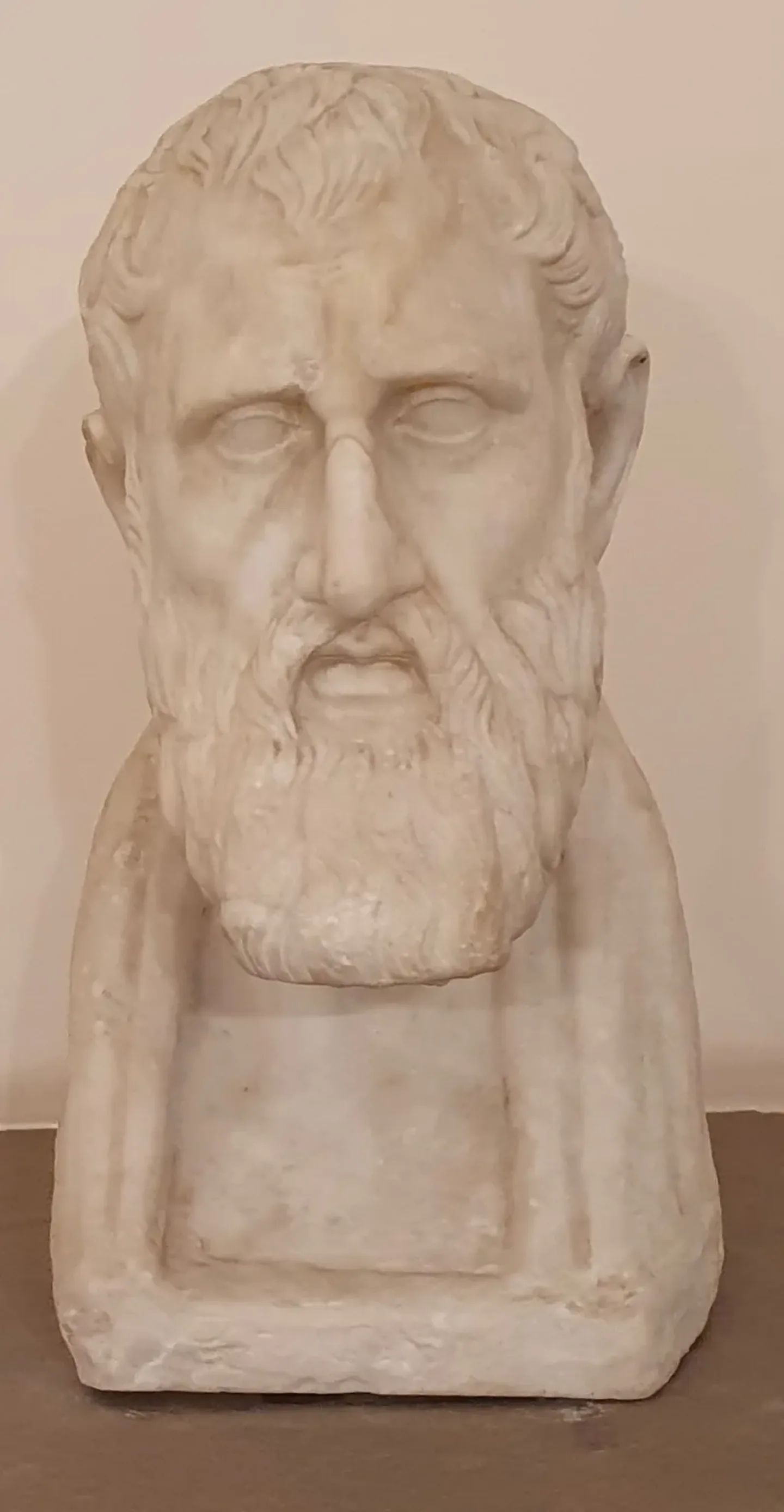
Founded on a Painted Porch
Around 300 BCE, Zeno of Citium began teaching in Athens on a public colonnade called the Stoa Poikile — the "Painted Porch." The school took its name from the spot: Stoicism. Zeno taught that the universe is ordered by a rational principle, the logos, and that the good life means living in harmony with it.
Some Things Are Up to Us
The engine of Stoic practice is what modern writers call the dichotomy of control. "Some things are within our power, while others are not," wrote Epictetus. Up to us: our opinions, desires, and aversions — our judgments. Not up to us: our body, our property, our reputation. The Stoics never said externals don't matter; they said your response to them is always your own.
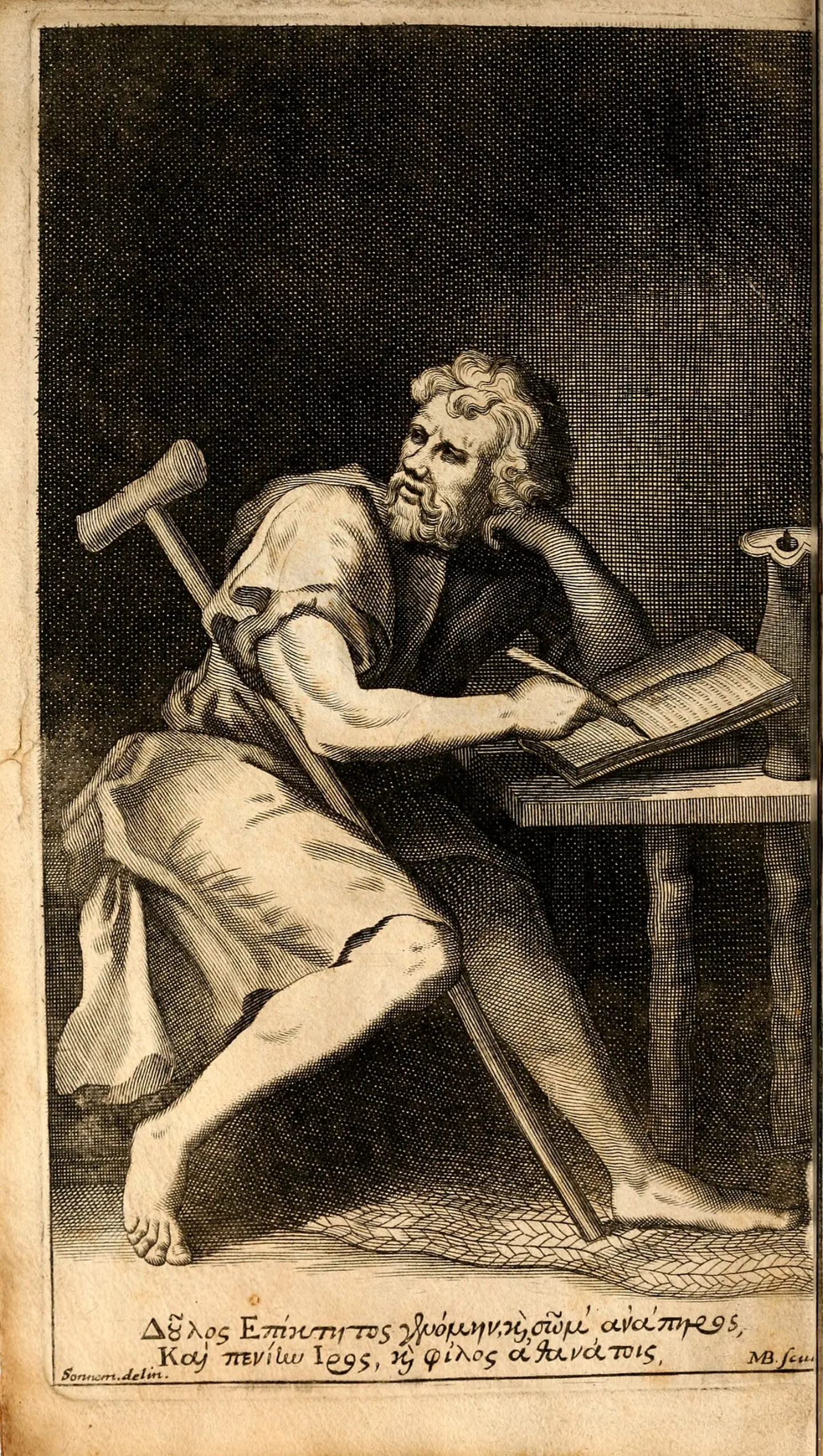
Epictetus: From Slave to Sage
Epictetus (c. 55–135 CE) was born a slave and taught philosophy after gaining his freedom. His handbook, the Enchiridion, is Stoicism distilled. Legend holds that when his master once twisted his leg, Epictetus said calmly, "You are going to break it." When it broke, he replied, "Did I not tell you?" — a story dramatizing his point that pain is external, composure is not.
What's Not Up to Us
The Stoics classed reputation as external, alongside body and property—only our own judgments, desires, and aversions are truly within our power.
Epicurus and the Garden
Epicurus (341–270 BCE) taught in a private garden outside Athens — open, unusually, to women and slaves. He held that the highest good is pleasure, but defined it as the absence of pain and anxiety, not indulgence. The Garden's life was strikingly modest: simple food, philosophy, and the company of friends, which Epicurus called the greatest aid to a happy life.
"Death Is Nothing to Us"
Much of human misery, Epicurus argued, comes from the fear of death — so he tried to argue it away. "Death is nothing to us, since when we are, death has not come, and when death has come, we are not." Where there is no subject left to suffer, he reasoned, there is no harm. Removing that dread was, for Epicurus, a first step toward a tranquil life.

Pyrrho and the Power of Doubt
Pyrrho of Elis (c. 360–270 BCE) founded Greek Skepticism. Having traveled with Alexander's army as far as India, he returned convinced that for every claim a counter-claim can be found, so certainty is out of reach. His radical response: suspend judgment entirely. The Skeptics found that this very refusal to dogmatically assert brought an unexpected peace.

Ataraxia: Freedom From Disturbance
In Epicurean thought, ataraxia is the mental half of pleasure—a serene calm and freedom from mental disturbance, distinct from aponia's freedom from bodily pain.
Friendship: Epicurus's Greatest Good
Epicurus prized friendship above all else as the greatest of all the means to a happy life, arguing that chasing wealth, fame, and power only breeds anxiety.
Philosophy Asks: How Should I Live?
After Alexander the Great shattered the old city-states into a sprawling, cosmopolitan world, philosophy's central question shifted. The Pre-Socratics had asked "What is real?"; the Hellenistic schools asked "How should I live?" Stoics, Epicureans, and Skeptics differed sharply on the answer — but all treated philosophy as a cure for a troubled mind.
Philosophy as Therapy
The Hellenistic schools saw philosophy less as abstract theory than as therapy for the soul — a set of daily exercises for living well. Stoics rehearsed misfortune at dawn; Epicureans repeated arguments to dissolve the fear of death; Skeptics trained themselves to withhold assent. The aim was practical: a mind no longer at war with the world.
The Stoic Route: Master Judgment
The Stoic path to a tranquil mind is to master your judgments—disciplining the will to want only what is actually up to you.
The Epicurean Route: Simplify Desire
The Epicurean path to peace is to simplify your desires—trimming wants down to what's natural and easily met, so anxiety has nothing left to feed on.
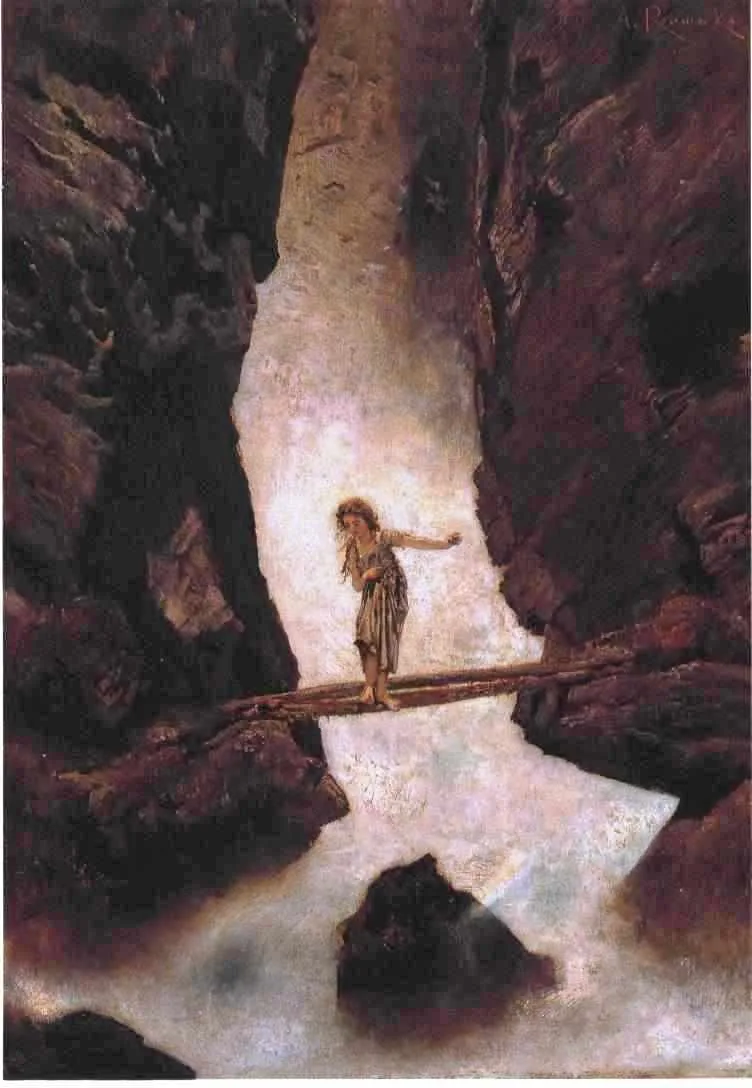
The Skeptic Route: Suspend Judgment
The Skeptic path to peace is epoché—suspending judgment on which of two competing views is correct, so the anxious need for certainty simply falls away.
Matched pairs
Each item on the left goes with the one on the right.
- Stoic view of virtue
- Virtue is the only true good; health, wealth, and reputation are merely "preferred indifferents."
- Living "according to nature"
- Living in agreement with reason and the rational order of the cosmos (the logos), accepting what cannot be changed.
- Aponia (Epicurus)
- Freedom from bodily pain — the physical half of Epicurean pleasure, paired with ataraxia, the mental half.
- Skeptic path to tranquility
- By suspending judgment (epoché), the Skeptic stops worrying about which view is true and so arrives at ataraxia — calm.
- The Stoic route to peace
- Master your judgments: want only what is up to you, accept the rest, and pursue virtue as the only true good.
- The Epicurean route to peace
- Simplify your desires: seek freedom from pain and anxiety through modest living, friendship, and the study of nature.
- The Skeptic route to peace
- Suspend your judgments: stop straining after certainties you cannot reach, and let the worry fall away with them.
Self-test
Answer each question from memory, then check your work against the answer key.
1. In Epictetus's teaching, which of these is "up to us"?
- AOur standing in others' eyes
- BOur own judgments and desires
- COur office and our public rank
- DOur body and our possessions
2. According to the Dichotomy of Control, which of these is NOT within our power?
- AOur composure
- BOur judgments
- COur reputation
- DOur responses
3. Which Stoic was born a slave and taught philosophy only after gaining his freedom?
- AMarcus Aurelius
- BPyrrho of Elis
- CZeno of Citium
- DEpictetus
4. Whose private journal, the Meditations, records Stoic reminders written while ruling as Roman emperor?
- AMarcus Aurelius
- BZeno of Citium
- CEpictetus
- DPyrrho of Elis
5. Applying the Dichotomy of Control, on which of these should a Stoic rest their peace of mind?
- AThe outcome of their projects
- BTheir health staying good
- CTheir own judgments about events
- DWhether others respect them
6. In Stoic ethics, what is held to be the only true good?
- ATranquility
- BVirtue
- CPleasure
- DReputation
7. How did the Stoics classify health, wealth, and reputation?
- APreferred indifferents
- BUnavoidable evils
- CIncomplete virtues
- DInstrumental goods
8. What does the Stoic exercise premeditatio malorum involve?
- APrivately writing reminders to oneself to discipline the mind
- BSorting events by what lies in one's power to steady the mind
- CCalmly enduring pain as it happens to prove the mind is free
- DDeliberately imagining loss in advance to prepare the mind
9. For the Stoics, living 'according to nature' means living in agreement with what?
- AComfort and the body's freedom from every pain (aponia)
- BPleasure and the calm of an untroubled mind (ataraxia)
- CDoubt and the suspension of every judgment (epoché)
- DReason and the rational order of the cosmos (logos)
10. Which of the following is NOT a Stoic ideal?
- ARehearsing misfortune in advance
- BMaking pleasure the highest good
- CTreating health as a preferred indifferent
- DLiving in agreement with the logos
11. What did Epicurus mean by "pleasure" as the highest good?
- ACalm agreement with the cosmic order, reached by accepting fate
- BFreedom from the strain of deciding, reached by suspending judgment
- CFreedom from pain and anxiety, reached through simple living
- DLasting security of body and fortune, reached through wealth and fame
12. In Epicurean thought, ataraxia refers to what?
- AFreedom from mental disturbance, a serene calm
- BThe suspension of judgment, a refusal to decide
- CIntense pleasure of the senses, a lavish feast
- DFreedom from bodily pain, a body at ease
13. What did Epicurus mean by aponia?
- AFreedom from craving wealth
- BFreedom from fear of death
- CFreedom from mental unrest
- DFreedom from bodily pain
14. Epicurus called which of these the greatest of all the means to a happy life?
- AFriendship
- BSimplicity
- CPhilosophy
- DTranquility
15. The daily life of Epicurus's Garden was actually characterized by what?
- ALavish banquets and fine wine
- BModest food, philosophy, and friendship
- CComplete ascetic silence
- DPolitical campaigning
16. Who founded Hellenistic Skepticism?
- AZeno of Citium
- BSocrates
- CPyrrho of Elis
- DEpicurus
17. What is epoché?
- AThe deliberate suspension of judgment
- BThe deliberate simplification of desire
- CThe deliberate rehearsal of misfortune
- DThe deliberate alignment with the cosmic order
18. What convinced Pyrrho that certainty is unavailable to us?
- AFor any perception, the senses that deliver it can be shown to distort it
- BFor any claim, an equally strong opposing claim can be found
- CFor any question, the evidence that would settle it lies beyond human reach
- DFor any argument, its premises call for a further argument in turn
19. According to the Skeptics, what unexpectedly followed from suspending judgment?
- ALogos — the rational order of the cosmos
- BAponia — freedom from bodily pain
- CPhronesis — practical, situational wisdom
- DAtaraxia — a serene, untroubled calm
20. How does the Skeptic reach tranquility differently from the Epicurean?
- ABy mastering judgments rather than desires
- BBy rehearsing misfortune each morning
- CBy letting go of the demand for certainty, not by simplifying desire
- DBy pursuing virtue as the only true good
21. What goal did the Stoics, Epicureans, and Skeptics largely share, despite their disagreements?
- AA pious, god-fearing life
- BA just, well-governed city
- CA firm, unshakable certainty
- DA tranquil, untroubled mind
22. Which phrase best captures the Stoic route to a tranquil mind?
- ASimplify your desires
- BMaster your judgments
- CDissolve your fear of death
- DSuspend your judgments
23. The Epicurean route to peace is best summed up as which of these?
- ASimplify your desires
- BMaster your judgments
- CSuspend your judgments
- DRehearse your misfortunes
24. A friend keeps himself anxious by straining to prove which of two competing views is correct. Which school's route is designed to dissolve exactly that anxiety?
- AThe Sophists
- BThe Epicureans
- CThe Skeptics
- DThe Stoics
25. What master concept of ancient ethics, meaning 'flourishing,' did each Hellenistic school redefine?
- AEpoché
- BEudaimonia
- CPhronesis
- DAtaraxia
26. Among the three Hellenistic routes to tranquility, which one calls for mastering your own judgments and prizing virtue as the sole good?
- AThe Stoic route
- BThe Epicurean route
- CThe Skeptic route
- DThe Cynic route
27. The Stoic path to peace is best described as which of these?
- ASimplify desires to modest, natural wants
- BWithdraw entirely from public life
- CMaster judgments; virtue is the only good
- DSuspend judgment on contested claims
28. Which Hellenistic route reaches tranquility by shrinking desires down to what is natural and easily satisfied?
- AThe Stoic route
- BThe Aristotelian route
- CThe Skeptic route
- DThe Epicurean route
29. The Epicurean path to peace works mainly by doing what?
- ASuspend judgment between rival claims
- BMaster judgments about what's up to us
- CRehearse misfortune each morning
- DSimplify desire to modest, natural wants
30. Which route to tranquility works by suspending judgment rather than mastering desire or will?
- AThe Epicurean route
- BThe Stoic route
- CThe Skeptic route
- DThe Cyrenaic route
Go deeper
- WatchThe People of the Porch Stoicism began around 300 BCE, on a painted porch in Athens. The school took its name from that porch, the Stoa.
- WatchTwo Roads to a Quiet Mind Epicurus said pleasure is the highest good. But he meant a calm mind and no pain, not luxury.
- WatchPhilosophy as Therapy Alexander the Great's conquests dissolved the small Greek city-states into a vast empire.
- StudyPhilosophy: The Big Questions in the FlashFeed app
Answer key
- 1. B Our own judgments and desiresOnly our own judgments, desires, and aversions are truly within our power. Body, property, reputation, and office are external.
- 2. C Our reputationThe Stoics classed reputation as external, with the body, property and office. Our judgments, and the responses and composure that follow from them, remain ours — the leg was external, the composure was Epictetus's own.
- 3. D EpictetusEpictetus (c. 55-135 CE) was born a slave in Asia Minor. Marcus Aurelius was an emperor; Zeno founded Stoicism; Pyrrho founded Skepticism.
- 4. A Marcus AureliusMarcus Aurelius (121-180 CE) wrote the Meditations as private notes to himself. Epictetus wrote nothing; his pupil recorded his words.
- 5. C Their own judgments about eventsOnly judgments are up to us. Reputation, health, and outcomes are external; staking your peace on them invites misery.
- 6. B VirtueThe Stoics held virtue to be the sole true good. Reputation, like health and wealth, is a 'preferred indifferent'; pleasure as the highest good is the Epicurean claim; and tranquility is the destination all three schools share, not the Stoic good itself.
- 7. A Preferred indifferentsThese are 'preferred indifferents' — nice to have but not the point. Only virtue is the true good.
- 8. D Deliberately imagining loss in advance to prepare the mindPremeditatio malorum means calmly rehearsing misfortune ahead of time so adversity finds a prepared mind. The other options describe other Stoic material: the Dichotomy of Control, Epictetus's composure as his leg was broken, and Marcus Aurelius's private notes.
- 9. D Reason and the rational order of the cosmos (logos)Zeno taught that a single rational principle, the logos, orders the cosmos, and that wisdom means bringing one's own life into agreement with that order. Ataraxia and aponia are the Epicurean goals; epoché is the Skeptic's suspension of judgment.
- 10. B Making pleasure the highest goodPleasure as the highest good is the Epicurean claim, not the Stoic one. Agreement with the logos, health as a preferred indifferent, and rehearsing misfortune in advance are all Stoic.
- 11. C Freedom from pain and anxiety, reached through simple livingEpicurean pleasure is ataraxia and aponia — tranquility and absence of pain — reached through modest desires, not indulgence. Suspending judgment is the Skeptic's road to calm, accepting fate the Stoic's; wealth and fame, Epicurus held, breed anxiety, being never secure.
- 12. A Freedom from mental disturbance, a serene calmAtaraxia is the mental half of Epicurean pleasure — serene calm. Freedom from bodily pain is aponia; suspension of judgment is the Skeptic's epoché; the lavish feast is only the modern caricature of Epicurean pleasure.
- 13. D Freedom from bodily painAponia is the physical half of Epicurean pleasure — freedom from bodily pain — paired with ataraxia, the mental half. Freedom from the fear of death and from craving wealth are Epicurean aims too, but not what this word names.
- 14. A FriendshipEpicurus prized friendship above all as a means to happiness. Simple living and philosophy were the Garden's daily means too, but friendship ranked first; tranquility (ataraxia) was the goal itself, not a means to it.
- 15. B Modest food, philosophy, and friendshipDespite the modern 'epicurean' caricature of luxury, the Garden lived austerely on bread and water, philosophy, and friendship — extravagant desires breed anxiety.
- 16. C Pyrrho of ElisPyrrho of Elis (c. 360-270 BCE) founded Greek Skepticism. Epicurus founded the Garden, Zeno founded Stoicism, and Socrates, for all his acknowledged ignorance, founded no school at all.
- 17. A The deliberate suspension of judgmentEpoché is suspending judgment — neither affirming nor denying when evidence on both sides seems balanced. The others are Stoic and Epicurean ideas.
- 18. B For any claim, an equally strong opposing claim can be foundPyrrho held that any claim can be met by an equally strong counter-claim, so certainty is out of reach — hence the response of suspending judgment.
- 19. D Ataraxia — a serene, untroubled calmOnce Pyrrho stopped straining to decide which view was true, the anxiety fell away, producing ataraxia — the same calm the Epicureans sought. Aponia is the Epicurean freedom from bodily pain, logos the Stoic order of the cosmos, and phronesis Aristotle's practical wisdom.
- 20. C By letting go of the demand for certainty, not by simplifying desireThe Skeptic reaches ataraxia by dropping the demand for certainty; the Epicurean reaches it by simplifying desire. The other options describe Stoic paths.
- 21. D A tranquil, untroubled mindAll three schools aimed at inner peace — tranquility (ataraxia) — even though they prescribed very different paths to reach it.
- 22. B Master your judgmentsThe Stoic disciplines the will — mastering judgments, wanting only what is up to you. Simplifying desire and dissolving the fear of death are Epicurean; suspending judgment is Skeptic.
- 23. A Simplify your desiresThe Epicurean trims desire down to what is natural and easily met so anxiety has nothing to feed on. Mastering judgment and rehearsing misfortune are Stoic; suspending judgment is Skeptic.
- 24. C The SkepticsThe Skeptic route is epoché: stop demanding certainty and the worry leaves with it. The Stoic disciplines the will and the Epicurean trims desire; the Sophists taught rhetoric and relativism, not a therapy for the mind.
- 25. B EudaimoniaEudaimonia — flourishing or a life well lived — was the shared target each school redefined through its own path. Ataraxia is the calm each route arrives at, epoché is the Skeptic's practice, and phronesis is Aristotle's practical wisdom.
- 26. A The Stoic routeThe Stoic route masters judgments, accepts what isn't up to you, and treats virtue as the only true good.
- 27. C Master judgments; virtue is the only goodThe Stoic route disciplines the will: master your judgments and treat virtue as the sole true good.
- 28. D The Epicurean routeThe Epicurean route trims desire to modest, natural wants so anxiety has nothing to feed on.
- 29. D Simplify desire to modest, natural wantsEpicureans sought tranquility by shrinking wants to what is natural and easily met.
- 30. C The Skeptic routeThe Skeptic route stops straining after certainty, letting worry fall away with the demand for judgment.
Sources
- Philosophy: A Comprehensive Study Guide
Image credits
- Founded on a Painted Porch: Wikimedia Commons · Yair-haklai — commons.wikimedia.org/wiki/File:Zeno_of_Citium_bust,_Farnese_collection_(Naples).jpg
- Epictetus: From Slave to Sage: Wikimedia Commons · William Sonmans / Michael Burghers · Public domain — commons.wikimedia.org/wiki/File:Epicteti_Enchiridion_Latinis_versibus_adumbratum_(Oxford_1715)_frontispiece.jpg
- Pyrrho and the Power of Doubt: AI-generated (gpt-image-1.5)
- Ataraxia: Freedom From Disturbance: AI-generated (gpt-image-1.5)
- The Skeptic Route: Suspend Judgment: Wikimedia Commons · Anton Romako · Public domain — commons.wikimedia.org/wiki/File:Anton_Romako_-_Am_Wasserfall.jpg


