
United States History study guide · Lesson 2 of 13
Imperial Crisis, the American Revolution, and Independence (1754–1783)
The French and Indian War, Imperial Taxes, and the Ideology of Liberty · The Continental Congress, Common Sense, and the Declaration of Independence · Revolutionary War Military Strategy, French Alliance, and the Peace of Paris
This is the lesson's study guide from the FlashFeed app, plus its key facts and a self-test.
What you'll be able to do
- Trace how the French and Indian War's debts led to imperial taxes and the colonial case against taxation without representation.
- Trace the path to independence through the Continental Congresses, Paine's Common Sense, and the Declaration of Independence.
Lesson 2: Imperial Crisis, the American Revolution, and Independence (1754–1783)
The French and Indian War, Imperial Taxes, and the Ideology of Liberty
The geopolitical architecture of North America was fundamentally restructured by the French and Indian War (1754–1763), the North American theater of the global Seven Years' War. Sparked by competing Virginian land claims and French fortifications in the Ohio River Valley, the conflict concluded with the Treaty of Paris (1763), which expelled France from continental North America and ceded French Canada and lands east of the Mississippi River to Great Britain. During Pontiac's War—a pan-Indigenous uprising against British post-war policies—King George III issued the Proclamation of 1763, prohibiting colonial settlement west of the Appalachian Mountains to prevent costly frontier warfare. This imperial edict deeply alienated colonial land speculators and settlers who viewed western lands as their hard-won prize.
The war doubled Britain's national debt, prompting Prime Minister George Grenville to terminate the longstanding policy of salutary neglect. Believing American colonists should contribute to imperial defense costs, Parliament enacted the Sugar Act of 1764 and the Stamp Act of 1765. The Stamp Act imposed a direct internal tax on legal documents, newspapers, pamphlets, and playing cards. Colonists reacted with unified outrage, asserting the fundamental constitutional principle of "no taxation without representation". Because colonists elected no members to Parliament, they rejected the British argument of "virtual representation", insisting that only their own colonial assemblies possessed the constitutional authority to levy internal taxes.
Resistance mobilized across social classes. Urban artisans and merchants organized as the Sons of Liberty, enforcing non-importation boycott agreements through public demonstrations and intimidation of stamp distributors. In October 1765, delegates from nine colonies assembled at the Stamp Act Congress in New York, drafting the Declaration of Rights and Grievances. While commercial boycotts compelled Parliament to repeal the Stamp Act in 1766, it simultaneously passed the Declaratory Act, asserting supreme parliamentary authority to bind the colonies "in all cases whatsoever."
Subsequent revenue measures reignited resistance. The Townshend Acts of 1767 taxed imported glass, lead, paint, paper, and tea. Colonial protests and boycotts prompted the dispatch of British troops to Boston, culminating on March 5, 1770, in the Boston Massacre, where British soldiers fired into a crowd, killing five colonists including Crispus Attucks. Although Parliament repealed all Townshend duties except the tea tax, persistent tensions erupted when Parliament passed the Tea Act of 1773 to rescue the British East India Company. On December 16, 1773, the Sons of Liberty staged the Boston Tea Party, dumping 342 chests of tea into Boston Harbor.
The Continental Congress, Common Sense, and the Declaration of Independence
Britain responded to the Boston Tea Party with punitive severity, enacting the Coercive Acts of 1774 (termed the "Intolerable Acts" in America). These statutes closed the port of Boston, replaced Massachusetts's elected council with one appointed by the Crown and curbed town meetings under the new royal governor and army commander, General Thomas Gage, authorized the quartering of troops in other buildings such as barns and empty houses, and protected royal officials from local trials. Coupled with the Quebec Act, which extended Quebec's boundaries south to the Ohio River and granted religious toleration to Roman Catholics, these measures convinced colonial leaders of a systemic imperial conspiracy against English liberties.
In response, twelve colonies sent fifty-six delegates to Philadelphia in September 1774 to form the First Continental Congress. The Congress established the Continental Association, a sweeping system of local committees enforcing a total non-importation, non-consumption, and non-exportation boycott against Britain. Local committees of safety effectively assumed de facto administrative governance throughout the countryside, marginalizing royal authorities.
Armed hostilities began on April 19, 1775, when British troops marching to seize militia munitions clashed with colonial minutemen at Lexington and Concord, Massachusetts. The Second Continental Congress convened in May 1775, establishing the Continental Army and appointing George Washington of Virginia as commander-in-chief to unify northern and southern colonies. Even as bloody combat unfolded at the Battle of Bunker Hill (June 1775), Congress issued the Olive Branch Petition in July 1775, professing loyalty to George III and begging for a ceasefire. The King rejected the petition outright, issuing the Proclamation of Rebellion and hiring thousands of Hessian mercenaries to crush the insurrection.
Colonial public opinion shifted decisively toward independence following the January 1776 publication of Thomas Paine's revolutionary pamphlet, Common Sense. Writing in direct, accessible prose, Paine dismantled monarchical legitimacy, attacked hereditary privilege, and argued that an island could not reasonably rule a continent. By June 1776, Congress appointed a committee of five—with Thomas Jefferson as principal drafter—to prepare a formal declaration. Adopted on July 4, 1776, the Declaration of Independence drew heavily on John Locke's Enlightenment social contract theory, proclaiming the universal natural rights to "Life, Liberty and the pursuit of Happiness" and articulating the right of a people to alter or abolish any government that becomes destructive of these ends.
Revolutionary War Military Strategy, French Alliance, and the Peace of Paris
The American War of Independence presented profound asymmetric challenges. Great Britain possessed the world's preeminent navy, a disciplined professional army, and substantial financial wealth, but faced long supply lines across the Atlantic, ambiguous strategic objectives, and an expansive territory hostile to foreign occupation. The Continental Army faced chronic shortages of munitions, food, and pay, operating under a decentralized Congress incapable of levying taxes. George Washington adopted a Fabian strategy of defensive attrition, avoiding catastrophic open-field engagements, preserving his army as the living symbol of the rebellion, and striking vulnerable outposts, as demonstrated by the surprise winter victories at Trenton (December 1776) and Princeton (January 1777).
The decisive military and diplomatic turning point occurred in upstate New York in October 1777 at the Battle of Saratoga. American forces commanded by General Horatio Gates surrounded and captured the British army of General John Burgoyne. This stunning victory convinced King Louis XVI of France to enter the war openly. Negotiated in Paris by Benjamin Franklin, the Franco-American Alliance of 1778 provided vital French naval power, professional infantry under the Comte de Rochambeau, gunpowder, and financial subsidies, transforming a colonial rebellion into an expansive global war.
Following the brutal winter encampment at Valley Forge (1777–1778)—where the Prussian officer Baron von Steuben drilled the Continental Army into a standardized European-style fighting force—the British military shifted its focus southward. The British Southern Strategy sought to exploit loyalist support in Georgia and the Carolinas. However, brutal partisan warfare and tactical defeats under American General Nathanael Greene depleted British resources. In August 1781, British General Lord Cornwallis withdrew his army to the Virginia peninsula at Yorktown. Combined American and French armies besieged Yorktown on land while the French fleet under Admiral de Grasse blockaded the Chesapeake Bay, preventing naval evacuation. Cornwallis surrendered on October 19, 1781.
In the Treaty of Paris (1783), negotiated by Benjamin Franklin, John Adams, and John Jay, Great Britain formally recognized the unconditional sovereignty and independence of the United States. The treaty established generous territorial boundaries: extending from the Atlantic Ocean west to the Mississippi River, and from the Great Lakes south to Spanish Florida (31st parallel), setting the stage for the precarious experiment in republican governance.
Key terms
- Virtual Representation
- The British constitutional doctrine that members of Parliament represented the interests of the entire empire rather than specific geographical constituencies.
- Natural Rights
- Fundamental moral entitlements to life, liberty, and property inherent to all human beings by birth, which governments are instituted to secure and cannot justly violate.
- Fabian Strategy
- A military doctrine characterized by avoiding decisive pitched battles, relying on strategic retreats, and wearing down an occupying enemy through prolonged attrition.
- Treaty of Paris (1783)
- The diplomatic agreement between Great Britain and the United States that formally recognized American sovereignty and established territorial boundaries westward to the Mississippi River.
Key concepts
Stamp Act of 1765
- First direct internal tax levied by British Parliament on American colonists
- Required official embossed tax stamps on legal documents, newspapers, and playing cards
- Provoked widespread colonial boycotts and the constitutional cry of 'no taxation without representation'
Boston Massacre
- Deadly clash between British soldiers and a colonial crowd on March 5, 1770
- Resulted in five civilian deaths including African-Native sailor Crispus Attucks
- Immortalized in Paul Revere's influential anti-British propaganda engraving
Common Sense
- Revolutionary political pamphlet authored anonymously by Thomas Paine in January 1776
- Sold an estimated 120,000+ copies in its first months, reaching ordinary citizens in plain language
- Attacked hereditary monarchical rule and urged immediate declaration of American independence
Declaration of Independence
- Foundational document adopted by the Second Continental Congress on July 4, 1776
- Drafted primarily by Thomas Jefferson, articulating universal unalienable natural rights
- Asserted that governments derive just powers from the consent of the governed
Battle of Saratoga
- Fought in upstate New York in October 1777, resulting in General John Burgoyne's surrender
- Halted British strategic plans to sever New England from the middle colonies along the Hudson
- Convinced King Louis XVI of France to negotiate a formal military alliance with the United States
George Washington
- Virginian planter appointed commander-in-chief of the Continental Army in June 1775
- Maintained army cohesion through a Fabian strategy of tactical attrition and preserved the revolution
- Forced the final British surrender at Yorktown before voluntarily relinquishing military power
Siege of Yorktown
- Final major military engagement of the American Revolutionary War in October 1781
- Trapped General Charles Cornwallis on a Virginia peninsula between allied armies and the French navy
- Concluded with the surrender of over 7,000 British troops, prompting Parliament to end the war
Key facts
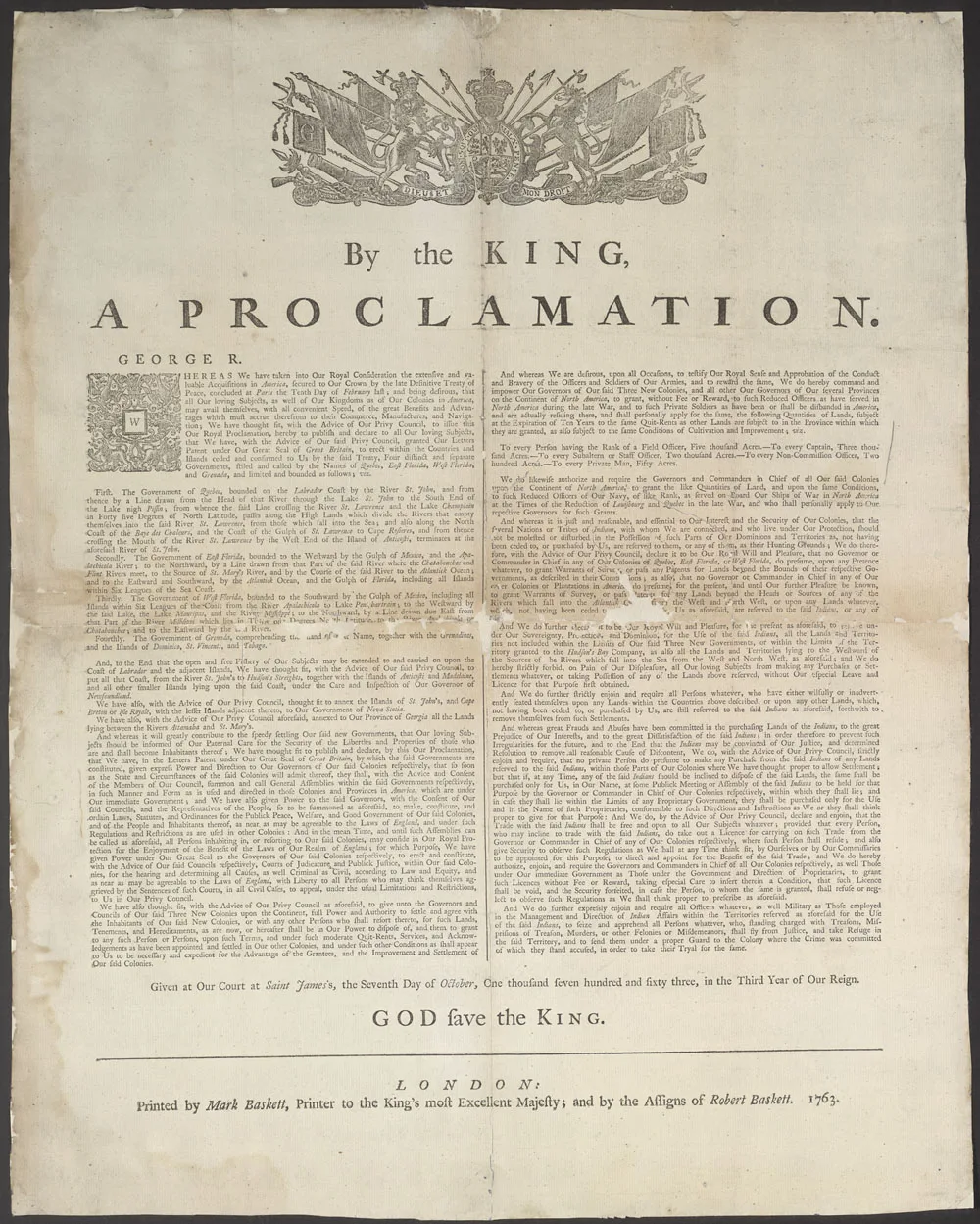
The Proclamation Line of 1763
During Pontiac's War, King George III issued the Royal Proclamation of 1763, forbidding Anglo-American settlement west of the Appalachian Mountains to prevent costly frontier warfare, enraging land speculators and colonists.
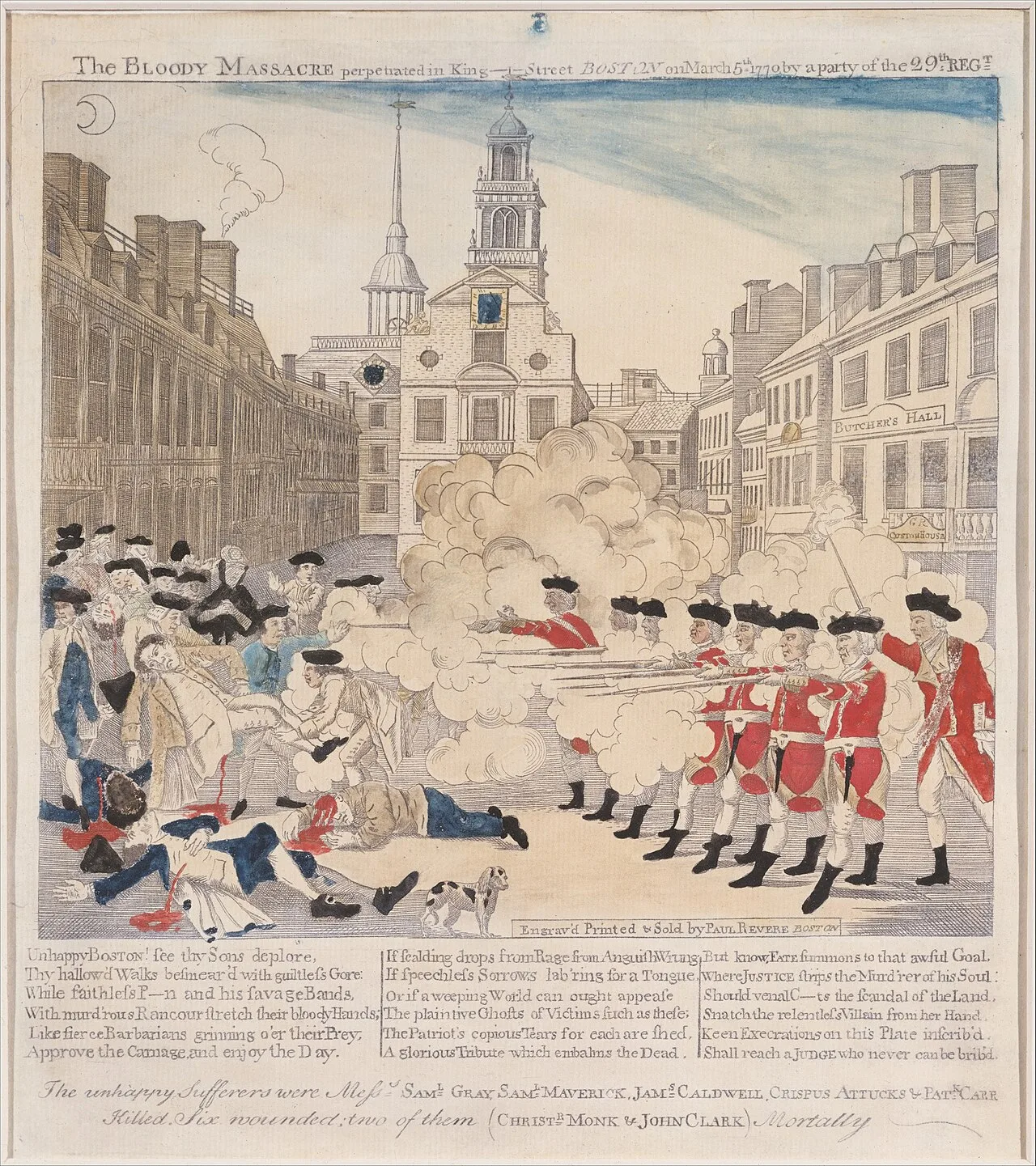
The Boston Massacre of 1770
On March 5, 1770, British troops occupying Boston fired into a crowd of colonists that had gathered around them and were taunting and pelting them with snow and ice, killing five colonists including Crispus Attucks, an event immortalized and publicized throughout the colonies by Paul Revere's propaganda engraving.
The Coercive Acts of 1774
In retaliation for the Boston Tea Party, Parliament passed the Coercive Acts (Intolerable Acts) of 1774, closing the Port of Boston, replacing Massachusetts's elected council with one appointed by the Crown, curbing town meetings, and allowing troops to be quartered in buildings such as barns and empty houses.
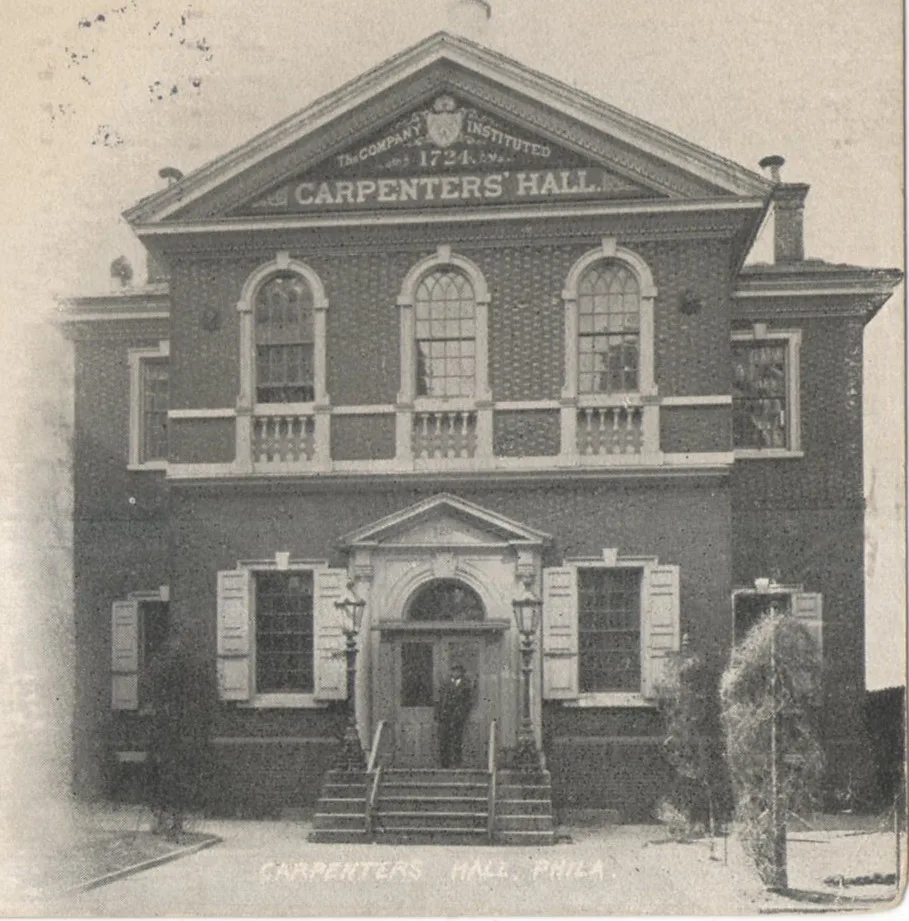
The Continental Association Boycott
Convening in Philadelphia in September 1774, the First Continental Congress created the Continental Association, a sweeping system of locally elected committees enforcing a total commercial boycott against British imports and exports.
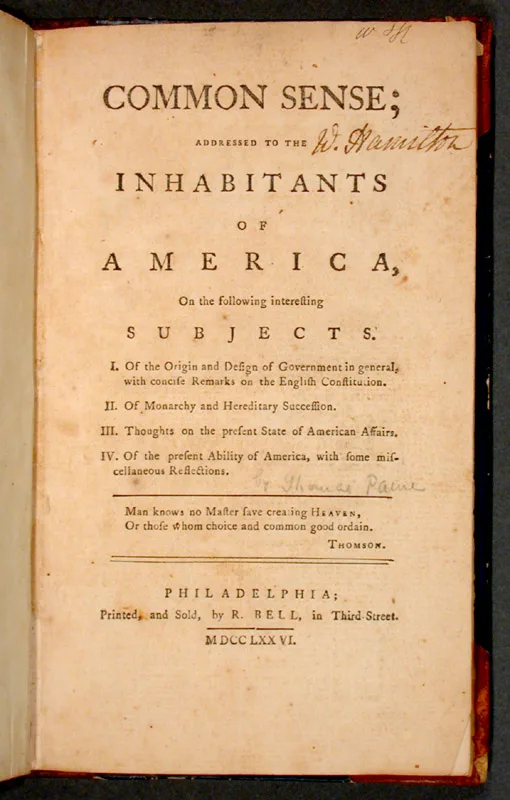
Thomas Paine's Common Sense
Published in January 1776, Thomas Paine's radical pamphlet Common Sense sold an estimated 120,000+ copies in its first months (contemporary estimates vary), dismantling monarchical legitimacy and persuading ordinary colonists that total republican independence was an urgent moral and practical necessity.
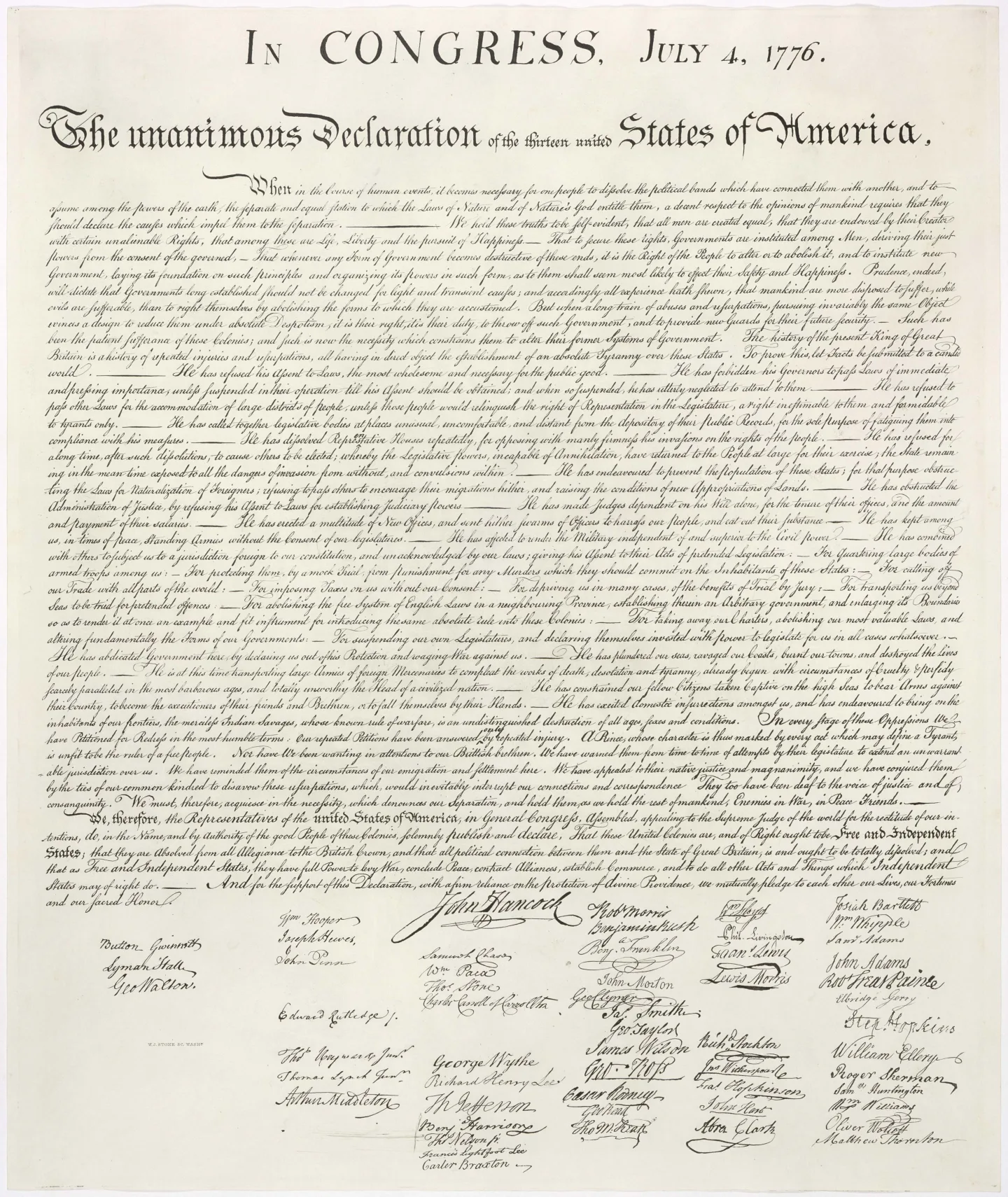
The Declaration of Independence
Adopted on July 4, 1776, by the Second Continental Congress, the Declaration of Independence—principally drafted by Thomas Jefferson—proclaimed universal natural rights to life, liberty, and the pursuit of happiness and declared the colonies free and independent states.
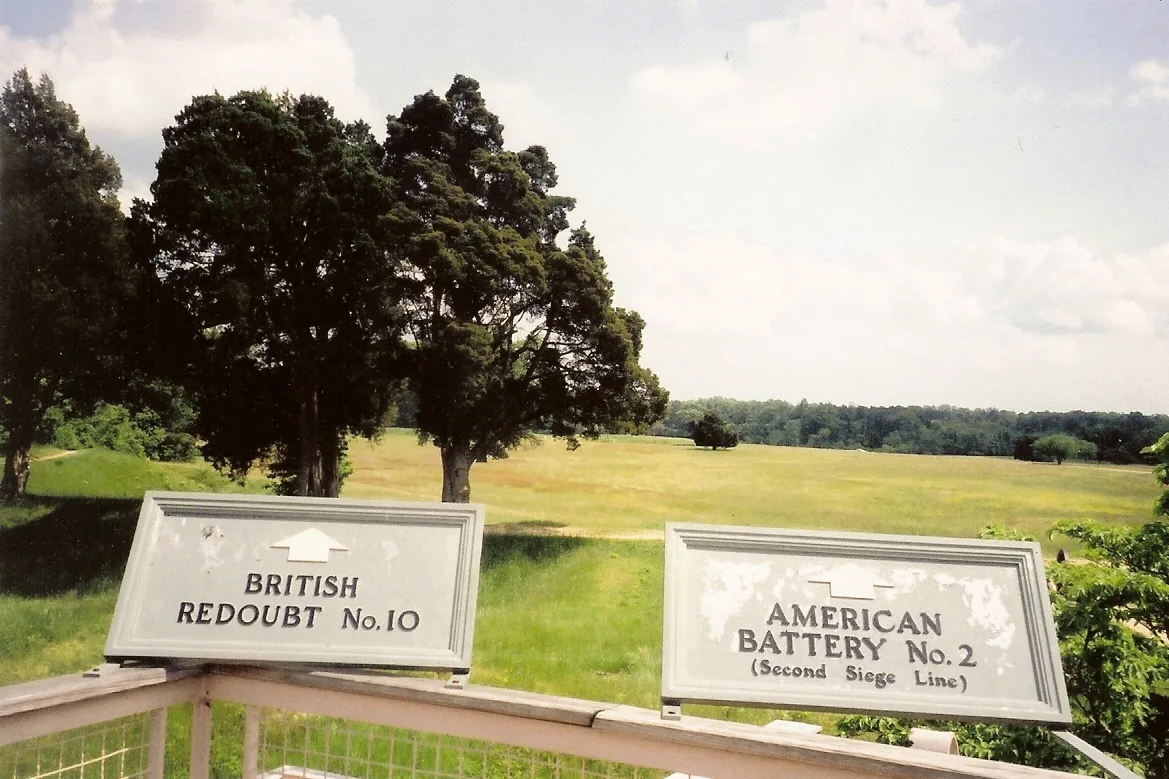
The Siege of Yorktown
In October 1781, combined American and French forces under George Washington and the Comte de Rochambeau trapped General Cornwallis at Yorktown, Virginia, while the French fleet blockaded the Chesapeake Bay, compelling the decisive British surrender of the war.
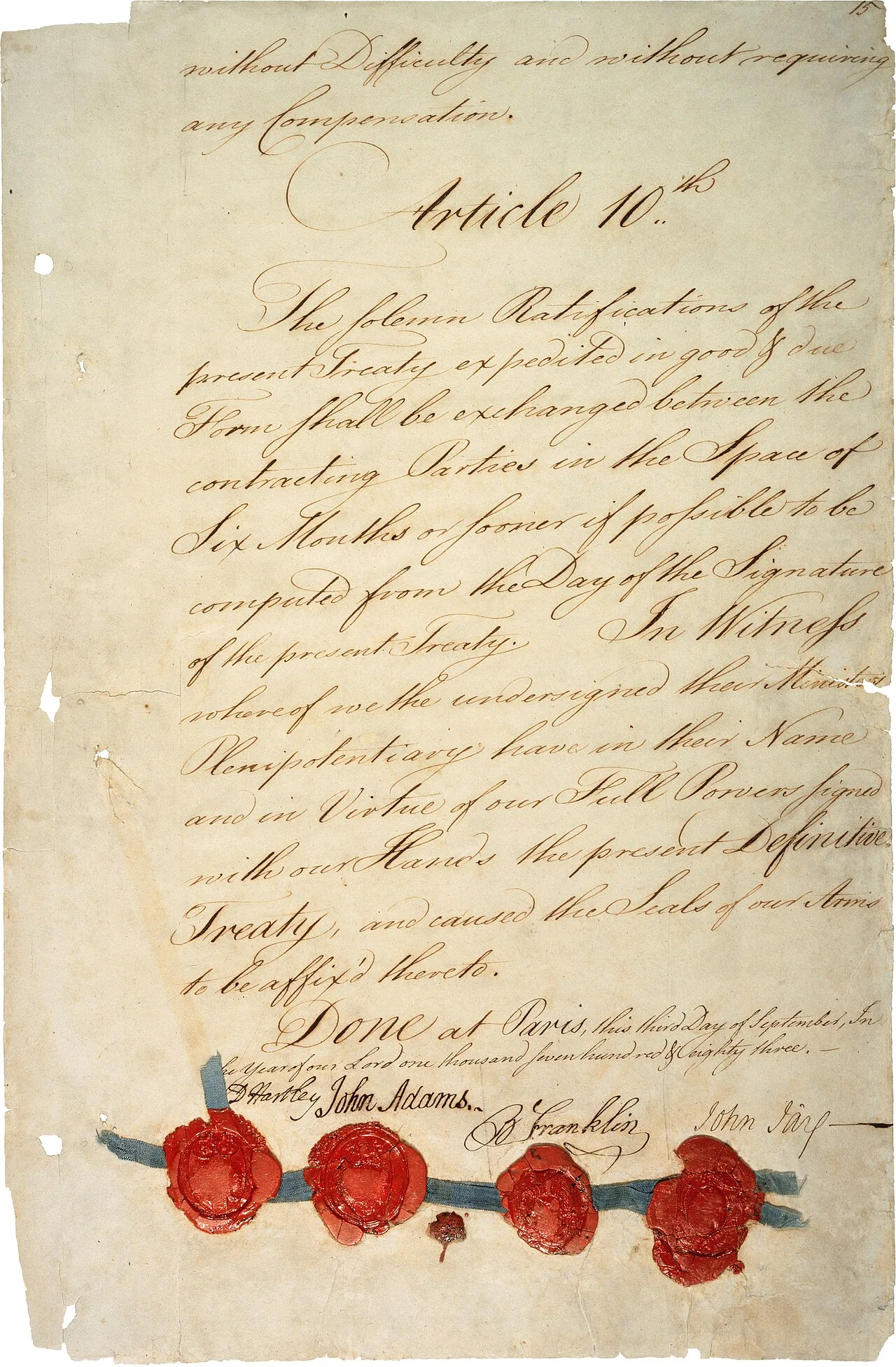
The Treaty of Paris of 1783
Signed in September 1783 by American commissioners Benjamin Franklin, John Adams, and John Jay, the Treaty of Paris formally recognized the independence of the United States and granted generous territorial boundaries extending west to the Mississippi River.
By the numbers
- How many chests of British East India Company tea were dumped during the Boston Tea Party in 1773?
- 342 chests
- In what calendar year was the United States Declaration of Independence formally adopted in Philadelphia?
- 1776 year
- In what calendar year did General George Washington force General Cornwallis to surrender at Yorktown?
- 1781 year
- In what calendar year was the Treaty of Paris signed, formally ending the American Revolutionary War?
- 1783 year
Matched pairs
Each item on the left goes with the one on the right.
- Declaratory Act
- Parliamentary assertion of absolute legislative power to bind colonies in all cases whatsoever
- Continental Association
- Intercolonial boycott pact created in 1774 to halt all British imports and exports
- Baron von Steuben
- Prussian military officer who instituted standardized tactical drill and hygiene at Valley Forge
- Admiral de Grasse
- French naval commander whose victory at the Capes sealed the Chesapeake Bay at Yorktown
Self-test
Answer each question from memory, then check your work against the answer key.
1. What primary rationale did British Prime Minister George Grenville offer for ending salutary neglect after 1763?
- AThe British national debt had doubled during the French and Indian War and colonists should share defense costs
- BColonial paper currency was destabilizing British merchant credit and Parliament needed to suppress it by decree
- CColonial assemblies had failed to suppress Pontiac's War, so the crown needed direct administrative control over frontier defense
- DColonial legislatures had grown too independent and needed closer supervision from royal governors
2. How did American colonists challenge the British theory of 'virtual representation' during the Stamp Act crisis?
- AThey argued that only the King personally, not Parliament, could lawfully approve new colonial taxes
- BThey proposed that colonial assemblies send non-voting observers to sit in the House of Commons
- CThey demanded that colonial assemblies each be granted actual, voting seats in Parliament itself
- DThey insisted that only their own elected colonial assemblies could levy internal taxes on them
3. What constitutional declaration did Parliament pass immediately after repealing the Stamp Act in 1766?
- AThe Sugar Act of 1764 imposing duties on imported molasses and other goods
- BThe Quartering Act requiring every civilian home to shelter royal infantry regiments
- CThe Declaratory Act asserting supreme legislative authority over colonies in all cases whatsoever
- DThe Townshend Acts taxing imported glass, lead, paint, paper, and tea
4. Why did colonial merchants and Sons of Liberty vehemently oppose the Tea Act of 1773 despite lower tea prices?
- AIt imposed a new direct tax on legal documents, newspapers, and pamphlets
- BIt granted the British East India Company a monopoly and affirmed Parliament's tax authority
- CIt required colonists to house British troops in their private homes
- DIt added new duties on glass, lead, paint, and paper alongside the tea duty
5. Which of these imperial crisis events occurred earliest?
- ABoston Massacre (1770)
- BStamp Act (1765)
- CTownshend Acts (1767)
- DBoston Tea Party (1773)
6. What primary mechanism did the First Continental Congress establish to enforce colonial resistance in 1774?
- AThe Continental Association enforcing non-importation, non-consumption, and non-exportation
- BA Continental Army placed under George Washington as commander-in-chief
- CA common treasury funded by a direct tax on every colony
- DA formal declaration of independence ending colonial allegiance to the Crown
7. What philosophical premise formed the central argument of Thomas Paine's 1776 pamphlet Common Sense?
- AThe British constitution was flawless but had been temporarily corrupted by French Catholic spies
- BColonies should accept parliamentary taxation if guaranteed five permanent seats in the House of Lords
- CEnslaved Africans should be immediately deported to establish an exclusively agrarian white republic
- DHereditary monarchy is inherently tyrannical and an island cannot reasonably govern a continent
8. Which Enlightenment philosopher's social contract theory directly influenced Thomas Jefferson in drafting the Declaration of Independence?
- ABaron de Montesquieu's treatise on separation of executive powers
- BJean-Jacques Rousseau's arguments on small-scale direct city democracies
- CJohn Locke's Two Treatises of Government on natural rights and popular consent
- DThomas Hobbes's defense of absolute sovereign monarchy in Leviathan
9. According to the Declaration of Independence, what natural rights are governments instituted to secure?
- ALife, Liberty, and Property
- BLiberty, Equality, and Fraternity
- CLife, Liberty, and the pursuit of Happiness
- DLife, Liberty, and freedom from taxation without representation
10. What did the Second Continental Congress establish when it convened in May 1775?
- AThe Franco-American Alliance
- BThe Declaration of Independence
- CThe Declaration of Rights and Grievances
- DThe Continental Army, under Washington
Go deeper
- WatchHow the Revolution Was Won Britain had the world's top navy. The Continental Army lacked food, pay and ammunition.
- WatchNo Taxation Without Representation Newspapers, legal papers, even playing cards. In 1765, Britain's Stamp Act taxed them all.
- WatchFrom Olive Branch to Independence After Lexington, Congress still professed loyalty to the King. That July, its Olive Branch Petition begged for a ceasefire.
- StudyUnited States History in the FlashFeed app
Answer key
- 1. A The British national debt had doubled during the French and Indian War and colonists should share defense costsGrenville argued that because Britain incurred massive debt protecting the colonies in the Seven Years' War, colonists must contribute revenue.
- 2. D They insisted that only their own elected colonial assemblies could levy internal taxes on themColonists rejected virtual representation, arguing that unrepresented subjects could only be constitutionally taxed by their own elected legislatures.
- 3. C The Declaratory Act asserting supreme legislative authority over colonies in all cases whatsoeverThe Declaratory Act asserted Parliament's absolute authority to bind the colonies 'in all cases whatsoever,' rejecting the colonial constitutional position.
- 4. B It granted the British East India Company a monopoly and affirmed Parliament's tax authorityColonists recognized that buying the cheap tea would concede Parliament's right to tax them and undercut independent colonial merchants.
- 5. B Stamp Act (1765)The Stamp Act (1765) predated the Townshend Acts (1767), Boston Massacre (1770), and Boston Tea Party (1773) in the escalating imperial crisis.
- 6. A The Continental Association enforcing non-importation, non-consumption, and non-exportationThe Continental Association organized local committees in every county to police compliance with comprehensive boycotts of British goods.
- 7. D Hereditary monarchy is inherently tyrannical and an island cannot reasonably govern a continentPaine argued that hereditary monarchy violated natural equality, and that it was absurd for an island across the sea to rule a vast continent.
- 8. C John Locke's Two Treatises of Government on natural rights and popular consentJefferson drew directly on John Locke's formulation that governments exist by consent to protect the natural rights of life, liberty, and property.
- 9. C Life, Liberty, and the pursuit of HappinessThe Declaration proclaims unalienable rights to 'Life, Liberty, and the pursuit of Happiness,' revising Locke's original 'life, liberty, and property.'
- 10. D The Continental Army, under WashingtonCongress created the Continental Army and named Washington commander-in-chief in May 1775; the others are real actions but from different congresses or later years.
Sources
- Middlekauff, The Glorious Cause, Ch. 3
- Morgan, The Stamp Act Crisis, Ch. 5
- Zobel, The Boston Massacre, Ch. 11
- Labaree, The Boston Tea Party, Ch. 6
- Ammerman, In the Common Cause, Ch. 2
- Middlekauff, The Glorious Cause, Ch. 12
- Foner, Tom Paine and Revolutionary America, Ch. 3
- Maier, American Scripture, Ch. 4
- Middlekauff, The Glorious Cause, Ch. 18
- Ferling, Almost a Miracle, Ch. 24
- Morris, The Peacemakers, Ch. 15
- Foner, Give Me Liberty!, Ch. 5
- Labaree, The Boston Tea Party, Ch. 4
- Foner, Tom Paine and Revolutionary America
- Ferling, Almost a Miracle, Ch. 7
- Ferling, Almost a Miracle, Ch. 14
- Morris, The Peacemakers
- Morgan, The Stamp Act Crisis
- Zobel, The Boston Massacre
- Maier, American Scripture
- Middlekauff, The Glorious Cause
- Ferling, Almost a Miracle
- National Archives, Declaration of Independence: A Transcription — www.archives.gov/founding-docs/declaration-transcript
- Labaree, The Boston Tea Party
- Ammerman, In the Common Cause
Image credits
- The Proclamation Line of 1763: King George III · Public domain — commons.wikimedia.org/wiki/File:Royal_Proclamation_of_1763.jpg
- The Boston Massacre of 1770: Paul Revere · Public domain — commons.wikimedia.org/wiki/File:The_Boston_Massacre_MET_DT2086.jpg
- The Continental Association Boycott: Wikimedia Commons · Scanned by User:Themfromspace · Public domain — commons.wikimedia.org/wiki/File:Carpenters%27_Hall,_Philadelphia_PA.jpg
- Thomas Paine's Common Sense: Scanned by uploader, originally by Thomas Paine. · Public domain — en.wikipedia.org/wiki/Common_Sense
- The Declaration of Independence: Wikimedia Commons · Second Continental Congress; reproduction by William Stone · Public domain — commons.wikimedia.org/wiki/File:United_States_Declaration_of_Independence.jpg
- The Siege of Yorktown: Ken Lund from Reno, Nevada, USA · CC BY-SA 2.0 — commons.wikimedia.org/wiki/File:Yorktown_Battlefield,_Yorktown,_Virginia_(2522845976).jpg
- The Treaty of Paris of 1783: Wikimedia Commons · U.S. National Archives · Public domain — commons.wikimedia.org/wiki/File:Treaty_of_Paris_1783_-_last_page_(hi-res).jpg


