
United States History study guide · Lesson 4 of 13
The Early Republic, Jeffersonian Democracy, and the Marshall Court (1800–1824)
The Revolution of 1800, Louisiana Purchase, and Embargo Politics · Marbury v. Madison and the Marshall Court's Constitutional Jurisprudence · The War of 1812, the Monroe Doctrine, and the Missouri Compromise
This is the lesson's study guide from the FlashFeed app, plus its key facts and a self-test.
What you'll be able to do
- Analyze Jefferson's presidency: the election of 1800, the Louisiana Purchase, and the failed Embargo of 1807.
- Explain how Marbury v. Madison and later Marshall Court rulings built judicial review and federal supremacy.
Lesson 4: The Early Republic, Jeffersonian Democracy, and the Marshall Court (1800–1824)
The Revolution of 1800, Louisiana Purchase, and Embargo Politics
The presidential election of 1800 marked a historic watershed in American constitutional governance. Dubbed by Thomas Jefferson as the "Revolution of 1800", it achieved the first peaceful transfer of executive power from one political party to another in American history, as the incumbent Federalist administration of John Adams yielded to the Democratic-Republicans. Because Jefferson and his vice-presidential running mate Aaron Burr received an identical number of electoral votes, the election was thrown into the House of Representatives, where Alexander Hamilton urged Federalist congressmen to prefer Jefferson as the lesser evil, and on the 36th ballot enough Federalists abstained to elect him, prompting the subsequent ratification of the Twelfth Amendment (1804) to separate presidential and vice-presidential ballots.
In office, Jefferson sought to implement his vision of agrarian republicanism, shrinking the federal bureaucracy, cutting military expenditures, and repealing the hated whiskey tax. Yet practical governance forced significant compromises with his strict constructionist principles. In 1803, Napoleon Bonaparte offered to sell the entire French territory of Louisiana for $15 million. Recognizing that the Louisiana Purchase would double the geographic size of the United States, secure navigation of the Mississippi River, and guarantee agricultural land for generations of yeoman farmers, Jefferson set aside his constitutional qualms about whether the federal government had the power to acquire foreign territory. The subsequent Lewis and Clark Expedition (1804–1806) explored the Pacific Northwest, mapping waterways and cataloging flora, fauna, and Indigenous nations.
Foreign policy crises dominated Jefferson's second term during the Napoleonic Wars. Both Great Britain and France seized neutral American commercial vessels. The British Royal Navy aggressively practiced impressment—the forced conscription of American sailors into British naval service. Following the Chesapeake-Leopard affair in 1807, Jefferson enacted the Embargo Act of 1807, cutting off all American foreign commerce to force European respect for American neutrality. The embargo failed disastrously: it devastated the American export economy, particularly in New England, and revitalized the moribund Federalist opposition.
Marbury v. Madison and the Marshall Court's Constitutional Jurisprudence
While the Federalists lost control of the executive and legislative branches in 1800, their judicial philosophy was entrenched by Chief Justice John Marshall, who presided over the Supreme Court from 1801 to 1835. In the landmark case of Marbury v. Madison (1803), Marshall established the foundational doctrine of judicial review—the authority of the Supreme Court to declare acts of Congress unconstitutional. Marshall ruled that while William Marbury was entitled to his commission as justice of the peace, Section 13 of the Judiciary Act of 1789, which granted the Court original jurisdiction to issue writs of mandamus, conflicted directly with Article III of the Constitution. By declaring a federal statute void, Marshall elevated the judiciary to a co-equal status with Congress and the President.
Over three decades, the Marshall Court issued a sequence of rulings establishing federal supremacy over state laws and protecting private property contracts:
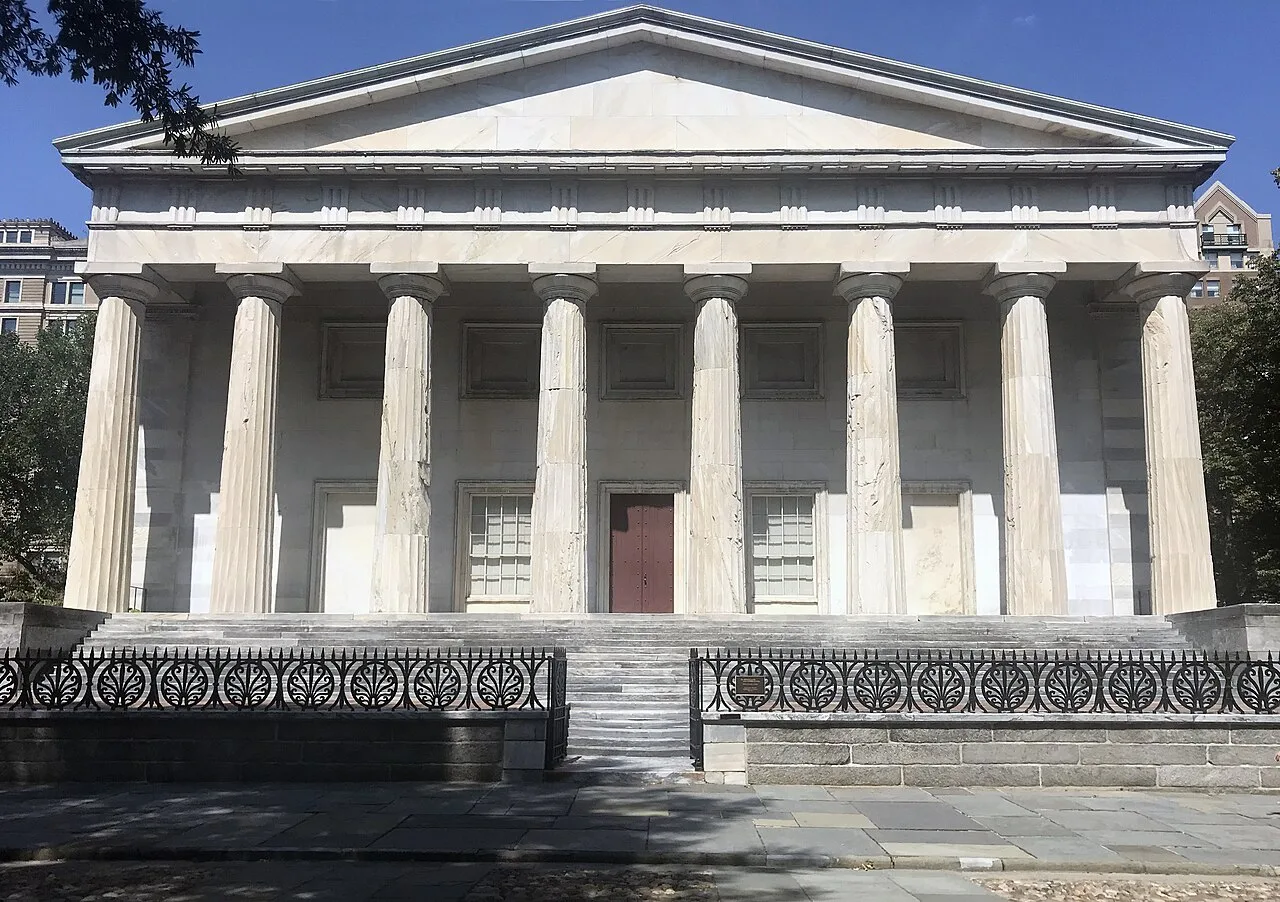
- McCulloch v. Maryland (1819): Marshall upheld the constitutional validity of the Second Bank of the United States under the Necessary and Proper Clause ("implied powers"), rejecting Maryland's attempt to tax the bank by declaring that "the power to tax involves the power to destroy" and confirming the Supremacy Clause.
- Dartmouth College v. Woodward (1819): The Court ruled that corporate charters are protected contracts that state legislatures cannot unilaterally alter under the Contract Clause.
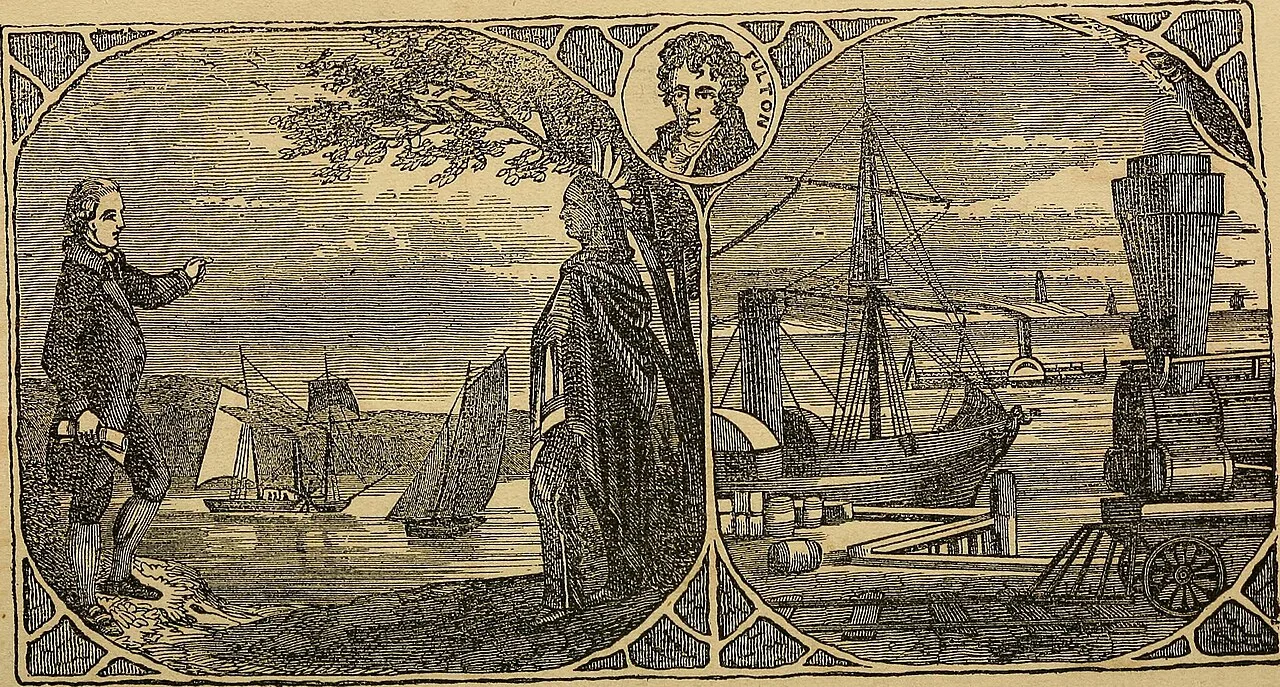
- Gibbons v. Ogden (1824): Marshall struck down a New York steamboat monopoly, ruling that Congress's power to regulate interstate commerce under the Commerce Clause is broad and includes navigation, and holding that the monopoly conflicted with a federal licensing act.
The War of 1812, the Monroe Doctrine, and the Missouri Compromise
Tensions with Great Britain culminated in the War of 1812 under President James Madison. Instigated by congressional "War Hawks" such as Henry Clay of Kentucky and John C. Calhoun of South Carolina, the war was fought over British impressment, violations of neutral trade, and British arming of Native American confederacies led by Shawnee leader Tecumseh in the Old Northwest. Although the war witnessed humiliating setbacks—including the British burning of the White House and Capitol in August 1814—it also featured iconic defensive triumphs, including the defense of Fort McHenry in Baltimore (inspiring Francis Scott Key's "Star-Spangled Banner") and General Andrew Jackson's decisive victory at the Battle of New Orleans in January 1815, fought two weeks after the signing of the Treaty of Ghent (1814).
The war had major domestic political consequences. Federalist opposition to the war culminated in the Hartford Convention (1814–1815), where New England delegates discussed radical constitutional amendments and secession. When news of Jackson's victory arrived simultaneously, the Federalists were branded as unpatriotic traitors, leading to the party's permanent demise and inaugurating the one-party "Era of Good Feelings" under President James Monroe. Henry Clay championed the American System, an economic platform consisting of:
- High protective tariffs to foster domestic manufacturing.
- A strong national currency backed by the Second Bank of the United States (1816).
- Federal funding for internal improvements (canals and roads) to bind national markets.
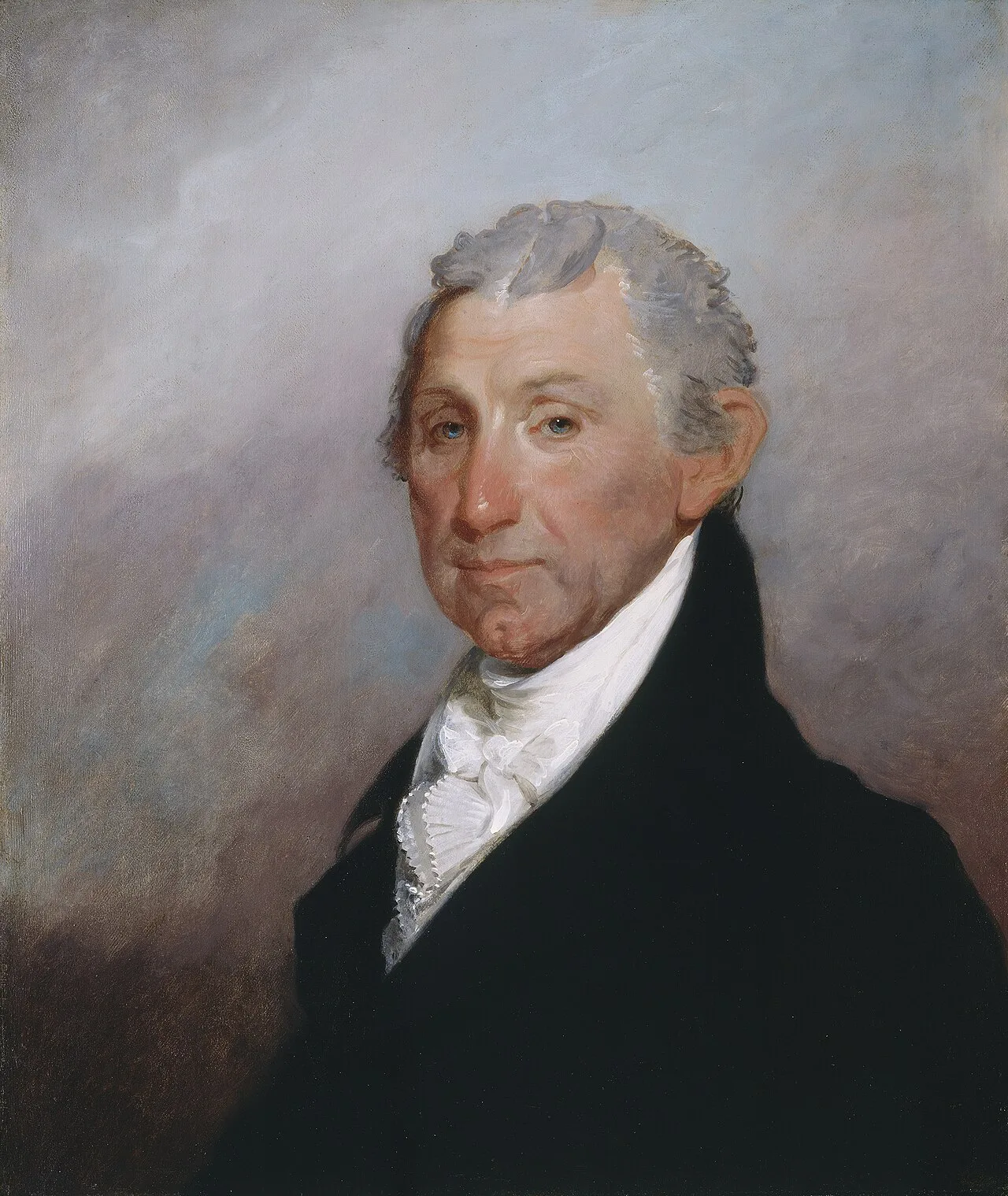
In foreign affairs, Monroe and Secretary of State John Quincy Adams issued the Monroe Doctrine (1823), declaring that the American continents were no longer open to European colonization and that European interference in newly independent Latin American republics would be viewed as acts of aggression.
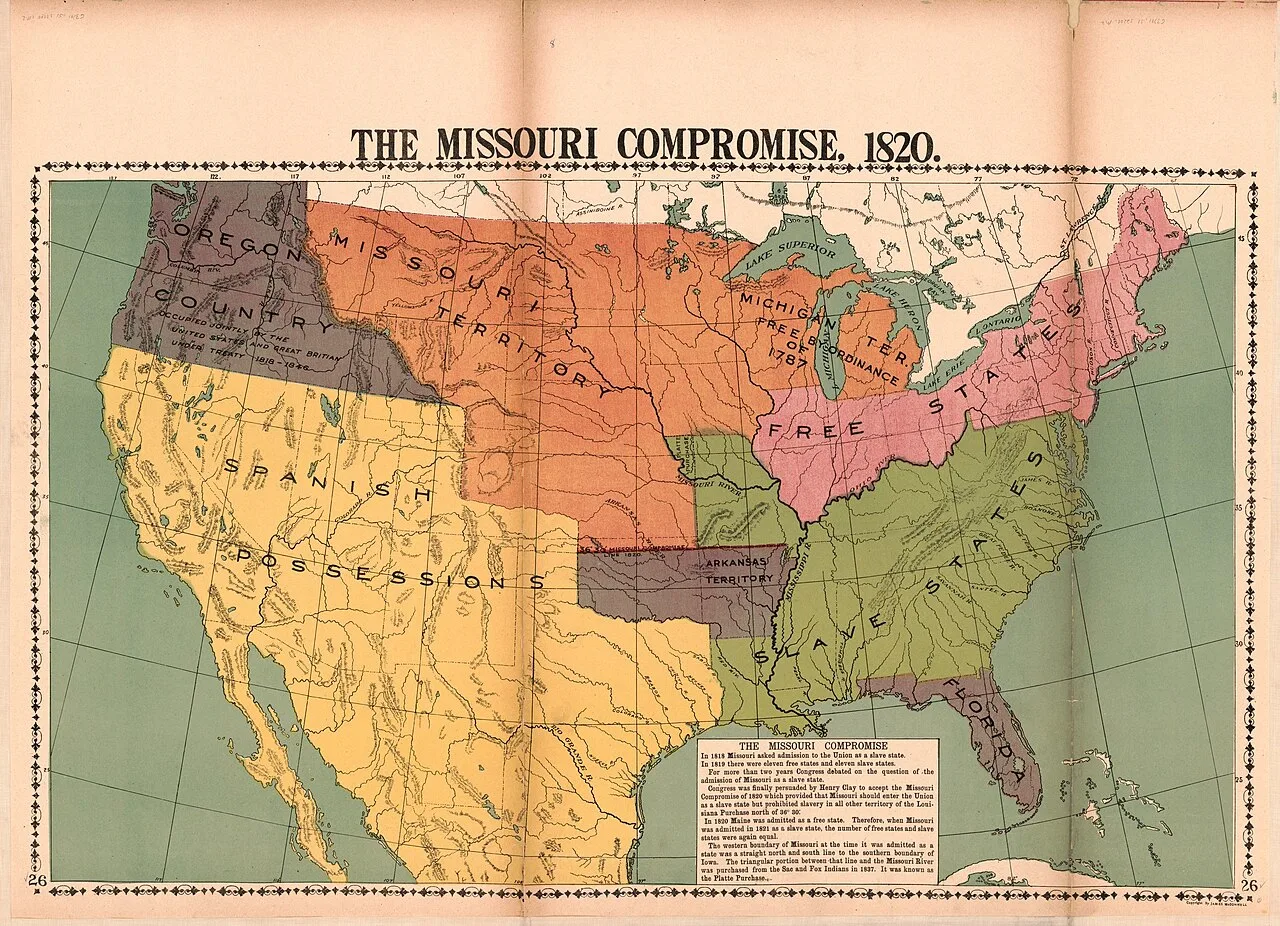
Simultaneously, sectional crisis erupted over the expansion of slavery into western territories. When Missouri petitioned for statehood as a slave state in 1819, Northern congressmen led by James Tallmadge proposed restricting slavery, threatening the delicate 11-to-11 state balance in the Senate. Henry Clay brokered the Missouri Compromise of 1820: Missouri entered as a slave state, Maine entered as a free state, and slavery was permanently prohibited in the remaining Louisiana Territory north of the 36°30' parallel. Thomas Jefferson famously described this sectional truce as a "fire bell in the night," warning that it was merely a temporary reprieve in the conflict over slavery.
Key terms
- Agrarian Republicanism
- A political philosophy championed by Thomas Jefferson emphasizing a virtuous republic anchored by self-sufficient, property-owning yeoman farmers rather than urban manufacturing.
- Judicial Review
- The doctrine under which legislative and executive actions are subject to review and potential invalidation by the judiciary for non-compliance with the Constitution.
- Monroe Doctrine
- A foreign policy declaration asserting that the Western Hemisphere is closed to European imperial colonization and that European intervention constitutes hostility toward the United States.
- Sectional Balance
- The deliberate legislative parity in the United States Senate between equal numbers of slave states and free states to prevent either region from dominating national policy.
Key concepts
Louisiana Purchase
- Territorial acquisition from France in 1803 negotiated for $15 million under President Jefferson
- Doubled the land area of the United States, adding 828,000 square miles west of the Mississippi
- Secured vital commercial navigation rights to the port of New Orleans and the Gulf of Mexico
Embargo Act of 1807
- Federal statute that halted all American commercial shipping to foreign ports
- Enacted by President Jefferson to pressure Britain and France into respecting neutral trade
- Devastated New England port economies and stimulated widespread regional smuggling
John Marshall
- Fourth Chief Justice of the Supreme Court who presided over the Court from 1801 to 1835
- Established the doctrine of judicial review in the landmark case of Marbury v. Madison
- Consistently strengthened federal supremacy and protected private property contracts
Judicial Review
- Constitutional power of courts to evaluate the legality of legislative acts and executive orders
- Established as an explicit Supreme Court authority by Chief Justice Marshall in 1803
- Authorizes the judiciary to strike down laws that conflict with the United States Constitution
American System
- Economic nationalist platform championed by Kentucky statesman Henry Clay after 1815
- Composed of high protective tariffs, a national bank, and federally funded internal improvements
- Sought to create a self-sufficient domestic market integrating eastern industry and western agriculture
Monroe Doctrine
- Foundational foreign policy statement delivered to Congress by President James Monroe in 1823
- Declared the Western Hemisphere permanently closed to future European imperial colonization
- Warned that European interference in independent American nations would be treated as hostile acts
Missouri Compromise
- Congressional sectional truce brokered by Speaker Henry Clay in 1820
- Admitted Missouri as a slave state and Maine as a free state to preserve Senate balance
- Prohibited slavery in the remaining Louisiana Territory north of latitude 36°30'
Key facts
The Revolution of 1800
The presidential election of 1800 marked the first peaceful transfer of executive power between opposing political parties in American history, as John Adams's Federalists yielded control of the presidency to Thomas Jefferson's Democratic-Republicans.
The Louisiana Purchase of 1803
In 1803, President Thomas Jefferson purchased 828,000 square miles of French territory from Napoleon Bonaparte for $15 million, doubling the geographic size of the United States and securing unrestricted commercial navigation of the Mississippi River.
The Lewis and Clark Expedition
Commissioned by President Jefferson in 1803, the Corps of Discovery led by Meriwether Lewis and William Clark departed in 1804 and journeyed across the northern plains to the Pacific Ocean, mapping river routes and establishing trade relations with Indigenous nations.
McCulloch v. Maryland and Implied Powers
In McCulloch v. Maryland (1819), the Marshall Court upheld the constitutional validity of the Second Bank of the United States under the Necessary and Proper Clause, striking down a state tax on the bank by affirming that 'the power to tax involves the power to destroy'.
Dartmouth College v. Woodward and Contracts
In Dartmouth College v. Woodward (1819), Chief Justice Marshall ruled that corporate charters are protected contracts that state legislatures cannot unilaterally alter or invalidate under the Contract Clause of Article I, Section 10 of the Constitution.
Gibbons v. Ogden and Interstate Commerce
In Gibbons v. Ogden (1824), the Supreme Court struck down a New York state monopoly on steamboat navigation, establishing that the federal government possesses broad and exclusive authority to regulate interstate commerce under the Commerce Clause.
The Monroe Doctrine of 1823
Drafted primarily by Secretary of State John Quincy Adams and announced by President James Monroe in 1823, the Monroe Doctrine declared the Western Hemisphere closed to future European colonization and warned that European intervention would be viewed as an act of hostility.
The Missouri Compromise of 1820
Brokered by Henry Clay in 1820, the Missouri Compromise admitted Missouri as a slave state and Maine as a free state, maintaining the Senate sectional balance while permanently prohibiting slavery in the remainder of the Louisiana Territory north of 36°30' latitude.
By the numbers
- How many millions of dollars did the United States pay to purchase the Louisiana Territory in 1803?
- 15 million dollars
- In what calendar year did Chief Justice John Marshall issue the landmark Marbury v. Madison ruling?
- 1803 year
- In what calendar year was the Missouri Compromise enacted by the United States Congress?
- 1820 year
- In what calendar year did President James Monroe announce the Monroe Doctrine in his annual message?
- 1823 year
Matched pairs
Each item on the left goes with the one on the right.
- Twelfth Amendment
- Constitutional reform separating electoral votes for president and vice president
- Contract Clause
- Constitutional provision preventing state legislatures from impairing corporate charters
- Era of Good Feelings
- Period of apparent national political consensus under President James Monroe
- War Hawks
- Young nationalist congressmen who aggressively advocated military conflict in 1812
Self-test
Answer each question from memory, then check your work against the answer key.
1. What constitutional challenge did President Thomas Jefferson confront regarding the 1803 Louisiana Purchase?
- AThe Supreme Court had already declared private land transactions with France unconstitutional
- BThe Constitution contained no explicit clause authorizing the president to acquire foreign territory
- CThe Bill of Rights barred federal spending exceeding two million dollars per fiscal calendar
- DThe Twelfth Amendment prohibited territorial expansion without approval from all state governors
2. Why was the electoral deadlock of 1800 between Thomas Jefferson and Aaron Burr referred to the House of Representatives?
- ABoth candidates received an identical number of electoral votes under the original ballot rules
- BThe Senate, controlled by Federalists, refused to certify the electoral results from the southern states
- CCongress had never fixed a date for the electors to meet, so no result could be certified
- DThe Federalist Party refused to allow popular ballots in New York and Pennsylvania
3. How did the Embargo Act of 1807 impact the domestic American economy during Jefferson's second term?
- AIt won New England's merchants over to Jefferson's Democratic-Republicans
- BIt forced Britain and France to lift their restrictions on neutral shipping within a year
- CIt devastated New England maritime shipping, resulting in widespread bankruptcies and smuggling
- DIt sharply increased cotton and tobacco exports to European markets
4. Which constitutional amendment resulted from the 1800 electoral tie between Jefferson and Burr?
- AThirteenth Amendment
- BEleventh Amendment
- CFourteenth Amendment
- DTwelfth Amendment
5. Which policy was NOT part of Jefferson's agrarian republicanism agenda in office?
- ACutting military expenditures
- BRepealing the whiskey tax
- CShrinking the federal bureaucracy
- DChartering a national bank
6. What foundational legal doctrine did Chief Justice John Marshall establish in Marbury v. Madison (1803)?
- AThe authority of the Supreme Court to declare acts of Congress unconstitutional through judicial review
- BThe constitutional prohibition on federal regulatory oversight of state chartered corporations
- CThe absolute sovereign right of individual states to nullify federal tax assessments at will
- DThe principle that Congress may charter a national bank under the Necessary and Proper Clause
7. In McCulloch v. Maryland (1819), how did the Supreme Court interpret the Necessary and Proper Clause?
- AFederal statutes must be approved by unanimous consent of all state supreme courts to take effect
- BCongress possesses broad implied powers to enact laws appropriate for executing enumerated powers
- CState governments have supreme constitutional authority over all federal military installations
- DThe federal legislature is strictly prohibited from creating any commercial banking institution
8. What constitutional protection for private enterprise was established in Dartmouth College v. Woodward (1819)?
- APrivate corporations may not be taxed by any state government
- BEvery business enterprise has a constitutional right to a federal charter
- CCorporate charters are protected legal contracts that state legislatures cannot unilaterally alter
- DPrivate corporations are immune from federal regulation of interstate commerce
9. How did the Marshall Court define the Commerce Clause in Gibbons v. Ogden (1824)?
- AFederal commercial regulation is restricted strictly to international trade with European powers
- BOnly the President, not Congress, holds constitutional authority to regulate interstate trade
- CCongress has broad authority to regulate interstate navigation and commercial transport, overriding conflicting state monopolies
- DIndividual states maintain absolute monopoly authority over all rivers within their territorial borders
10. Maryland taxes a federally chartered bank, arguing states retain full sovereignty over economic institutions inside their borders. Which ruling rejects that claim?
- AMarbury v. Madison
- BGibbons v. Ogden
- CDartmouth College v. Woodward
- DMcCulloch v. Maryland
Go deeper
- WatchThe Louisiana Purchase One deal doubled the size of the United States. The price was $15 million.
- WatchMarbury v. Madison A fight over one man's job gave the Supreme Court a key power. The case was Marbury versus Madison, in 1803.
- WatchA Battle After the Peace The Treaty of Ghent was signed two weeks before Andrew Jackson won at New Orleans in January 1815.
- StudyUnited States History in the FlashFeed app
Answer key
- 1. B The Constitution contained no explicit clause authorizing the president to acquire foreign territoryAs a strict constructionist, Jefferson worried the Constitution gave no express power to purchase foreign land, but used his treaty power.
- 2. A Both candidates received an identical number of electoral votes under the original ballot rulesBefore the 12th Amendment, electors did not separate president and vice president votes, producing a tie between Jefferson and Burr.
- 3. C It devastated New England maritime shipping, resulting in widespread bankruptcies and smugglingThe embargo paralyzed American shipping, plunging port cities into economic depression while failing to stop British or French aggression.
- 4. D Twelfth AmendmentThe tie exposed a flaw in the ballot system, so the Twelfth Amendment (1804) required separate electoral votes for president and vice president.
- 5. D Chartering a national bankJefferson favored small government and yeoman farmers; a national bank was central to Hamilton's and Clay's programs, not Jefferson's agrarian agenda.
- 6. A The authority of the Supreme Court to declare acts of Congress unconstitutional through judicial reviewMarshall established judicial review by striking down Section 13 of the Judiciary Act of 1789 as conflicting with Article III.
- 7. B Congress possesses broad implied powers to enact laws appropriate for executing enumerated powersMarshall ruled that 'necessary' meant convenient and useful, confirming Congress's broad implied powers to create the national bank.
- 8. C Corporate charters are protected legal contracts that state legislatures cannot unilaterally alterThe Court held that the Contract Clause prevented states from altering private corporate charters without mutual consent.
- 9. C Congress has broad authority to regulate interstate navigation and commercial transport, overriding conflicting state monopoliesMarshall defined commerce broadly to include navigation, invalidating state monopolies that obstructed interstate trade.
- 10. D McCulloch v. MarylandMcCulloch v. Maryland (1819) upheld the bank under the Necessary and Proper Clause and the Supremacy Clause, holding 'the power to tax involves the power to destroy.'
Sources
- Wood, Empire of Liberty, Ch. 7
- Kastor, The Nation's Crucible, Ch. 2
- Ambrose, Undaunted Courage, Ch. 12
- Wood, Empire of Liberty, Ch. 17
- Newmyer, John Marshall and the Heroic Age of the Supreme Court
- White, The Marshall Court and Cultural Change, Ch. 6
- White, The Marshall Court and Cultural Change
- Newmyer, John Marshall and the Heroic Age
- Hickey, The War of 1812, Ch. 1
- May, The Making of the Monroe Doctrine, Ch. 5
- Forbes, The Missouri Compromise and Its Aftermath, Ch. 3
- Wood, Empire of Liberty: A History of the Early Republic, 1789-1815
- Hickey, The War of 1812, Ch. 11
- Howe, What Hath God Wrought: The Transformation of America, 1815-1848
- May, The Making of the Monroe Doctrine
- Forbes, The Missouri Compromise
- Jefferson to John Holmes, 22 April 1820 (Founders Online); Forbes, The Missouri Compromise and Its Aftermath
- Kastor, The Nation's Crucible
- Wood, Empire of Liberty
- Hickey, The War of 1812
Image credits
- McCulloch v. Maryland and Implied Powers: Myotus · CC BY-SA 4.0 — commons.wikimedia.org/wiki/File:Second_Bank_of_the_United_States,_Philadelphia,_Pennsylvania.jpg
- Gibbons v. Ogden and Interstate Commerce: Wikimedia Commons · Internet Archive Book Images · No restrictions — commons.wikimedia.org/wiki/File:Ensign,_Bridgman_and_Fanning%27s_lake_and_river_guide;_(1856)_(14773217921).jpg
- The Monroe Doctrine of 1823: Wikimedia Commons · Gilbert Stuart · Public domain — commons.wikimedia.org/wiki/File:James_Monroe_by_Gilbert_Stuart_c1817.jpg
- The Missouri Compromise of 1820: McConnell Map Co. · Public domain — commons.wikimedia.org/wiki/File:Map_of_the_Missouri_Compromise,_1820.jpg


