
United States History study guide · Lesson 11 of 13
The Roaring Twenties, the Great Depression, and the New Deal (1920–1939)
Mass Consumerism, Prohibition, Harlem Renaissance, and Nativism · The 1929 Wall Street Crash, Systemic Banking Collapse, and the Depression · First & Second New Deals, the Social Security Act, and the Welfare State
This is the lesson's study guide from the FlashFeed app, plus its key facts and a self-test.
What you'll be able to do
- Analyze 1920s consumer culture and the decade's clashes over Prohibition, immigration, evolution, and race.
- Explain the 1929 crash, how the 1933 Bank Holiday answered the bank failures, and the deepening Depression, from Smoot-Hawley to the Dust Bowl.
Lesson 11: The Roaring Twenties, the Great Depression, and the New Deal (1920–1939)
Mass Consumerism, Prohibition, Harlem Renaissance, and Nativism
The 1920s—the "Roaring Twenties" or the "Jazz Age"—witnessed explosive economic growth driven by mass production, consumer credit, and technological innovation. Republican administrations under Warren G. Harding, Calvin Coolidge, and Herbert Hoover pursued pro-business policies characterized by low corporate taxes, deregulation, and high protective tariffs. Henry Ford's moving assembly line slashed the manufacturing time of the Model T, making automobiles affordable to ordinary Americans and stimulating secondary industries like oil, steel, rubber, and highway construction. In January 1914 Ford had announced the Five-Dollar Day, doubling daily pay for eligible workers, largely through a profit-sharing bonus, at a time when monotonous assembly-line work had pushed labor turnover to 370 percent; the higher wage steadied the workforce and made his workers new customers for the Model T. Mass consumer culture was reinforced by national advertising, commercial radio broadcasting (KDKA in Pittsburgh went on the air in 1920), and Hollywood cinema.
However, the decade was characterized by fierce cultural battles between modern urban values and traditional rural fundamentalism:
- Nativism and Red Scare: The First Red Scare (1919–1920), led by Attorney General A. Mitchell Palmer, arrested thousands of suspected radicals without warrants (Palmer Raids), with the same fears resurfacing in the controversial 1927 execution of Italian anarchist immigrants Nicola Sacco and Bartolomeo Vanzetti. In 1924, Congress passed the National Origins Act (Immigration Act of 1924), establishing strict national quotas (2 percent of each nationality based on the 1890 Census) to drastically curtail immigration from Southern and Eastern Europe while completely banning Asian immigration.
- Resurgence of the Ku Klux Klan (KKK): The second KKK expanded nationwide into the Midwest and West, broadening its targets beyond Black Americans to include Roman Catholics, Jews, and immigrants, claiming millions of members before collapsing amid financial and moral scandals.
- The Scopes Trial (1925): In Dayton, Tennessee, biology teacher John T. Scopes was prosecuted for teaching Darwinian evolution in violation of the state's Butler Act. The "Monkey Trial" pitted celebrated defense attorney Clarence Darrow against fundamentalist orator William Jennings Bryan in a nationwide debate over science, modernism, and religious fundamentalism.
- Prohibition (1920–1933): Enforced by the Volstead Act, national prohibition stimulated widespread disrespect for law, illegal speakeasies, and violent organized crime syndicates led by gangsters like Al Capone, until repealed by the Twenty-First Amendment (1933).
- Harlem Renaissance: The Great Migration of African Americans from the rural South to Northern cities fostered an explosion of Black literary, artistic, and musical creativity centered in Harlem, New York. Writers like Langston Hughes, Zora Neale Hurston, and Claude McKay celebrated Black heritage and protested racial injustice, while jazz innovators like Louis Armstrong and Duke Ellington redefined American music. Marcus Garvey's Universal Negro Improvement Association (UNIA), which Garvey claimed had millions of followers though historians dispute the true membership size, promoted Black pride and economic self-reliance.
The 1929 Wall Street Crash, Systemic Banking Collapse, and the Depression
The prosperity of the 1920s masked deep structural vulnerabilities: chronic agricultural depression, severe wealth inequality (where top 5% received 30% of income), corporate overproduction, consumer underconsumption, and reckless speculative borrowing ("buying on margin") in the stock market.
On October 29, 1929 ("Black Tuesday"), the stock market suffered a catastrophic crash, losing billions in value and triggering a systemic deflationary spiral. Banks that had invested depositor funds in stocks collapsed; between 1929 and 1933, over 9,000 banks failed, wiping out the life savings of millions of depositors. The money supply contracted by nearly one-third, business investment plummeted, and by 1933, national unemployment reached an unprecedented 25 percent (over 12 million workers).
International trade collapsed following Congress's passage of the protectionist Smoot-Hawley Tariff of 1930, which provoked retaliatory European tariffs. In the Great Plains, severe drought and aggressive over-plowing triggered the catastrophic ecological disaster of the Dust Bowl, driving many farm families off the land; with the wider Depression, it fed a westward migration of hundreds of thousands of people ("Okies") to California.
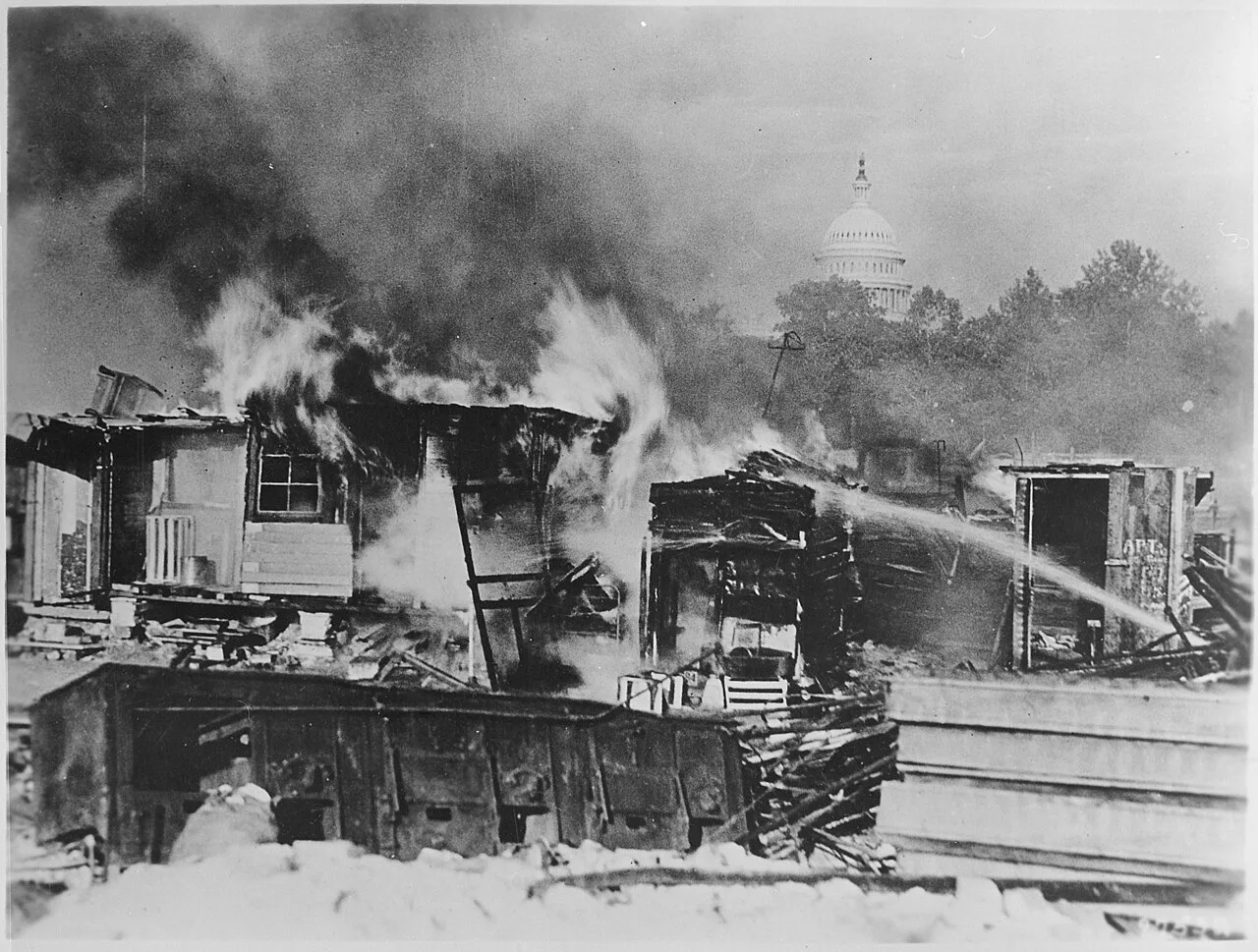
President Herbert Hoover initially resisted direct federal relief, believing in "rugged individualism" and voluntary corporate cooperation. When local charities and municipal governments ran out of funds, Hoover created the Reconstruction Finance Corporation (RFC) in 1932 to provide emergency federal loans to banks, railroads, and insurance companies. However, public outrage peaked in the summer of 1932 when the "Bonus Army"—over 15,000 WWI veterans who marched to Washington demanding early payment of their military service bonuses—were violently evicted by federal troops under General Douglas MacArthur using tanks and tear gas.
First & Second New Deals, the Social Security Act, and the Welfare State
In the 1932 presidential election, Democrat Franklin D. Roosevelt (FDR) won in a historic landslide, promising a "New Deal" for the American people. Guided by a pragmatic "Brain Trust" of academic advisors, Roosevelt launched the legendary "First Hundred Days" of legislative action in spring 1933, pursuing the "3 Rs": Relief, Recovery, and Reform:
- Emergency Banking Act of 1933: FDR declared a national four-day "Bank Holiday," restoring public confidence through his first radio "Fireside Chat".
- Glass-Steagall Banking Act of 1933: Separated commercial from investment banking and created the Federal Deposit Insurance Corporation (FDIC) to insure individual bank deposits.
- Securities and Exchange Commission (SEC) (1934): Created after the Hundred Days by the Securities Exchange Act of 1934, building on the Securities Act of 1933, to regulate stock exchanges and curb fraud.
- Civilian Conservation Corps (CCC): Employed millions of young men in reforestation, flood control, and national park infrastructure.
- Agricultural Adjustment Act (AAA): Raised crop prices by paying farmers subsidies to reduce production.
- Tennessee Valley Authority (TVA): Built dams across the impoverished Tennessee Valley, providing flood control, regional economic development, and cheap public hydroelectric power.
- National Industrial Recovery Act (NIRA): Created the National Recovery Administration (NRA) to establish industry codes for wages and prices, and the Public Works Administration (PWA) for large-scale infrastructure projects.
In 1935, responding to pressure from left-wing populists like Louisiana Senator Huey Long ("Share Our Wealth" plan) and Dr. Francis Townsend, FDR launched the Second New Deal, focused on permanent institutional security:
- Works Progress Administration (WPA): Headed by Harry Hopkins, employed over 8 million people building roads, bridges, public buildings, and funding arts projects (Federal Art, Music, Theatre, and Writers' Projects).
- National Labor Relations Act of 1935 (Wagner Act): Guaranteed workers the legal right to organize unions, engage in collective bargaining, and created the National Labor Relations Board (NLRB), spurring industrial union growth through the Congress of Industrial Organizations (CIO) led by John L. Lewis.
- Social Security Act of 1935: Established the foundation of the modern American welfare state, providing old-age pensions funded by payroll taxes, a federal-state unemployment insurance system, and aid for dependent children, the blind, and children with physical disabilities.
In the 1936 election, FDR forged the enduring New Deal Coalition, uniting labor unions, big-city political machines, Northern Black voters, white Southerners, and ethnic minorities. When the conservative Supreme Court struck down key New Deal legislation (including the NRA and AAA), FDR introduced the controversial Judicial Procedures Reform Bill of 1937 ("Court-Packing Plan"), seeking to appoint an additional justice for every sitting justice over age 70. Although Congress rejected the plan, the Court shifted in favor of New Deal regulation ("the switch in time that saved nine").
In 1937 Roosevelt cut relief and public works spending in an effort to balance the federal budget, and the economy slid into the Roosevelt Recession of 1937–1938 as unemployment threatened to return to pre-New Deal levels. Advisers such as Harry Hopkins and Marriner Eccles had accepted the ideas of British economist John Maynard Keynes, whose General Theory of Employment, Interest, and Money (1936) argued that when business activity falls and unemployment is high, government should raise spending or cut taxes. In 1938 Roosevelt said he would seek large new spending without tax increases, setting a precedent for deficit spending as a tool of economic recovery.
The New Deal did not fully end the Great Depression—a task accomplished only by total wartime mobilization in World War II—but it permanently transformed the federal government into an active guarantor of economic security and regulatory arbiter between capital and labor.
Key terms
- Speakeasy
- An illicit, covert establishment that sold alcoholic beverages during national Prohibition, often requiring a password or membership for customer entry.
- Margin Buying
- The financial practice of purchasing corporate stocks by paying only a fraction of the share price in cash and borrowing the remainder from a stockbroker.
- Welfare State
- A governmental framework in which the state accepts statutory responsibility for the basic economic well-being, healthcare, and social security of its citizens.
- Collective Bargaining
- The formal negotiation process between an organized labor union representing employees and employers to determine wages, hours, and working conditions.
Key concepts
Fordism
- Economic system combining mechanized assembly line mass production with high worker wages
- Pioneered by Henry Ford at Highland Park, Michigan, with the Model T
- Created a consumer base capable of purchasing mass-manufactured durable goods
Harlem Renaissance
- Vibrant African American cultural and literary movement centered in New York during the 1920s
- Featured poets, novelists, and musicians including Langston Hughes, Zora Neale Hurston, and Duke Ellington
- Articulated the concept of the 'New Negro' demanding racial dignity and civil equality
Black Tuesday
- Catastrophic Wall Street stock market collapse that occurred on October 29, 1929
- Wiped out over $30 billion in stock valuation following unsustainable speculative margin buying
- Marked the dramatic beginning of the Great Depression across the United States
Dust Bowl
- Severe ecological disaster spanning the Southern Great Plains during the 1930s
- Caused by severe drought and aggressive over-plowing that pulverized delicate topsoil
- With the wider Depression, helped push hundreds of thousands of 'Okies' to California
Social Security Act
- Landmark New Deal statute signed into law by Franklin D. Roosevelt in August 1935
- Established federal old-age retirement pensions, unemployment compensation, and aid to dependent children
- Formed the permanent structural foundation of the modern American welfare safety net
Wagner Act
- National Labor Relations Act of 1935 authored by Senator Robert F. Wagner
- Guaranteed the legal right of private-sector workers to organize and bargain collectively
- Established the National Labor Relations Board (NLRB) to enforce fair labor practices
New Deal Coalition
- Electoral alignment of voting blocs that supported Franklin D. Roosevelt and the Democratic Party
- Included urban working-class ethnics, organized labor unions, African Americans, and white Southerners
- Dominated national presidential and congressional politics from 1932 until the late 1960s
Key facts
Henry Ford and the Moving Assembly Line
In 1913, Henry Ford introduced the continuous moving assembly line at his Highland Park plant in Michigan, reducing Model T production time from twelve and a half hours to 93 minutes, enabling the $5 workday and inaugurating modern mass consumer capitalism.
Prohibition and the Volstead Act
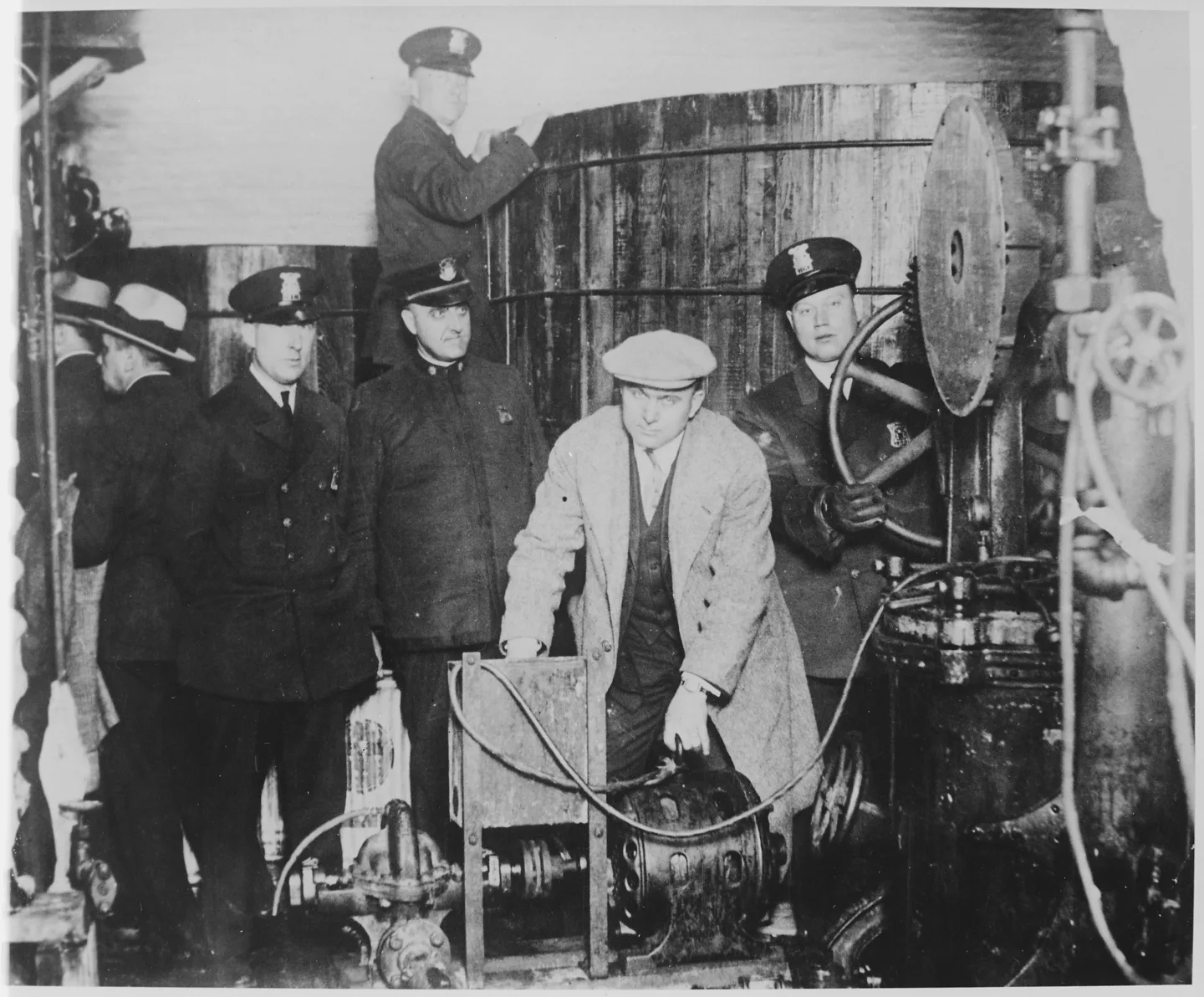
Ratified in 1919 and taking effect on January 17, 1920, the Eighteenth Amendment and the Volstead Act launched national Prohibition, outlawing the manufacture, sale, and transport of intoxicating liquors, inadvertently giving rise to speakeasies, rampant bootlegging, and violent organized crime syndicates.
The Immigration Act of 1924 (Johnson-Reed)
Driven by nativist sentiment and the resurgence of the second Ku Klux Klan, Congress passed the National Origins Act of 1924, setting annual quotas at 2 percent of each nationality's foreign-born population in the 1890 census to drastically curtail Southern and Eastern European immigration and bar Asian entry.
The Stock Market Crash of October 1929
On Black Tuesday, October 29, 1929, the Wall Street stock market collapsed after years of rampant speculative margin buying, erasing tens of billions of dollars in paper wealth within weeks and becoming the most dramatic early shock of the downturn that deepened into the Great Depression.
The Great Contraction and Banking Panics
Between 1929 and 1933, over 9,000 commercial banks failed across the United States as depositors launched runs to withdraw cash, resulting in a devastating 33 percent contraction of the national money supply and plunging unemployment to 25 percent.
The Bonus Army March of 1932
In the summer of 1932, over 15,000 unemployed World War I veterans marched on Washington D.C. as the Bonus Expeditionary Force demanding early payment of service certificates, but were violently evicted by federal troops under General Douglas MacArthur using tanks and tear gas.
Franklin D. Roosevelt and the First Hundred Days
Taking office in March 1933, President Franklin D. Roosevelt declared a national Bank Holiday and passed fifteen major relief and recovery statutes during his First Hundred Days, including the Federal Deposit Insurance Corporation (FDIC) (Glass-Steagall), the Civilian Conservation Corps (CCC), the Agricultural Adjustment Act (AAA), and the Tennessee Valley Authority (TVA).
The Social Security Act of 1935
The cornerstone of the Second New Deal, the Social Security Act of 1935 created a permanent federal safety net providing old-age pensions, unemployment insurance, and aid to dependent children, establishing the modern American welfare state.
By the numbers
- In what calendar year did Henry Ford introduce the moving assembly line at Highland Park?
- 1913 year
- In what calendar year did the Wall Street Stock Market crash on Black Tuesday occur?
- 1929 year
- In what calendar year was the historic Social Security Act signed into law by Franklin D. Roosevelt (FDR)?
- 1935 year
- How many total justices did Franklin D. Roosevelt (FDR) propose to add to the Supreme Court in his 1937 Court-Packing plan?
- 6 justices
Matched pairs
Each item on the left goes with the one on the right.
- Twenty-First Amendment
- Constitutional amendment that formally repealed national alcohol Prohibition in 1933
- Hoovervilles
- Makeshift shantytowns constructed from cardboard and tin by homeless families in the Depression
- Civilian Conservation Corps
- New Deal agency employing millions of young men in forestry, soil conservation, and park building
- Tennessee Valley Authority
- Federal regional corporation that constructed hydroelectric dams to electrify rural Appalachia
Self-test
Answer each question from memory, then check your work against the answer key.
1. How did Henry Ford's $5 workday introduced in 1914 transform industrial labor economics?
- AIt slashed worker turnover and enabled assembly line laborers to afford buying the cars they produced
- BIt cut the company's annual net profits by roughly half in its first year
- CIt shortened the workday from ten hours to eight with no accompanying pay increase
- DIt guaranteed every worker a lifetime job with a company pension
2. What unintended social consequence arose from national Prohibition under the Eighteenth Amendment?
- AA significant increase in federal tax revenue from legal alcohol sales
- BA dramatic, lasting decline in nationwide alcohol consumption
- CA steady decline in organized crime's profits and influence
- DThe explosive growth of illegal speakeasies and violent organized crime syndicates
3. How did the National Origins Act of 1924 restrict European immigration to the United States?
- ABy setting one overall yearly immigration ceiling with no quotas by nationality
- BBy setting quotas at 2% of each nationality's foreign-born population in the 1890 census
- CBy requiring immigrants to prove a skilled trade or profession before being admitted
- DBy requiring every immigrant to pass a literacy test in their native language
4. What cultural conflict was put on trial in the 1925 Scopes Trial in Dayton, Tennessee?
- AState regulation of child labor in textile mills
- BThe constitutionality of requiring a foreign language in public schools
- CTraditional Christian fundamentalism versus modern scientific modernist evolution
- DThe legality of mandatory flag-salute ceremonies in public schools
5. What term describes the 1920s flowering of African American literature, art, and music that emerged after the Great Migration to Northern cities?
- ALost Generation
- BProgressive Movement
- CHarlem Renaissance
- DGilded Age
6. What practice on Wall Street inflated stock prices prior to the Great Crash of October 1929?
- ARampant margin buying where speculators purchased shares using mostly borrowed money from brokers
- BWidespread short-selling by brokers used to drive up blue-chip share prices
- CFederal Reserve purchases of corporate shares to prop up prices
- DGovernment-backed insurance that guaranteed investors against stock losses
7. Why was the Smoot-Hawley Tariff of 1930 disastrous for the global economy during the Depression?
- AIt cut tariffs on farm goods, letting cheap foreign grain undersell American farmers
- BIt provoked retaliatory tariffs from foreign trading partners, causing international trade to collapse sharply
- CIt triggered a sudden, sharp devaluation of the U.S. dollar against European currencies
- DIt forced many American manufacturers to shut down rather than pay new import taxes
8. What physical factors caused the ecological disaster of the Dust Bowl across the Southern Plains?
- AHeavy irrigation and salt buildup from the Ogallala aquifer
- BHeavy logging and wildfires that cleared windbreak trees
- CWidespread strip mining and oil drilling on the Plains
- DSevere drought and aggressive over-plowing of native grass
9. What was the primary purpose of Franklin D. Roosevelt's national 'Bank Holiday' in March 1933?
- ATo immediately nationalize all commercial banks in the country
- BTo temporarily close all banks, inspect their solvency, and restore public depositor confidence
- CTo shift responsibility for guaranteeing bank deposits entirely onto individual state governments
- DTo suspend all interest payments on savings accounts nationwide
10. Which specific day in October 1929 saw the stock market's most catastrophic single-day collapse, effectively starting the Great Depression?
- ABlack Tuesday
- BBlack Friday
- CBlack Thursday
- DBlack Monday
Go deeper
- WatchThe Banks Fall More than 9,000 American banks failed in four years. Millions of depositors lost their life savings.
- WatchRelief, Recovery, Reform To save the failing banks, Franklin Roosevelt closed them for four days. Then he won back public trust in a radio Fireside Chat.
- WatchThe Five-Dollar Day Henry Ford's moving assembly line made cars affordable. But his own workers kept leaving.
- StudyUnited States History in the FlashFeed app
Answer key
- 1. A It slashed worker turnover and enabled assembly line laborers to afford buying the cars they producedHigh wages stabilized Ford's workforce and created a consumer class with purchasing power for manufactured goods.
- 2. D The explosive growth of illegal speakeasies and violent organized crime syndicatesProhibition failed to curb demand, transferring alcohol profits to violent gangsters like Al Capone in Chicago.
- 3. B By setting quotas at 2% of each nationality's foreign-born population in the 1890 censusUsing the 1890 census explicitly favored Northern and Western Europeans while severely limiting Southern and Eastern Europeans.
- 4. C Traditional Christian fundamentalism versus modern scientific modernist evolutionThe Scopes 'Monkey Trial' pitted Clarence Darrow against William Jennings Bryan over teaching human evolution.
- 5. C Harlem RenaissanceCentered in Harlem, this movement featured writers like Langston Hughes and Zora Neale Hurston and jazz artists like Duke Ellington.
- 6. A Rampant margin buying where speculators purchased shares using mostly borrowed money from brokersInvestors bought stocks on 10% margin; when prices dropped, margin calls forced panic selling, crashing the market.
- 7. B It provoked retaliatory tariffs from foreign trading partners, causing international trade to collapse sharplySmoot-Hawley raised tariffs to among the highest levels in U.S. history, triggering foreign retaliatory tariffs that paralyzed world trade.
- 8. D Severe drought and aggressive over-plowing of native grassOver-farming and drought destroyed the topsoil, allowing high winds to generate massive 'black blizzards'.
- 9. B To temporarily close all banks, inspect their solvency, and restore public depositor confidenceThe Emergency Banking Act reopened sound banks under federal supervision, ending depositor bank runs.
- 10. A Black TuesdayPanicked selling on Black Tuesday, October 29, 1929, wiped out billions in paper wealth and triggered the Depression's onset.
Sources
- Ford's Five-Dollar Day (The Henry Ford) — www.thehenryford.org/collections/explore/articles/fords-five-dollar-day
- FDR: From Budget Balancer to Keynesian (FDR Presidential Library) — www.fdrlibrary.org/budget
- Keynes Proposes Government Management of the Economy (EBSCO Research Starters) — www.ebsco.com/research-starters/economics/keynes-proposes-government-management-economy/
- Brinkley, Wheels for the World, Ch. 6
- Okrent, Last Call: The Rise and Fall of Prohibition
- Lewis, When Harlem Was in Vogue, Ch. 4
- Ngai, Impossible Subjects, Ch. 1
- Galbraith, The Great Crash 1929, Ch. 5
- Friedman & Schwartz, A Monetary History of the United States
- Worster, Dust Bowl: The Southern Plains in the 1930s
- Dickson & Allen, The Bonus Army, Ch. 12
- Kennedy, Freedom from Fear, Ch. 5
- Gordon, Pitied But Not Entitled, Ch. 6
- Lichtenstein, State of the Union, Ch. 2
- Brinkley, Wheels for the World
- Okrent, Last Call
- Ngai, Impossible Subjects
- Larson, Summer for the Gods
- Galbraith, The Great Crash 1929
- Kennedy, Freedom from Fear, Ch. 2
- Worster, Dust Bowl
- Kennedy, Freedom from Fear, Ch. 6
- Gordon, Pitied But Not Entitled
- Lichtenstein, State of the Union
- Kennedy, Freedom from Fear, Ch. 11
- Kennedy, Freedom from Fear
- Kennedy, Freedom from Fear, Ch. 12
- Lewis, When Harlem Was in Vogue
Image credits
- Prohibition and the Volstead Act: Wikimedia Commons · Unknown author · Public domain — commons.wikimedia.org/wiki/File:Detroit_police_inspecting_equipment_found_in_a_clandestine_underground_brewery_during_the_prohibition_era_-_NARA_-_541928.jpg
- The Bonus Army March of 1932: Unknown photographer (U.S. Army Signal Corps record, National Archives) · public domain — commons.wikimedia.org/wiki/File:Shacks,_put_up_by_the_Bonus_Army_on_the_Anacostia_flats,_Washington,_DC,_burning_after_the_battle_with_the_military,_193_-_NARA_-_531102.jpg

