
The Complete Volkswagen GTI study guide · Lesson 5 of 13
Mk4 Ownership: Problems, DIY & Tuning
Common Problems · The Critical Service · Tuning the 1.8T
This is the lesson's study guide from the FlashFeed app, plus its key facts and a self-test.
What you'll be able to do
- Recognize common Mk4 faults: oil-spec neglect, worn control-arm bushings, and the brake-light switch.
- Explain why the interference-engine 1.8T demands strict timing-belt and water-pump service.
- Describe the 1.8T tuning ladder (Stage 1–3) and its approximate power gains.
- Define coilovers as a combined spring-and-adjustable-damper suspension upgrade.
Common Problems
The Mk4 1.8T is a rewarding car to own, but it has a well-documented list of failure points. Know them before they know you.
Coil Packs: The First Thing That Goes
The Mk4 1.8T uses one pencil coil pack per cylinder — small, inexpensive, and prone to heat-induced failure. When one cooks, the engine misfires and throws P0300–P0304 codes. The rookie mistake is replacing only the failed coil. Every experienced Mk4 owner replaces all four at once: if one pack has reached its limit, the remaining three are typically within a few thousand miles of the same fate. Tuned cars on higher boost run hotter and accelerate this timeline. Bosch or OEM replacements run 15–25 each — the labor cost of doing them one by one over three visits dwarfs the kit price.
Oil Sludge: The Silent Killer
The 1.8T's turbocharger runs extremely hot, and the heat cycles oil through narrow galleries near the center housing. Stick to VW's old factory 10,000-mile drain interval and that oil breaks down, oxidizes, and cooks into a thick sludge that clogs the pickup screen and starves the turbo. By the time the low oil pressure light appears, the damage is done and usually unrecoverable. The fix is prevention: every 5,000 miles maximum with a quality synthetic that meets VW 502.00 spec — VW's oil-quality standard for turbocharged gasoline engines. Many veteran owners go tighter still, at 3,000–4,000 miles.
Coolant Sensor and the Cracking Line
Two cooling system failures are all but inevitable on a high-mileage Mk4. The coolant temperature sensor drifts and fails, which corrupts the ECU's cold-start fuel enrichment and makes the gauge unreliable. It is a 15–30 plug-and-play fix, but it causes real drivability problems until replaced. More serious is the coolant hard line that enters the engine block above the transmission — a known crack-and-leak point. The solution that holds long-term is a silicone replacement line, which costs a bit more than the OEM part but eliminates the recurring failure.
Windows in the Door
Almost every Mk4 has experienced this: a plastic clip inside the door fails, the window glass decouples from the regulator, and the window drops into the door. It requires pulling the door panel to access the window regulator and replace the clips or the assembly. The logic is identical to the coil packs — when one door goes, the other three are on borrowed time. Replacing all four clips preemptively while one door is already open is the pragmatic call. Also worth noting for the quiz: a brake light switch behind the pedal is the cheap culprit when Mk4 brake lights stay on and cruise control fails, and worn lower control arm bushings — the rubber or poly mounts at the front suspension arms — are among the most common front-end service items. When they wear, the car steers vaguely and wanders, and the front end clunks over bumps; new OEM rubber, polyurethane bushings or complete new arms fix it.
The Critical Service
One service interval defines whether a Mk4 1.8T lives or dies. Everything else on this car is recoverable. This is not.
The Timing Belt: The One That Matters
The 1.8T is an interference engine — meaning that at different points in the combustion cycle, the valves and pistons occupy the same space in the cylinder. A chain-driven engine can survive a broken timing chain limping for a moment; the 1.8T cannot. When the timing belt snaps, the pistons continue moving and slam directly into open valves. The result is bent valves, broken pistons, and in many cases a total engine loss that no budget repair will solve.
VW's official replacement interval is 75,000 miles. Older manuals listed 105,000 miles, a figure widely regarded in the community as dangerously optimistic and no longer recommended. The experienced-mechanic consensus has settled lower still: change the belt at 60,000 miles on any Mk4 you're going to keep. This is not paranoia — rubber degrades from heat, age, and oil contamination regardless of mileage, and a used car with an uncertain service history should be treated as overdue until proven otherwise.
The job is not just the belt. The correct approach is the full kit: belt, tensioner, idler pulley, and water pump all replaced at the same time. The water pump is driven by the timing belt and sits inside the same housing — if it fails it can take the belt with it, and replacing it while the cover is already off costs a fraction of what a second teardown would. Skipping the water pump to save 50–80 on a timing belt job is the kind of short-cut that produces a second, more expensive timing belt job three years later.
Any independent VAG-specialist shop should be comfortable with this service. If you are buying a used Mk4, the first question is: when was the timing belt last done, and do you have receipts? No receipts means budget for the service immediately. The belt is invisible from the outside — there is no warning before it breaks.
Tuning the 1.8T
Few four-cylinder engines from the early 2000s respond to tuning the way the 1.8T does. Its factory tune is conservative, its internals are stout at modest power levels, and a clear upgrade ladder exists that owners have stress-tested for twenty-plus years.
Stage 1: Software Only
Stage 1 is a pure ECU reflash — no hardware changes, no wrench required. The stock turbo, intake, and exhaust stay in place; the tune rewrites boost pressure, ignition timing, and fuel maps for 91 or 93 octane pump fuel. Expect roughly 195–215 hp at the wheels, up from a stock figure in the 150s. The major tune providers — APR, GIAC, Eurodyne, and Motoza — charge 350–600. The only prerequisite is a healthy engine with no boost leaks: a tune tells the ECU to deliver more boost, so any pressure escaping through a cracked hose or loose clamp will prevent that boost from materializing and make the car feel worse than stock.
Stage 2: Add Breathing
Stage 2 retains the K03 stock turbo but removes the exhaust restriction that limits its output. A 3-inch catback exhaust and a high-flow downpipe (often catless or with a high-flow cat) are the hardware additions, paired with a Stage 2 tune calibrated for the freer exhaust flow. Power reaches approximately 215–225 hp. An intake upgrade is commonly added at this stage — it contributes modest power and sets up the engine bay for a bigger turbo if the owner continues up the ladder.
Stage 3: The K04 Turbo
The K04 turbocharger, sourced directly from the Audi S3 and TT 225, is the defining upgrade for the 1.8T platform. The stock K03 is the hard ceiling on power; the K04, matched with a high-flow downpipe, upgraded intercooler, cold-air intake, and a custom tune, pushes the engine to approximately 260–320 hp on pump gas. Two supporting upgrades become mandatory at this level: the stock clutch will slip under K04 power and must be replaced with an upgraded unit (SouthBend or Spec are common choices), and fuel injectors may require upgrading above roughly 270 whp to maintain proper air-fuel ratios. Coilovers — combined coil-spring-and-damper units from brands like BC Racing, KW, or H&R — are a popular complementary suspension upgrade at this stage to handle the added performance.
Boost Leak Test First
Before any tune lands on the ECU, find your boost leaks. Pressurize the intake system with the engine off and listen for hissing at hoses, clamps, and the intercooler end tanks. A leaking system robs boost, confuses the mass airflow sensor, and produces erratic fueling that a new tune cannot correct. While the intake system is accessible, fitting a catch can is worth the effort: the Mk4's PCV and breather system is failure-prone and allows oil mist to accumulate in the intake manifold. A catch can intercepts that mist before it reaches the intake valves. Atmosphere-venting blow-off valves are not recommended on this MAF-based system — they dump air the sensor has already measured, causing rich-running at tip-out.
Key terms
- VW 502.00
- VW's oil-quality spec for gasoline engines, including turbocharged ones like the 1.8T; a 5W-40 synthetic meeting it (e.g. Castrol Edge) is the standard choice.
- Lower control arm bushings
- Rubber/poly mounts at the front suspension arms. When worn they cause vague steering and clunks over bumps; new OEM rubber, poly, or whole new arms fix it.
- Interference engine
- An engine where valves and pistons occupy the same space at different times. If the timing belt breaks they collide — destroying valves and pistons. The 1.8T is one.
- Coilovers
- A combined coil spring and adjustable damper unit (BC Racing, KW, H&R) that lowers ride height and sharpens handling. Don't pair lowering springs with worn stock shocks.
Key concepts
Stage 1
- The entry rung of the 1.8T tuning ladder, requiring no wrench and no hardware at all.
- A pure ECU reflash on 91 or 93 octane that leaves the stock turbo, intake, and exhaust in place.
- It lifts output to roughly 195–215 hp at the wheels, up from a stock figure in the 150s.
Stage 2
- The middle rung of the 1.8T tuning ladder, where hardware first joins the software.
- It keeps the stock K03 turbo but frees the exhaust with a 3-inch catback and a high-flow downpipe.
- Retuned for the freer exhaust flow, it reaches approximately 215–225 hp.
Stage 3
- The top rung of the 1.8T tuning ladder, defined by fitting a bigger turbocharger.
- It swaps in the K04 unit from the Audi S3 and TT 225, plus a bigger intercooler, cold-air intake, and custom tune.
- Output climbs to roughly 260–320 hp, making a clutch upgrade mandatory and often bigger injectors too.
Key facts
Coil Packs: The First Thing That Goes
The Mk4 1.8T runs one "pencil" coil pack per cylinder, and they are notorious for heat-induced failure. The classic symptom set is a misfire, rough idle, and a check-engine light throwing P0300–P0304. Tuned cars chew through them faster. The fix is cheap (~15–25 each from Bosch or OEM) — but replace all four at once: if one has died, the rest are close behind.
Oil Sludge: The Silent Killer
The 1.8T is infamously prone to oil sludge. The turbo's extreme heat cooks oil deposits into the galleries, the oil pickup screen, and the turbo itself — and by the time the low oil pressure light comes on, it is usually too late. The cause is almost always VW's old extended 10,000-mile drain interval. Change oil every 5,000 miles maximum with a quality synthetic meeting VW 502 spec; many veteran owners go to 3,000–4,000.
Coolant Sensor and the Cracking Line
Two cooling gremlins haunt every Mk4. The coolant temperature sensor (CTS) fails often, throwing off gauge readings and ruining cold-start enrichment — but it's a 15–30 plug-and-play swap. Worse is the coolant hard line that enters the block just above the transmission; it's notorious for cracking and leaking. Replacing it takes some disassembly, but an upgraded silicone line is the fix-it-once answer.
Windows in the Door
Virtually universal to the Mk4: the plastic clips that hold the window glass to the regulator snap, and the window drops down into the door. The DIY requires pulling the door panel to replace the clips or the full window regulator. Like the coils, when one goes the rest are on borrowed time — many owners preemptively do all four.
The Cruise Control Clue
On a Mk4, brake lights that stay on and cruise control that suddenly quits both trace back to the same cheap part: the brake light switch behind the pedal, a five-minute, no-tools swap.
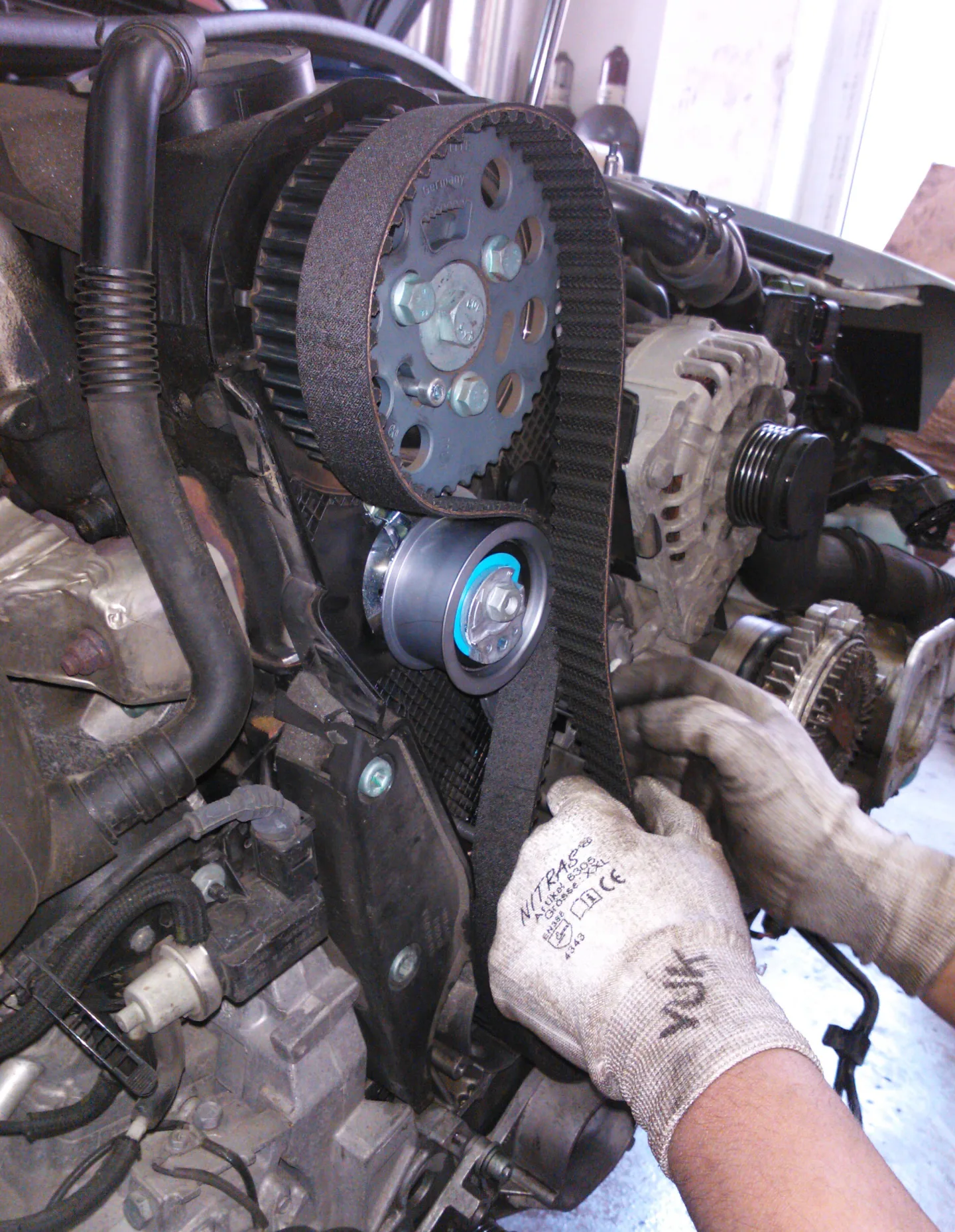
The Timing Belt: The One That Matters
This is the single most important service on the 1.8T. The engine is an interference design — if the timing belt snaps, the valves slam into the pistons and the result is catastrophic, often unrecoverable damage. VW's recommended interval is 75,000 miles (older manuals said 105k — widely considered too long). Experienced mechanics change it at 60,000–70,000 miles to be safe, and always replace the full kit: belt, tensioner, idler pulleys, and water pump while you're in there.
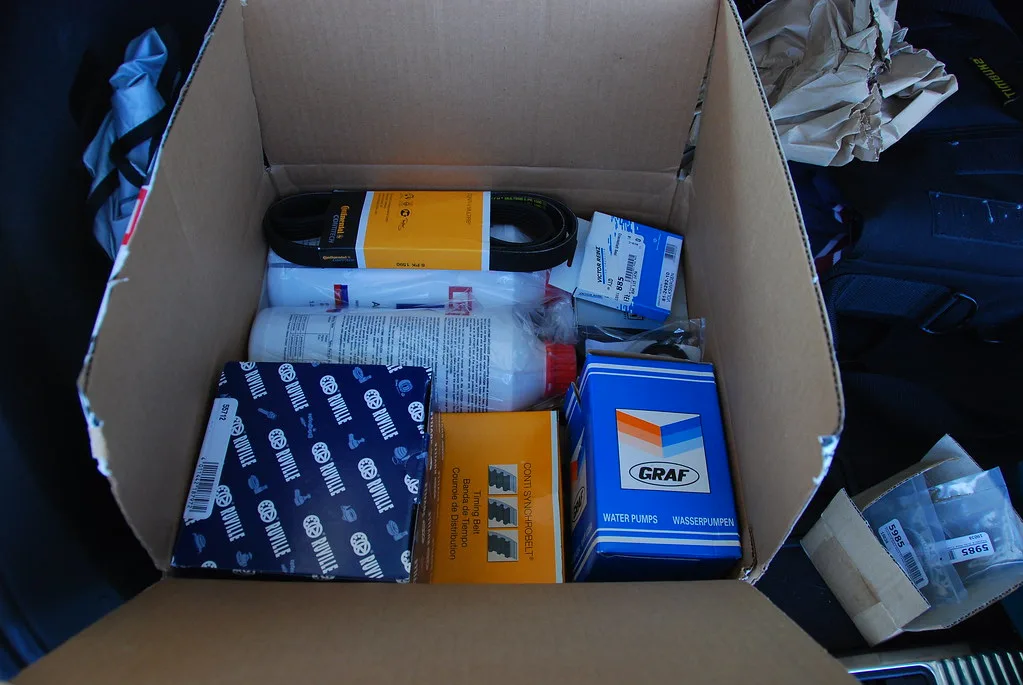
While You're In There
Because the water pump is driven by the timing belt and shares its housing, a failing pump can shred the belt outright. Replacing it during the same job costs $50-80 more but avoids a second teardown.
When Pistons Meet Valves
The 1.8T is an interference engine, meaning pistons and valves share the same space at different moments. If the timing belt snaps, pistons slam into open valves — bending the valves and breaking the pistons in the process.
VW's Official Number
Volkswagen's official factory interval for replacing the Mk4 1.8T's timing belt is 75,000 miles — well down from an older, now-discredited 105,000-mile figure once considered acceptable.
The Mechanics' Consensus
Experienced mechanics recommend swapping the Mk4 1.8T's timing belt by 60,000 miles on a car you plan to keep, since the rubber degrades from heat and age, not just mileage.
Stage 1: Software Only
The 1.8T is one of the most tunable engines of its era, and Stage 1 is the best dollar-per-horsepower move you'll ever make. It's a software-only ECU flash for 91/93 octane — no hardware — rewriting boost, timing, and fuel maps for roughly 195–215 hp. The big names are APR, GIAC, Eurodyne, and Motoza, for about 350–600. The only requirement: a healthy engine with no boost leaks.
Stage 2: Add Breathing
Stage 2 keeps the stock K03 turbo but opens up the exhaust: a 3-inch catback and a high-flow downpipe, paired with a Stage 2 tune. Power climbs to roughly 215–225 hp. An intake upgrade adds modest flow and, more importantly, future-proofs the car for a bigger turbo down the road. This is the natural stopping point before you commit to real turbo hardware.
Stage 3: The K04 Turbo
The defining 1.8T upgrade is the K04 turbocharger, sourced from the Audi S3 / TT 225. At stock the K03 is the limiting factor; with a K04, a high-flow downpipe, upgraded intercooler, intake, and a custom tune, the engine makes ~260–320 hp on pump gas. The catch: at this power the stock clutch will slip — a SouthBend or Spec clutch is mandatory — and injectors may need upgrading above ~270 whp.
Boost Leak Test First
Before any tune, find your boost leaks. A cracked hose or loose clamp bleeds off pressure, robs power, and confuses the ECU into bad fueling — making a fresh tune feel broken. The test is simple: pressurize the intake system with the engine off and listen for the hiss. While you're under there, fit a catch can: the Mk4's PCV/breather system is failure-prone and a catch can keeps oil mist out of the intake.
Borrowed From Audi
The K04 turbo used in a Stage 3 1.8T build is sourced directly from the Audi S3 and TT 225, bolting onto the GTI in place of the smaller, power-limiting stock K03.
By the numbers
- VW's recommended timing belt replacement interval for the Mk4 1.8T
- 75000 miles
- The conservative "change-it-by" mileage experienced mechanics recommend for the 1.8T timing belt (lower end)
- 60000 miles
- Approximate peak power from a Stage 1 software-only tune on the Mk4 1.8T (upper end)
- 215 hp
- Approximate peak power from a K04 (Stage 3) 1.8T build on pump gas (upper end)
- 320 hp
Step by step
Replace the timing belt on a Mk4 1.8T (full kit)
- Turn the key off and disconnect the battery; let the engine fully cool
- Rotate the engine to TDC and paint-mark the rotation direction and the timing positions on all gears
- Lock the camshaft and crankshaft with the dedicated locking tools
- Release the tensioner and remove the old belt
- Install the new belt, tensioner, idler pulleys, and water pump from the full kit
- Set belt tension with a gauge, remove the locking tools, and rotate by hand to verify timing
Moderate-Hard, 4–6 hours your first time. Needs a cam locking tool set, crank holding tool, and a belt tension gauge.
Swap all four 1.8T ignition coil packs
- Turn the key off and let the engine cool to avoid burns
- Unplug the electrical connector from each coil pack
- Unscrew and pull each old coil pack straight up off its spark plug
- Apply a little dielectric grease inside each new coil's boot
- Press each new coil pack down onto its plug and reconnect the connectors
Do all four at once. Consider R32 / Audi TT coils, which run cooler and last longer.
Tune a Mk4 1.8T in the recommended order
- Boost leak test first — pressurize the intake (engine off) and fix any cracked hoses or loose clamps
- Stage 1: flash a software-only ECU tune for ~195–215 hp
- Stage 2: add a 3-inch catback, high-flow downpipe, and intake; re-tune
- Stage 3: install a K04 turbo, upgraded intercooler, and custom tune for ~260–320 hp
- Back the K04 with an upgraded clutch (SouthBend/Spec) and larger injectors above ~270 whp
Supporting mods at any stage: catch can for the failure-prone PCV, upgraded diverter valve, and coilovers (don't pair lowering springs with worn shocks).
Self-test
Answer each question from memory, then check your work against the answer key.
1. A Mk4's brake lights stay on, and cruise control has stopped working. What's the classic cheap culprit?
- AThe brake light switch behind the pedal
- BA cracked coolant hard line
- CThe coolant temp sensor
- DA failed ABS module
2. What does the VW 502.00 spec designate for the Mk4 1.8T?
- AThe coolant type required for the cooling system
- BThe minimum octane rating for the factory ECU tune
- CAn oil-quality standard for turbo gasoline engines
- DThe factory timing-belt replacement interval
3. Worn lower control arm bushings on a Mk4 typically produce which symptom?
- AA floaty ride that keeps bouncing after every bump
- BVague steering and front-end clunking
- CThe nose diving heavily under hard braking
- DA rhythmic front-wheel hum that rises with road speed
4. To avoid sludge, what is the maximum oil-change interval recommended for the 1.8T turbo?
- AEvery 10,000 miles
- BEvery 20,000 miles
- CEvery 7,500 miles
- DEvery 5,000 miles
5. Which of these is NOT described as a common Mk4 1.8T failure point?
- APencil coil pack failure causing misfires
- BA cracking coolant hard line
- CA stretched timing chain from cold starts
- DWindow regulator clips breaking
6. On the Mk4 1.8T, why should the water pump always be replaced during a timing belt job?
- AIt shares an oil bath with the belt tensioner and wears at the same rate
- BIt's driven by the timing belt and can destroy the belt if it fails
- CIt cannot be reached without first removing the cylinder head
- DIt cools the turbocharger and fails on the same interval
7. Why is the 1.8T's interference-engine design so dangerous if the timing belt breaks?
- AThe pistons slam into open valves, bending them
- BThe crankshaft snaps under load
- CThe engine overheats before it can be shut off
- DThe oil pump loses pressure and seizes the turbo
8. What is VW's official timing-belt replacement interval for the Mk4 1.8T?
- A60,000 miles
- B50,000 miles
- C105,000 miles
- D75,000 miles
9. Experienced mechanics recommend changing the 1.8T timing belt by what mileage on a car you plan to keep?
- A75,000 miles
- B90,000 miles
- C60,000 miles
- D105,000 miles
10. Which statement about the 1.8T timing-belt service is FALSE?
- AThere is no external warning before the belt breaks
- BThe engine is an interference design
- CThe water pump should be replaced at the same time
- DA broken belt on this engine is usually a harmless inconvenience
11. What distinguishes a Stage 1 tune on the Mk4 1.8T from the later stages?
- AIt swaps the K03 for a larger K04 turbo
- BIt's a pure ECU reflash with no hardware changes
- CIt adds a 3-inch catback and a high-flow downpipe
- DIt requires an upgraded clutch and fuel injectors
12. What hardware defines a Stage 2 build on the Mk4 1.8T?
- AA 3-inch catback and high-flow downpipe on the stock K03
- BAn ECU reflash with no hardware changes
- CA larger intercooler and upgraded fuel injectors
- DA K04 turbo swap with an upgraded clutch and fuel system
13. The K04 turbo used for a Stage 3 1.8T build is sourced from which cars?
- AThe VW Golf R32 (VR6)
- BThe Audi RS4 and R8
- CThe Audi S3 and TT 225
- DThe Porsche Boxster
14. Approximately how much power does a Stage 1 software-only tune make on the 1.8T?
- AAbout 195 to 215 hp
- BAbout 400 hp
- CAbout 260 to 320 hp
- DAbout 150 hp
15. A K04 (Stage 3) 1.8T build on pump gas makes roughly what peak power?
- AAbout 195 to 215 hp
- BAbout 400 to 450 hp
- CAbout 215 to 225 hp
- DAbout 260 to 320 hp
16. What hardware upgrade defines Stage 2 tuning on the 1.8T while keeping the stock K03 turbo?
- AK04 turbo upgrade
- B3-inch catback exhaust and high-flow downpipe
- CCoilover suspension
- DUpgraded fuel injectors
17. Approximately what wheel horsepower does a Stage 2 1.8T tune reach?
- A260–320 hp
- B215–225 hp
- C150 hp (stock)
- D195–215 hp
18. What is a coilover?
- AA combined coil spring and adjustable damper in one unit
- BA replacement rubber bushing for the control arm
- CA stiffer anti-roll bar for the front axle
- DAn adjustable rear camber arm used to set alignment
19. Which brands are named as makers of coilovers for the Mk4?
- AAPR, GIAC, and Eurodyne
- BSouthBend and Spec
- CBosch, NGK, and Denso
- DBC Racing, KW, and H&R
20. What is the main benefit of installing coilovers?
- AExtra suspension travel for more off-road ground clearance
- BA softer, more compliant ride than the factory springs
- CLower ride height and sharper handling
- DAutomatic self-leveling that adjusts ride height to cabin load
21. Which of these 1.8T upgrades is a suspension upgrade rather than a power upgrade?
- AA high-flow downpipe
- BA set of coilovers
- CA K04 turbo swap
- DA Stage 1 ECU reflash
22. At which point in the tuning ladder are coilovers commonly added?
- AAs part of the Stage 1 software flash package
- BBefore any engine tune, as the first step
- CAs a suspension upgrade at the Stage 3 / K04 level
- DOnly after the timing belt is replaced
Go deeper
Answer key
- 1. A The brake light switch behind the pedalThe brake light switch is a known gremlin — under $10, a 5-minute no-tools swap — and its failure also affects cruise control.
- 2. C An oil-quality standard for turbo gasoline enginesVW 502.00 is VW's oil-quality spec for turbocharged gas engines; a 5W-40 synthetic meeting it is the standard choice for the 1.8T.
- 3. B Vague steering and front-end clunkingLCA bushings are rubber/poly mounts at the front suspension arms; when worn they cause vague steering and front-end clunks over bumps.
- 4. D Every 5,000 milesThe 1.8T needs 5,000-mile changes maximum with a quality synthetic. VW's old 10,000-mile interval is exactly what cooks oil into turbo-killing sludge.
- 5. C A stretched timing chain from cold startsThe 1.8T is belt-driven, not chain-driven, so a stretched timing chain isn't a thing. Coil packs, the coolant hard line, and window clips are all classic Mk4 faults.
- 6. B It's driven by the timing belt and can destroy the belt if it failsThe water pump is driven by the timing belt and sits in the same housing. If it seizes it can shred the belt, so replacing it while the cover is off (for ~$50-80 more) avoids a second, costlier teardown.
- 7. A The pistons slam into open valves, bending themIn an interference engine, valves and pistons share the same space at different times. A snapped belt lets pistons hit open valves, bending valves and breaking pistons.
- 8. D 75,000 milesVW's official interval is 75,000 miles. The old 105,000-mile figure is considered dangerously optimistic; 60,000 is the conservative mechanic recommendation, not the official spec.
- 9. C 60,000 milesThe mechanic consensus settled on 60,000 miles because rubber degrades from heat, age, and oil regardless of mileage. 75,000 is VW's official figure; 105,000 is the discredited old one.
- 10. D A broken belt on this engine is usually a harmless inconvenienceA broken belt is catastrophic on this interference engine, often a total engine loss. The other three statements are all true of the correct service approach.
- 11. B It's a pure ECU reflash with no hardware changesStage 1 is software only — the ECU reflash rewrites boost, timing, and fuel maps on stock hardware for ~195-215 whp. Exhaust work defines Stage 2; the K04 turbo plus its mandatory clutch/injector upgrades are Stage 3.
- 12. A A 3-inch catback and high-flow downpipe on the stock K03Stage 2 keeps the stock K03 but frees exhaust flow with a 3-inch catback and high-flow downpipe plus a matched tune. No-hardware is Stage 1; the K04 is Stage 3.
- 13. C The Audi S3 and TT 225The defining Stage 3 upgrade is the K04 turbo, sourced directly from the Audi S3 and TT 225. The stock K03 is the hard power ceiling until it's swapped.
- 14. A About 195 to 215 hpStage 1 lifts a stock car from the 150s to roughly 195 to 215 hp on 91/93 octane. 260 to 320 hp is a K04 Stage 3 build.
- 15. D About 260 to 320 hpA full K04 build makes about 260 to 320 hp on pump gas. 215 to 225 is Stage 2; 195 to 215 is Stage 1.
- 16. B 3-inch catback exhaust and high-flow downpipeStage 2 retains the stock K03 turbo but adds a 3-inch catback exhaust and a high-flow downpipe to remove exhaust restriction.
- 17. B 215–225 hpWith the freer-flowing exhaust and a Stage 2 tune, the 1.8T reaches approximately 215–225 hp, above Stage 1's 195–215 hp.
- 18. A A combined coil spring and adjustable damper in one unitA coilover integrates a coil spring and an adjustable damper into a single unit that lowers ride height and sharpens handling.
- 19. D BC Racing, KW, and H&RBC Racing, KW, and H&R make coilovers. APR/GIAC/Eurodyne are tune providers, and SouthBend/Spec make upgraded clutches.
- 20. C Lower ride height and sharper handlingCoilovers lower ride height and sharpen handling. They are a suspension upgrade and add no engine power.
- 21. B A set of coiloversCoilovers are combined coil-spring-and-damper units, which makes them a suspension upgrade. The K04 turbo, the high-flow downpipe, and the Stage 1 ECU flash all add engine power instead.
- 22. C As a suspension upgrade at the Stage 3 / K04 levelCoilovers are a popular complementary suspension upgrade at the Stage 3 K04 level to handle the added performance.
Sources
- VWTuning — Mk4 GTI engine problems — vwtuning.co/vw-mk4-gti-engine-problems/
- ECS Tuning — best upgrades for your Mk4 GTI 1.8T — blog.ecstuning.com/best-upgrades-for-your-vw-mk4-gti-1-8t/
- OilsAdvisor — VW 502 00 approved oils guide — oilsadvisor.com/vw-50200-approved-oil-list/
- MOOG — Signs and symptoms of a failing control arm — www.moogparts.com/parts-matter/Signs-of-a-Failing-Control-Arm.html
- UroTuning — Mk4 Golf/Jetta polyurethane control arm bushing kit — www.urotuning.com/products/control-arm-bushing-kit-polyurethane-mk4-mk3-mk2-15-3117g
- Euro Sport Accessories — Mk4 control arm with bushings — www.eurosportacc.com/products/control-arm
Image credits
- The Timing Belt: The One That Matters: Wikimedia Commons · Petar Milošević · CC BY-SA 3.0 — commons.wikimedia.org/wiki/File:Replacing_a_timing_belt.jpg
- While You're In There: osunick (Openverse) · by-sa 2.0 — www.flickr.com/photos/19601457@N00/2769780380
